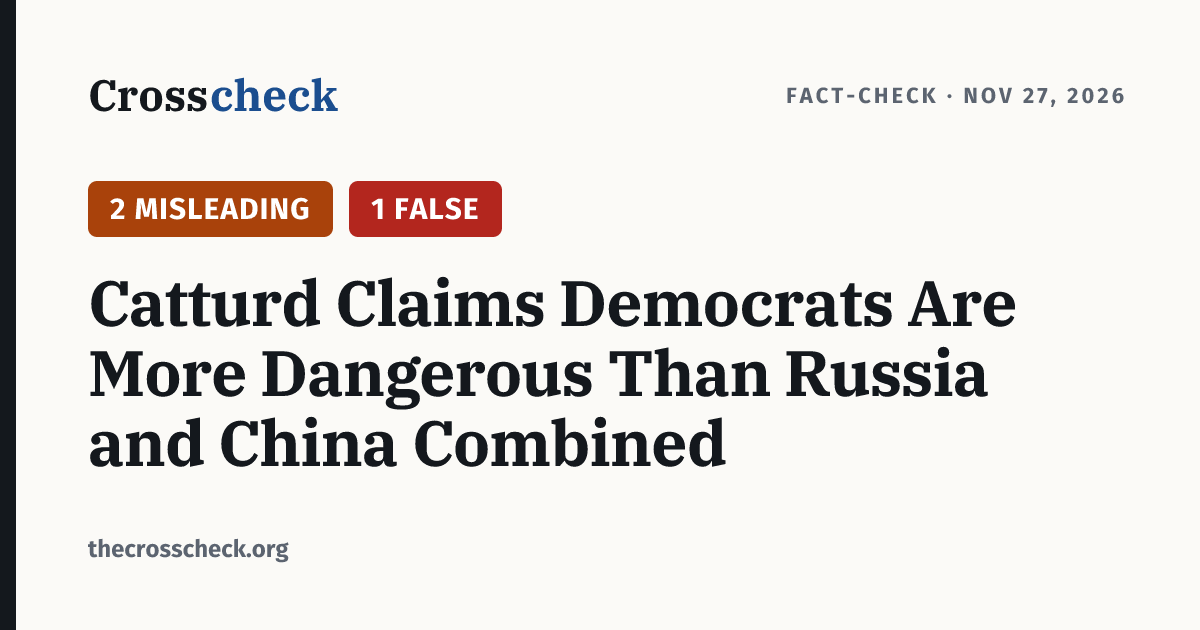
Benny Johnson, an American conservative commentator with more than 6 million YouTube subscribers, shared a screenshot from the anonymous X/Twitter account Catturd2 (also known as @catturd2) on Facebook with three check-mark emojis signaling endorsement.[1] The image read: “The Democrat party is more dangerous to our country than Russia and China combined.”
The claim belongs to a broader family of similar assertions. In October 2024, former President Donald Trump made a nearly identical argument on Fox News: “We have the outside enemy, and then we have the enemy from within, and the enemy from within, in my opinion, is more dangerous than China, Russia and all these countries.”[4] Catturd2 has posted related formulations repeatedly, including one from March 2025: “Democrats are more of a threat to this country than a million Putins.”
Verdict
The claim is false. The United States intelligence community’s own Annual Threat Assessment for 2025, drafted under President Trump’s appointed Director of National Intelligence Tulsi Gabbard and released on March 25, 2025, does not name any domestic political party as a threat to the United States. It names China and Russia as the country’s top foreign adversaries.[2][3]
What the official record shows
The 2025 assessment describes China as the United States’ “most capable strategic competitor” and “most active and persistent” cyber threat.[2] China’s documented capabilities include hypersonic missiles, stealth aircraft, advanced submarines, and an expanding nuclear arsenal. Its Salt Typhoon campaign in 2024 breached major American telecommunications providers, exposing call records of government officials and private citizens across the country.
Russia, the report states, is a “formidable competitor” that possesses more nuclear weapons than any other nation.[2] Moscow has expanded its stated conditions for nuclear use, developed a satellite designed to carry a nuclear warhead against U.S. space assets, and pre-positioned cyberattack access inside critical American infrastructure. Russian forces continue to wage the largest land war in Europe since World War II.
No edition of the Annual Threat Assessment, across multiple administrations of either party, has characterized a domestic political organization as a threat comparable to either nation, let alone both combined.
Why the comparison breaks down
The post conflates two different categories of risk. Russia and China are foreign states with nuclear weapons, standing armies, intelligence services, and documented use of all three against the United States and its allies. The Democratic Party is a domestic political organization that operates through elections. The two are not the same kind of entity, and “dangerous” means something different when applied to each.
The strongest version of the counter-argument typically points to the fentanyl epidemic (roughly 70,000 to 100,000 American overdose deaths per year, with synthetic opioids largely traced to Chinese chemical manufacturers) and argues that permissive Democratic border policies have enabled more American deaths than Russian or Chinese direct action. That argument, however, attributes the fentanyl supply to China (a liability the ODNI assessment assigns to Beijing directly) and requires several contested causal steps: from party platform to federal enforcement to individual trafficking to individual death. None of those steps are established by the claim, and the argument does not account for the existential-scale risks the ODNI assessment explicitly associates with nuclear and cyber capabilities that no domestic political party possesses.
Why the source matters
In September 2024, the U.S. Department of Justice indicted two Russian state media employees for allegedly routing nearly $10 million through a media company called Tenet Media to pay American conservative influencers to produce content designed to “amplify U.S. domestic divisions” in ways favorable to Russian foreign policy interests.[5] Johnson was among the listed Tenet Media contributors. He says he was not aware of the Russian connection and calls himself a victim of the scheme. The specific argument that Russia poses a lesser threat to the United States than a domestic political party is the type of message the DOJ alleged the operation was designed to produce and spread.
What the post implies
Implied: Russia and China are not genuine top-tier national security threats to the United States. Misleading
The Trump administration’s own intelligence community, under DNI Gabbard, explicitly rated both countries as tier-one foreign threats in March 2025. China received the designation of “most capable strategic competitor.” Russia was described as a “formidable competitor” with the world’s largest nuclear arsenal. The implication that their threat level has been exaggerated or is comparable to domestic politics is contradicted by the official government position of the administration whose supporters share this claim.
Implied: The Democratic Party poses a threat to U.S. national security comparable to adversarial foreign powers. Misleading
No national security framework — official or academic — classifies a legally operating domestic political party as a foreign-adversary-level threat. The comparison requires treating policy disagreement and electoral competition as equivalent to adversarial espionage, nuclear buildup, and military aggression. Those are not the same thing.
Implied: Citizens should regard the Democratic Party as an enemy and act accordingly. This is a political conclusion that no factual source can settle, including this fact-check. Whether and how voters should weigh characterizations of domestic political parties is an electoral judgment beyond the scope of factual rating.
What this fact-check is about
Benny Johnson is a conservative commentator with more than 6 million YouTube subscribers. He posted a screenshot on Facebook from an account called Catturd2 on X (formerly Twitter). He added three check-mark emojis to show he agreed. The screenshot said: “The Democrat party is more dangerous to our country than Russia and China combined.”
This kind of claim has been made before. Former President Donald Trump said something similar in October 2024. He told Fox News: “The enemy from within, in my opinion, is more dangerous than China, Russia and all these countries.”
Verdict: False
The claim is false. The U.S. intelligence community’s official report on threats to the United States is called the Annual Threat Assessment. It came out on March 25, 2025. It was produced under President Trump’s chosen intelligence director, Tulsi Gabbard. The report does not name any U.S. political party as a threat to the country. It names China and Russia as the top foreign threats.
What Russia and China actually do
The 2025 report says China is the country’s “most capable strategic competitor” and its top cyber threat. China has built advanced weapons, including missiles that can evade U.S. defenses. In 2024, Chinese hackers broke into major American phone companies in an operation called Salt Typhoon. They gained access to phone records for government officials and millions of private citizens.
Russia has more nuclear weapons than any other country. The report calls Russia a “formidable competitor.” Russia has also carried out cyberattacks on U.S. systems, and Russian troops are fighting the largest war in Europe since World War II.
No version of this report, under any president, has ever said a U.S. political party is as dangerous as these two countries combined.
Why the comparison does not hold
Russia and China are foreign governments. They have armies, nuclear weapons, and spies. They have used all of these against the United States. The Democratic Party is a political group that runs candidates for election. These are very different kinds of things.
Some people argue that Democratic border policies allowed fentanyl trafficking to grow. About 70,000 to 100,000 Americans die from drug overdoses every year, with much of the fentanyl traced to Chinese chemical companies. But the same U.S. intelligence report lists China’s role in fentanyl as a threat from China — not from American politicians. And fentanyl deaths do not equal nuclear weapons or military forces pointed at the United States.
Why the source matters
In September 2024, the U.S. Department of Justice charged two Russian government media workers with secretly paying American conservative commentators to make videos. The goal, according to the DOJ, was to make Americans fight with each other in ways that helped Russia. The company that paid the commentators was called Tenet Media. Benny Johnson was one of its contributors. He says he did not know about the Russian connection. But telling Americans that Russia is less dangerous than their own political opponents is exactly what the DOJ said the operation was designed to spread.
What the post implies
Implied: Russia and China are not genuine top threats to the United States. Misleading
The Trump administration’s own intelligence report says they are the top foreign threats. China is the “most capable strategic competitor.” Russia has the world’s largest nuclear arsenal.
Implied: The Democratic Party is as dangerous as a foreign enemy. Misleading
No security expert or government report has ever said that. A political party that runs candidates for election is a different kind of thing from a country with nuclear weapons and an army.
Implied: People should treat the Democratic Party as an enemy. This is an opinion about politics and voting. This fact-check does not rate political opinions.
Sources
- Benny Johnson — Facebook post sharing Catturd2 screenshot
- Annual Threat Assessment of the U.S. Intelligence Community 2025
- Chairman Crawford on Release of the ODNI 2025 Annual Threat Assessment
- ‘The enemy from within’: Trump calls Democrats more dangerous than U.S. foreign adversaries
- Tenet Media: DOJ alleges Tim Pool, Benny Johnson helped spread Russian disinformation