The Video
On November 24, 2026, YouTube personality Benny Johnson published a video covering recent cybersecurity incidents affecting US government agencies. Johnson confirmed the CIA breach was real but insisted it was more serious than reported, suggested the FBI attributed the incidents to state actors, and framed the simultaneous events as a coordinated operation designed to prime the public for a larger event.
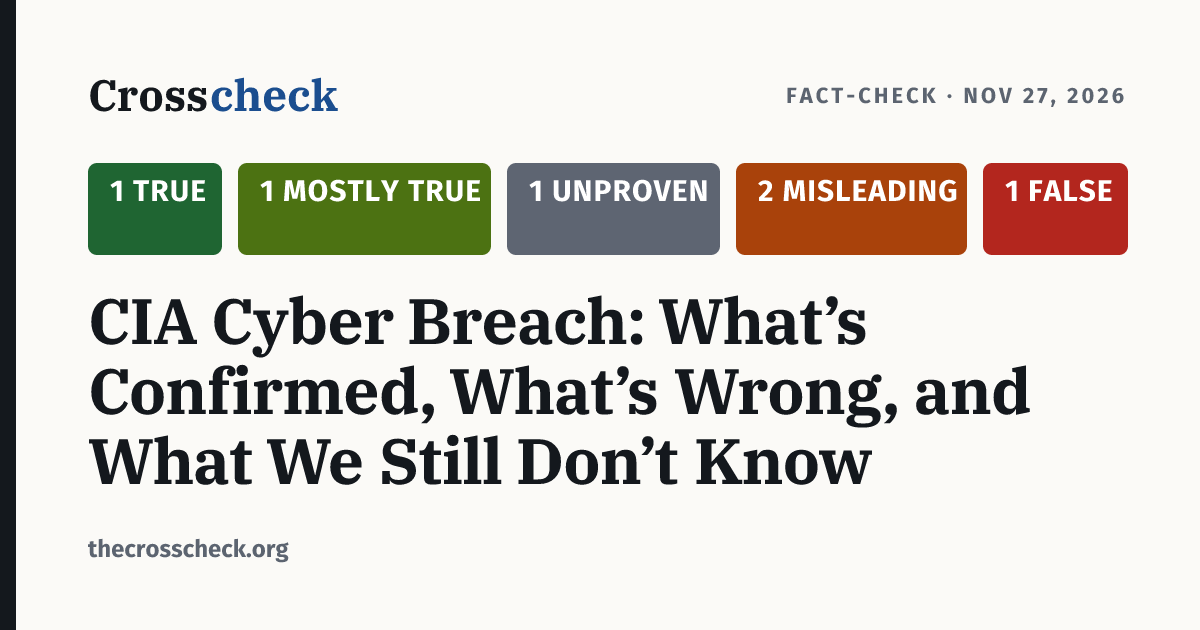
Below is a verdict summary, followed by a full analysis of each claim.
| Claim | Verdict |
|---|---|
| CIA, ODNI, and NGA suffered a cyber breach exposing unclassified intelligence data | True |
| “There is no such thing as unclassified data at the CIA” / classified data must have been stolen | False |
| “The FBI warned that these were state actors” (attributed to the intelligence breaches) | Misleading |
| Airlines were hacked; the O’Hare ground stop was part of the attack wave | Misleading |
| FinCEN (Treasury) confirmed a cyberattack forcing some systems offline | Mostly True |
| These simultaneous events constitute a coordinated operation to “prime the American public for something bigger” | Unproven |
What Actually Happened
Three US intelligence agencies discovered a breach in an unclassified computer network on or around November 20–24, 2026. The Central Intelligence Agency, the Office of the Director of National Intelligence (ODNI), and the National Geospatial-Intelligence Agency (NGA) were all affected. A person familiar with the incident told the Associated Press the problem had been resolved.[1]
The affected system handled open-source intelligence (OSINT): analysis of publicly available information including social media content, commercial satellite imagery, news reports, and data purchased from commercial data brokers. ODNI told CNN there had been “no disruptions to critical capabilities or classified systems.”[3]
Security researchers and news outlets have tied the breach to a tool called ARTEX, an AI-powered framework originally released in July 2025 by a Chinese cybersecurity engineer known online as Autumn-27. The FBI issued a FLASH advisory on November 13 warning that state-aligned and criminal groups were using ARTEX to automate attacks globally. Microsoft has linked six hacking groups to ARTEX’s adoption, including China-linked groups Salt Typhoon and Crystal Typhoon.[11] However, neither the CIA nor any other US agency has officially attributed the intelligence breach to any specific actor.
Separately, the FBI’s National Crime Information Center and the US Department of Agriculture were reported to have been targeted by hackers in the same general period.[9] The NSA’s internal classified network, NSANet, went down on November 17, but the agency attributed the outage to routine scheduled maintenance; multiple sources confirmed no evidence of a cyberattack.[5][10]
Claim 1: The CIA, ODNI, and NGA suffered a cyber breach exposing unclassified intelligence data
Claim 1
TrueThe CIA, ODNI, and NGA suffered a cyber breach exposing unclassified intelligence data.
This is confirmed by multiple independent news organizations citing US officials. The AP, New York Times, Fox News, and Reuters all reported the breach based on sources familiar with the incident. ODNI itself confirmed the breach, telling CNN there were “no disruptions to critical capabilities or classified systems.”[1][2][3]
The affected system was an OSINT analysis network used by the three agencies to process and analyze publicly available information. The AP reported a source confirmed the incident was resolved. Three agencies were affected: CIA, ODNI, and NGA. Nextgov/FCW also noted the Defense Department’s Cyber Defense Command as a potentially affected entity, though that claim was less confirmed at time of publication.[3]
Claim 2: “There is no such thing as unclassified data at the CIA” / classified data must have been stolen
Claim 2
FalsePer auto-transcript: “There is no such thing as unclassified data at the CIA” / “It is not possible that they hack the CIA and they get no classified information.”
This is false. The CIA operates explicit, deliberate unclassified systems as a core part of its intelligence mission.
The CIA’s Open Source Enterprise (OSE), formerly the Foreign Broadcast Information Service, is specifically tasked with collecting and analyzing unclassified, publicly available information from foreign media, websites, academic publications, and commercial data sources. It has operated under this mandate for decades. The OSE’s products are routinely provided to policymakers in unclassified form precisely because foreign public media is not a secret source.
The OSINT system that was breached is part of this unclassified infrastructure. As TechRadar reported: “Attackers accessed ‘an open source intelligence analysis system’ that processes publicly available material rather than classified data.”[2] The explainx.ai analysis of the breach noted the distinction clearly: intelligence agencies maintain separate unclassified and classified networks by design, and an OSINT network handles publicly available material that “any researcher, journalist, or government employee could legally access.”[13]
Johnson’s inference that “it is not possible they hacked the CIA and got no classified information” is an opinion unsupported by any official statement or evidence. No agency, security researcher, or credible news outlet has reported that classified CIA systems were compromised. Officials familiar with the incident confirmed the opposite.
The claim also conflates the existence of a breach with the scope of a breach. A system can be penetrated without exposing every other system in an organization. The CIA operates air-gapped classified networks, entirely separate from OSINT infrastructure, specifically to prevent this kind of lateral compromise.
Claim 3: “The FBI warned that these were state actors” (applied to the intelligence breaches)
Claim 3
MisleadingPer auto-transcript: “The FBI warned that these were state actors.”
This is misleading for two reasons: the FBI’s warning about state actors was a general advisory that preceded the CIA breach disclosure by 11 days, and the official intelligence assessment specifically said the November outage cluster was not a coordinated state attack.
On November 13, 2026, the FBI issued a FLASH advisory warning that “cybercriminals and state-aligned hackers” were exploiting ARTEX to automate cyberattacks globally. The advisory was a general threat warning about an AI hacking tool, not an attribution statement about any specific US government breach. BleepingComputer reported the advisory named ARTEX as capable of compressing a network intrusion from days to under three hours, and cited state-linked groups including Salt Typhoon as among its adopters.[4]
The CIA/ODNI/NGA breach was not disclosed until November 24, eleven days after the FBI advisory. The advisory cannot be interpreted as a response to a breach that had not yet been reported. As ibtimes.co.uk noted: the CIA hack is “linked to AI Tool the FBI Warned About 11 Days Before Breach Was Disclosed.”[11]
More consequentially, Director of National Intelligence Jay Clayton testified before the House Homeland Security Committee on November 18 that the intelligence community did not see “the indicia of a coordinated cyberattack” or “the indicia of state-sponsored activity” in the cluster of November incidents. Clayton attributed the outages primarily to “efforts by companies and government agencies to repair cybersecurity vulnerabilities and upgrade aging computer systems.”[14] This directly contradicts Johnson’s framing.
The CIA/ODNI breach itself has not been officially attributed to any state actor. ARTEX’s connection to Chinese state-aligned groups (Salt Typhoon, Crystal Typhoon) provides circumstantial grounds for suspicion of Chinese involvement, but that is not the same as an official FBI attribution for this specific breach.
Claim 4: “All the airlines are hacked” / O’Hare ground stop was part of the attack wave
Claim 4
MisleadingPer auto-transcript: “All the airlines are hacked. There’s a ground stop right now at O’Hare airport.”
The O’Hare ground stop Johnson describes was not caused by a cyberattack. The FAA issued the ground stop on November 24, 2026, because of a malfunction in the ASDE-X ground surveillance radar system, a piece of physical air traffic control equipment, not a hacked network. The FAA stated the issue was specific to O’Hare and did not affect other airports.[6] An earlier nationwide FAA ground stop on November 13 was also caused by a router outage, not a cyberattack.
“All the airlines are hacked” is an overstatement. A supply chain attack on November 16–17 injected malicious JavaScript through Optimizely, a website testing platform used by several companies including Alaska Airlines and Hawaiian Airlines. This affected passenger-facing websites and potentially exposed some customer data. It did not compromise any airline’s operational or flight systems, and no US airline reported operational disruptions from a cyberattack. Combing distinct events (a real supply chain attack on some airline websites, unrelated equipment-driven ground stops) and characterizing them as “all the airlines are hacked” misidentifies both the target and the cause.
Claim 5: FinCEN (Treasury) confirmed a cyberattack forcing some systems offline
Claim 5 — Ticked claim from editor
Mostly TrueFinCEN (Treasury) confirmed a cyberattack forcing some systems offline, following reported CIA and ODNI hacks.
This is mostly true. The Financial Crimes Enforcement Network (FinCEN), a Treasury Department bureau that tracks financial crimes including money laundering and terrorism financing, confirmed a cybersecurity incident on November 25, 2026, involving “unauthorized access to a limited subset of its systems.” The agency took some systems offline as a precaution and extended filing deadlines for covered reports.[7][8]
What limits this to Mostly True rather than True: FinCEN’s official language was “cybersecurity incident” and “unauthorized access,” not “cyberattack,” a word some outlets added editorially. More importantly, forensic analysis as of the evening of November 25 found no evidence that the core Bank Secrecy Act database or the beneficial ownership database, FinCEN’s most sensitive repositories, was compromised. Government Executive reported that the investigation found “no evidence that the core Bank Secrecy Act or beneficial ownership databases were compromised.”[15]
The breach is confirmed and the system-offline response is confirmed. The full scope was still being assessed at time of publication.
Claim 6: These simultaneous events constitute a coordinated operation to “prime the American public for something bigger”
Claim 6
UnprovenPer auto-transcript: “All of this happening at the same time points to coordination. [...] They’re priming the pump for something. [...] It’s a guaranteed setup for something bigger.”
This is unproven. No intelligence agency, law enforcement body, or credible cybersecurity firm has presented evidence of a coordinated operation linking the CIA/ODNI breach, the FinCEN intrusion, the O’Hare ground stop, the NSA outage, and the various bank issues into a single campaign. Director of National Intelligence Jay Clayton told the House Homeland Security Committee on November 18 that the intelligence community found no indication of coordination or state sponsorship in the November incident cluster.[14]
Johnson raises several possible explanations including foreign state actors, domestic hacker groups, and “the deep state” seeking funding or legislative authorization. None is supported by named sources or official statements. The conspiratorial logic, coordination inferred from temporal simultaneity, does not distinguish between a coordinated attack and an ordinary cluster of independent incidents, which occur routinely in complex technological environments.
Johnson also suggests the CIA headquarters HVAC fire on November 17 may have been “potentially part of the hack.” This is speculation without supporting evidence. The fire was a minor HVAC electrical smoke event at Langley, crews found light smoke dissipating in a basement, later determined to have been vented through the building’s HVAC system. The fire occurred seven days before the CIA breach was publicly disclosed. No connection to any cyberattack has been established by any investigative or official source.
The Right Question
Johnson’s video asks: “Is this a coordinated attack?” That framing routes the analysis into a trust-the-officials versus distrust-the-officials binary. A more productive question is: “What does the ARTEX AI tool’s emergence reveal about real vulnerabilities in US government cybersecurity infrastructure, and how significant is an OSINT-network breach?”
On that question, there are substantive answers. ARTEX represents a qualitative shift in attack capability: an open-source AI tool that lets less-skilled attackers execute sophisticated intrusions in hours rather than days. The FBI’s concern predates the CIA breach by weeks. The fact that OSINT networks at three intelligence agencies were breached using a tool publicly available since summer 2025 suggests the government’s unclassified network security lagged behind a known and documented threat. That is a finding worth scrutinizing, independent of any conspiracy framing.
The Strongest Case for Concern
Johnson’s core alarm, stripped of unsupported inferences, is this: governments routinely minimize breaches, and “unclassified” is a convenient label that may understate what was actually exposed. That concern is not baseless.
OSINT networks are not empty. They contain analysts’ queries, targeting methodologies, assessments of which public sources agencies prioritize, and analytical frameworks that reveal how the intelligence community thinks about adversaries. Without touching a single classified document, an adversary who can read an OSINT analyst’s work product can learn what intelligence agencies are watching, what questions they are asking, and which commercial data vendors they use. That information carries non-trivial intelligence value.
Additionally, intelligence agencies often run classified analysis alongside OSINT on the same underlying questions. Even if the OSINT system was siloed from classified networks, understanding what the OSINT analysts were asking can point an adversary toward where classified collection is probably focused.
These concerns score 3 out of 5 on the adversarial rubric: they identify real limitations in the “it was just unclassified” framing without directly refuting the core finding that classified systems were not accessed.
Who Is Affected and What Is at Stake
The breach affected the agencies responsible for processing, analyzing, and coordinating US intelligence. The ODNI sits atop all 18 US intelligence agencies; a breach of its systems, even unclassified ones, reveals the analytical posture of the country’s entire intelligence apparatus. The NGA provides geospatial intelligence (satellite imagery analysis) to military and national security customers. The CIA’s OSINT function underpins open-source reporting provided to the White House and Congress.
What is at stake in the breach itself: the exposure of analytical queries, vendor relationships, source priorities, and assessment frameworks that adversaries could exploit to anticipate US intelligence focus. The timing matters too. The video was posted the same day the breach was disclosed (November 24), before full forensic analysis was complete. Johnson’s certainty that classified data was accessed was asserted before any investigative body had concluded the same.
What is at stake in the reporting: the distinction between a confirmed, serious but bounded breach and an unbounded conspiracy claim. If officials minimized a catastrophic compromise, public pressure matters. If officials accurately characterized a limited intrusion, inflated reporting diverts attention from the verifiable security question (the ARTEX tool, unclassified network hardening) toward speculation that generates engagement but no accountability.
Precedent: “You’ve Never Seen Anything Like It”
Compared against: major US government cybersecurity breaches, 2014–2026, ranked by scope of sensitive data compromised.
Johnson said, per auto-transcript: “You’ve never seen anything like it.” The record does not support this.
The 2020 SolarWinds/SUNBURST campaign compromised 18,000 organizations including US Treasury, the State Department, the NSA, and parts of the Pentagon via a supply chain attack embedded in software updates. It went undetected for nine months and affected classified and unclassified networks. It is widely described as among the most sophisticated cyberattacks ever executed against the US government.
The 2015 Office of Personnel Management breach, attributed to China, exposed security clearance applications, background investigation files, and sensitive personal data for 21.5 million federal employees, contractors, and their families, including financial records, foreign contacts, mental health history, and polygraph data.
The 2024 Salt Typhoon campaign, also attributed to China, compromised telecom infrastructure used for law enforcement wiretaps, potentially exposing ongoing surveillance targets.
By comparison, the 2026 CIA/ODNI/NGA breach affected unclassified OSINT systems at three agencies. It is a confirmed security incident. It is not unprecedented, and it appears considerably less severe than SolarWinds or the OPM breach on the metrics of data sensitivity and systemic penetration depth.
What the Video Implies
Beyond its explicit claims, a reasonable viewer would likely take away several things the video never states directly.
Implied: The CIA is hiding a classified data breach under the cover of “unclassified.”
Implied Claim
FalseImplied: The CIA is concealing a classified data compromise by labeling the breach “unclassified.”
This is false as a factual matter. Multiple independent news organizations — AP, NYT, Reuters, Fox News — cited their own sources and all reached the same conclusion: an unclassified OSINT system was breached, classified systems were not. When four competing news organizations with separate source networks agree on the same characterization, the claim that all of them are running the same cover story requires substantial evidence. None has been presented.
Implied: The CIA headquarters fire, the NSA outage, and the cyber breach are connected events.
No connection between the November 17 HVAC fire at Langley, the November 17 NSA network outage (attributed to maintenance), and the November 24 CIA/ODNI/NGA breach has been established by any official or investigative source. The implied connection rests entirely on temporal proximity. Temporal proximity is not causation, and coincident events are routine in complex technological environments. No official source has denied a connection either. This implied claim carries no factual rating; it is an open empirical question that has not been answered.
Implied: These events are the beginning of a larger crisis or false-flag operation.
This is a predictive political inference, not a factual claim. It carries no factual rating here. Whether subsequent events vindicate or undermine this framing can only be assessed as those events occur.
What This Changes
The CIA/ODNI/NGA breach confirms two things with significance beyond the breach itself.
First, the ARTEX AI hacking tool represents an acceleration in attack capability. The FBI warned about it. Multiple state-linked and criminal groups have already integrated it. An open-source tool that lets less-technical attackers compromise networks in under three hours is a structural shift in the threat environment, not a one-time incident. The breach at three intelligence agencies is an indicator of that shift made concrete.
Second, unclassified government networks have not been treated with the same security investment as classified ones. This is a known gap. OSINT systems often run on commercial infrastructure with civilian-grade cybersecurity, on the assumption that the data is public anyway. This breach tests that assumption: even if the data was unclassified, what an adversary can infer from an intelligence agency’s analytical processes is not.
What this finding does not change: the official assessment that classified systems were secure. That assessment may be revised as forensic analysis continues, but as of publication it stands, and there is no contrary evidence to weigh against it.
Parties Affected
| Party | Effect | Why |
|---|---|---|
| CIA / ODNI / NGA | Costs | Unclassified OSINT networks breached; analytical methodologies and query histories potentially exposed; reputational cost of breach under a tool the FBI had already warned about |
| FinCEN / Treasury | Costs | Unauthorized access to unspecified systems; some filing deadlines extended; ongoing forensic investigation; core databases reportedly intact |
| US financial institutions reporting to FinCEN | Mixed | Filing extensions offered; potential disruption to real-time suspicious activity reporting; core BSA database appears secure |
| Adversarial state actors (suspected China-linked groups) | Gains (suspected) | If attribution confirmed: gained insight into US OSINT analytical focus, vendor relationships, and collection priorities without touching classified systems |
| Open-source security community / ARTEX developer | Mixed | Tool linked to nation-state exploitation; original developer converted it to closed-source in October 2026; broader open-source security tooling now under political scrutiny |
| US public | Mixed | Legitimate security concern about government cybersecurity posture; risk of inflated threat narratives undermining accurate threat assessment |
Effect labels: Gains = benefited; Costs = harmed; Mixed = both. Suspected rows reflect security researcher findings, not confirmed official attribution.
What to Watch
- Official attribution for the CIA/ODNI breach: The FBI and CIA have not publicly named the attacker. Attribution to China via ARTEX is suspected but unconfirmed. Watch for an official FBI or intelligence community statement naming a specific actor.
- FinCEN investigation outcome: Forensic investigation was ongoing as of November 25. The scope of what was actually accessed, including whether any Suspicious Activity Reports (SARs) or beneficial ownership data were exposed, will determine whether this breach has law enforcement consequences.
- Congressional oversight: The CIA breach, FinCEN intrusion, and FBI National Crime Information Center investigation will likely prompt oversight hearings. Watch for testimony from ODNI, CIA, and Treasury officials on ARTEX mitigation and OSINT network security upgrades.
- ARTEX proliferation: The developer took ARTEX closed-source in October 2026, but archived copies remain available. Watch for whether additional state-linked or criminal groups launch ARTEX-based intrusions against other government targets.
- NSA outage resolution: The NSA’s internal network had been down since November 17. Confirm whether return to full operation was complete and whether any revision to the “maintenance” attribution emerged.
What this fact-check is about
On November 24, 2026, YouTube personality Benny Johnson posted a video about hacks at the CIA and other US government agencies. He said the breach was much bigger than the government admitted. This fact-check rates six claims from that video.
What actually happened
Three US intelligence agencies found a hacker had broken into one of their computer networks. The agencies were the CIA, the Office of the Director of National Intelligence (ODNI), and the National Geospatial-Intelligence Agency (NGA).
The hacked network handled open-source intelligence (OSINT). OSINT is information gathered from public sources — websites, social media, news articles, and commercial satellite images. It is not secret. Officials said no classified (secret) systems were affected.
Investigators think the attacker used a tool called ARTEX. ARTEX is an AI-powered hacking tool released online in July 2025. It can break into computer networks much faster than older methods. Groups connected to China are suspected of using it, but no government has officially named an attacker.
Separately, the Treasury Department’s financial crimes bureau, called FinCEN, reported a separate hack on November 25. The FBI’s crime database and the US Agriculture Department were also reportedly targeted around the same time. The NSA’s internal network went down on November 17, but the NSA said it was due to routine maintenance, not a hack.
Claim 1: The CIA and other spy agencies were hacked
Verdict: True.
This is confirmed. The AP, New York Times, Fox News, and Reuters all reported the breach based on US officials. ODNI confirmed it happened and said no secret information was accessed.
Claim 2: “There is no such thing as unclassified data at the CIA” and classified data must have been stolen
Verdict: False.
The CIA does have unclassified (non-secret) computer systems. The CIA has a whole division called the Open Source Enterprise that only works with public information. It reads foreign news websites, analyzes public social media, and reviews commercial satellite photos. These products are shared in unclassified form because the information itself is not secret.
The hacked system was one of these unclassified OSINT networks. The CIA keeps its classified systems on completely separate networks. No investigation found that those classified systems were accessed. Johnson’s claim that it is “not possible” for the CIA to be hacked without classified data being stolen is an opinion not supported by any evidence. Multiple independent news organizations confirmed the opposite.
Claim 3: “The FBI warned these were state actors”
Verdict: Misleading.
The FBI did warn about state-aligned hackers, but not in the way Johnson suggests. On November 13, the FBI issued a general warning that criminal groups and state-linked hackers were using ARTEX to attack computer networks worldwide. This warning came 11 days before the CIA breach was publicly reported. It was about the ARTEX tool in general, not about any specific CIA or government breach.
More importantly, the Director of National Intelligence told Congress on November 18 that the November cyber incidents were “not a coordinated or state sponsored attack.” That is the opposite of what Johnson claims.
Claim 4: “All the airlines are hacked” and the O’Hare ground stop was part of the attack
Verdict: Misleading.
The O’Hare airport ground stop on November 24 was not caused by a hack. The FAA stopped flights because a radar system called ASDE-X broke down. It was an equipment problem, not a cyberattack. An earlier nationwide FAA ground stop on November 13 was also caused by a router failure, not a hack.
Some airline websites were caught up in a separate attack on website software. This may have exposed some customer data on those websites. It did not affect any airline’s ability to fly planes. No US airline reported having its flight operations hacked during this period. “All the airlines are hacked” is a significant overstatement.
Claim 5: Treasury’s FinCEN confirmed a cyberattack with some systems offline
Verdict: Mostly True.
FinCEN tracks financial crimes like money laundering. On November 25, FinCEN confirmed that hackers gained unauthorized access to some of its systems. The bureau took some systems offline and extended certain bank filing deadlines.
This is mostly true with a caveat: FinCEN used the phrase “cybersecurity incident” and “unauthorized access,” not “cyberattack.” More importantly, investigators found that the core databases, including the Bank Secrecy Act database and the beneficial ownership registry, were not compromised.
Claim 6: These events are part of a coordinated operation to prepare the public for something bigger
Verdict: Unproven.
Johnson says the timing of these events proves coordination. No government agency, security firm, or journalist has found evidence linking all these incidents into one coordinated campaign. The Director of National Intelligence specifically said there was no sign of coordination or state sponsorship.
Johnson also wonders if the CIA building’s HVAC fire on November 17 was part of the hack. That fire was a small smoke event from an air handling unit. Fire crews found light smoke venting through the building’s HVAC system. No investigator has linked it to the November 24 cyber breach.
What the video implies
Implied: The CIA is hiding a classified data breach. This is False. Four major competing news organizations cited independent sources and all reported the same thing: the OSINT (unclassified) system was breached, and classified systems were not.
Implied: The CIA fire, the NSA outage, and the breach are connected. No investigator has established this. The implied link relies only on timing. Temporal proximity is not causation. This carries no factual rating — the question is simply unanswered.
Implied: Something bigger is coming. This is a prediction, not a fact. It cannot be rated.
What to watch next
- Official attribution: No government has officially named who carried out the CIA/ODNI breach. Watch for an FBI or CIA statement naming a specific attacker.
- FinCEN investigation: The full scope of the FinCEN breach was still being investigated as of November 25. Watch for whether sensitive financial crime reports were accessed.
- Congressional hearings: Multiple breaches will likely prompt hearings. Watch for testimony from officials about ARTEX mitigation and security upgrades.
- ARTEX spread: The tool is still available in archived form online despite the developer taking it down in October 2026. Watch for other government networks being hit by the same tool.
Sources
- An unclassified CIA system was breached in a cyberattack, AP source says
- Hackers breach CIA system in possible ARTEX cyberattack and leak unclassified data
- CIA, ODNI unclassified intelligence system hacked
- FBI warns ARTEX AI hacking tool is powering global cyberattacks
- National Security Agency’s Highly Classified Internal Network Went Down During Maintenance, Agency Says
- O’Hare Airport under ground delay program due to equipment outage
- Treasury’s FinCEN says ‘cybersecurity incident’ includes ‘unauthorized access’ of some systems
- U.S. Treasury’s Financial Crimes Agency Takes Some Systems Offline After Cyber Intrusion
- FBI crime database and USDA reportedly hacked following week of nationwide outages
- NSA attributes US network outage to routine ‘maintenance’ activities
- CIA and US Spy Chiefs Hit by Data Breach Days After Officials Dismissed Fears of Cyberattacks
- Chinese AI Hacking Tool Linked To Breach Of CIA System
- CIA OSINT Breach: What Unclassified Means (Nov 2026)
- DNI Jay Clayton says recent US service outages not coordinated cyberattack
- Treasury’s financial crimes bureau takes systems offline after hack