Background: The 2026 Iran War
The 2026 Iran war began on February 28, 2026, when the United States and Israel launched extensive airstrikes targeting Iranian military infrastructure and nuclear sites. Early strikes killed Supreme Leader Ali Khamenei and several senior officials, fundamentally disrupting Iran’s command structure. Iran responded with missile and drone attacks against Israel and US bases across the Middle East and blocked the Strait of Hormuz, the chokepoint through which roughly 20% of global seaborne oil flows.[6]
A US naval blockade followed the collapse of ceasefire talks in April. On June 17, 2026, the US and Iran signed a memorandum to end the war and lift the dual blockade, but the arrangement collapsed on July 8 after Iran renewed attacks on commercial vessels. By late September, negotiations were continuing through Qatari, Pakistani, and Russian intermediaries, with no deal reached and both sides continuing to threaten resumed hostilities.
The Six Claims at a Glance
Claim 1: Iran’s FM Is “Desperately Seeking” a Deal Because Trump “Crushed” Iran
Iran’s Foreign Minister Abbas Araghchi has been actively pursuing negotiations through multiple channels since mid-2026. That part is accurate. On September 27, the day of the Johnson video, CNBC reported that Araghchi “remained open to negotiations” and stated: “We are ready to negotiate as much as we are ready to face any challenge.”[2]
“Desperately seeking” mischaracterizes the posture. Araghchi’s public statements paired diplomatic openness with explicit war threats. He told NBC News that Iran is “fully prepared for the time for the war to be resumed” and would “stand firm in the face of any new aggression, even if it comes to a doomsday war.”[3] Iran’s Foreign Ministry spokesman Esmaeil Baqaei told CBS News the Islamic Republic participates in diplomacy “with the utmost caution and complete distrust,” citing America’s history of violating agreements.[7] This is a dual-track posture, not desperation. Iran is making demands from what it considers a position of ongoing leverage, not pleading for relief.
“Trump has crushed Iran militarily” overstates the military outcome. US and Israeli strikes significantly damaged Iranian nuclear infrastructure and killed the previous supreme leader. Iran has nevertheless continued launching missile and drone attacks on Israel and US positions, retains proxy forces across the region, and has not surrendered any territory or accepted any of the core US demands.[6]
“Trump has crushed Iran economically” has firmer grounding. The IMF projected Iranian consumer-price inflation at 68.9% for 2026; the Foundation for Defense of Democracy estimated total war-related economic damage at $144 billion, roughly 40% of pre-war GDP; and Iran’s Deputy Labor Minister confirmed at least one million direct job losses.[13] The economic damage is severe and undeniable. Iran was already in an economic crisis before February 28, 2026; the war has sharply worsened conditions without breaking the government’s ability to negotiate.
The video’s core logical problem: if Iran had no leverage and was crushed, the US would have no reason to pursue a negotiated settlement rather than simply waiting for capitulation. The video itself acknowledges Trump told reporters he expected the conflict to end “this week” and expected more negotiations shortly, suggesting pressure on both sides, not unilateral US dominance.
Claim 2: Iran Has Rejected the Nuclear Deal and Will Surrender No Enriched Uranium
Iran’s National Security Council Secretary Mohsen Rezaei stated publicly that Iran “will not remove even a single particle of enriched nuclear material from the country.”[10] The US negotiating demand, as stated repeatedly by the Trump administration, has been complete dismantlement of Iran’s nuclear enrichment program and transfer of its stockpile of 60%-enriched uranium. Iran rejected that demand outright, and Rezaei’s statement was categorical.
The qualification: Iran has not refused all nuclear diplomacy. Araghchi kept nuclear talks “conditionally on the table” in his September 27 statements, saying Iran would engage on the nuclear question once primary demands (end of blockade, unfreeze of assets, end to hostilities) are met.[2] The specific US demand — full nuclear dismantlement and transfer of enriched uranium — has been flatly refused. Broader nuclear talks, in principle, have not. “Flatly rejected US overtures for a nuclear deal” is accurate regarding the specific terms the US set; calling it a wholesale rejection of the subject overstates the position slightly, hence Mostly True rather than True.
Claim 3: Oil Flows at “~92% of Pre-War Levels”; Iran’s Exports Collapse; China Froze Assets; Iran Has No Leverage
This claim bundles three factual assertions. Each requires separate examination.
Sub-claim A: Oil flows at “92% of pre-war levels”
Multiple independent datasets put Strait of Hormuz oil flow recovery well below 92%. As of late September 2026, the picture varied sharply by methodology:
- Kpler (independent tracking firm): Laden crude tankers exiting the Gulf (the direct seaborne metric) averaged 8.9 million barrels per day in September, or 43% of the pre-war level of 20.6 mb/d.[4]
- US Energy Secretary Chris Wright: Cited “80 to 90 per cent of pre-war levels,” explicitly including supplies via bypass pipelines, not direct Strait transit only.[4]
- CNBC analysis (September 30): Combined crude and refined products through Hormuz at 14.2 mb/d vs. the 17 mb/d pre-war total — 83% recovery. Crude alone had matched pre-war baselines; refined products had not.[5]
- Refined products specifically: Recovered to only 677,000 barrels/day versus 3.6 mb/d pre-war — 19% of pre-war levels. Diesel and jet fuel shortages persisted through October despite crude recovery.[5]
The 92% figure appears in a graphic Johnson displayed on-screen attributed to unnamed “independent analysts.” No matching public dataset supports that figure as of September 27, 2026. Notably, the transcript contradicts itself: Johnson also cites a graphic showing “two-thirds pre-war level” (66%) in the same video. The honest range from named, citable sources on September 27 was 43–83%, with the spread explained by whether direct Strait seaborne transit or broader regional flows including bypass pipelines are being measured.
Sub-claim B: China froze Iranian assets
This sub-claim is not supported by the evidence. Iran holds tens of billions of dollars in Chinese banks from years of oil sales (estimates range from $20 billion to $50 billion), but those funds have not been frozen by China.[8] Iranian officials themselves avoid describing the funds as “formally frozen,” because mechanisms exist to use at least part of the money for trade and imports, per Iran International reporting.[8]
What actually happened: US secondary sanctions pressure caused Chinese financial institutions to become more cautious. In May 2026, Chinese financial regulators instructed major banks to suspend new renminbi lending to sanctioned Iranian oil refiners while preserving existing credit lines. China also issued a Mofcom blocking order stating US sanctions “must not be recognised.” Iran and China continue trading oil via a shadow banking network that processes tens of billions annually in yuan.[9] The video’s characterization that “China just froze all of their assets after the Xi Jinping meeting” has no support in published reporting or in Chinese government statements.
Sub-claim C: Iran has no leverage
Iran retains meaningful leverage at the negotiating table. It controls the Strait of Hormuz through mine-laying, attack boat operations, and satellite spoofing, which is why shipping insurance costs remain elevated even as tanker traffic partially recovers.[15] Iran also maintains proxy networks in Lebanon, Iraq, and Yemen capable of expanding the conflict at relatively low cost. If Iran lacked leverage altogether, the US would have no incentive to negotiate rather than simply waiting for Iranian capitulation under economic pressure.
Claim 4: Iran Threatened “Devastating Blows” with No Geographic Limits
Both specific phrases in this claim trace to confirmed statements by senior Iranian officials:
- “Devastating blows”: National Security Council Secretary Mohsen Rezaei stated: “we will inflict devastating blows on the aggressor using new weapons.”[10]
- “No geographic limits”: Supreme Leader Ayatollah Mojtaba Khamenei declared that “any level or type of threat must be met with an immediate, impactful, and geographically unrestricted response,” with Iran’s military ordered to expand target lists “across a broader geographic area.”[10]
One minor qualification: the Rezaei and Khamenei statements came from different public appearances in October and November 2026, after the September 27 video was published. They are not from a single joint statement. The underlying pattern of Iranian military messaging, however, is consistent throughout the conflict period. The substance of the claim — that Iran has threatened severe and geographically unbounded retaliation — is confirmed.
Claim 5: Iran Set Seven Conditions and “Refuses to Discuss” Its Nuclear Program
Iran’s parliament speaker Mohammad Bagher Ghalibaf confirmed on October 4, 2026 that “the Strait of Hormuz will not open until our seven conditions based on the Islamabad memorandum are met.”[11] The conditions cited in the video — unfrozen assets, Hormuz control, regional ceasefires — are broadly consistent with reported Iranian demands, which include: an end to the US blockade, release of frozen Iranian assets, an end to hostilities on all fronts (including Lebanon and Gaza), and recognition of Iranian sovereignty over the Strait.[12]
Two qualifications:
- “Reconstruction funds” is an approximation of “war reparations.” The documented conditions specify reparations for war damage, not a narrower reconstruction fund. The substance is similar but the framing matters for negotiations.
- “Refuses to discuss its nuclear program” goes further than the evidence supports. Iran has not agreed to dismantle its enrichment capability or surrender material, but Araghchi kept nuclear discussions “conditionally open,” contingent on primary conditions being resolved first.[2] The specific US terms have been refused; the subject has not been categorically closed.
Claim 6: Trump Is “Desperately Begging” Mediators While Iran “Dictates Terms”
This claim, presented as a counter-frame to the Johnson video’s thesis, is symmetrically distorted in the opposite direction.
What is accurate: Trump has been using multiple mediators — Qatar, Pakistan, Russia, and China — to pursue indirect talks with Iran. No deal has been reached. After midterm elections, analysts noted the results reflected public dissatisfaction with the war, increasing domestic political pressure on Trump to reach a settlement.[14] Russia’s Putin agreed to assist in brokering talks after a request from the Trump administration.[16]
What the claim gets wrong: Trump publicly rejected Iran’s most recent proposal, threatened resumed strikes if talks stalled, and in his public September 27 statements emphasized US strength rather than urgency for a deal.[7] Enlisting mediators is standard diplomatic practice, not a sign of desperation. Iran’s demands have consistently been rejected; Iran has not “dictated terms” that the US has accepted. The negotiations, by all reporting, are a stalemate: neither side has achieved its core objectives.
The Better Question: Who Actually Has Leverage?
US leverage: Severely damaged Iran’s nuclear infrastructure; killed the previous supreme leader; imposed the heaviest economic sanctions in Iran’s history; achieved partial restoration of Hormuz oil flows via military convoy protection; secured some Chinese bank compliance with secondary sanctions; holds military superiority in any direct engagement.
Iran leverage: Controls the Strait of Hormuz through unconventional means that cannot be swept away quickly; can re-escalate shipping disruptions at low cost; maintains proxy networks in Lebanon, Iraq, and Yemen capable of widening the conflict; holds enriched uranium as a negotiating asset the US wants but has not obtained; benefits from mounting US domestic political pressure (evidenced by Trump’s own public desire to end the conflict soon) to reach a deal before further electoral damage.
Both sides face real pressure. Both sides have real leverage. Negotiations remain stalemated because the gaps between core demands are large. Iran wants sanctions lifted, assets unfrozen, a Hormuz sovereignty guarantee, and war reparations. The US wants nuclear dismantlement and proxy demobilization. Neither side has obtained its goals. No single frame of “who is desperate” captures this accurately.
Precedent
Compared against: global energy supply disruptions and US military campaigns since 1945. The 2026 conflict has produced the largest disruption to world energy supply since the 1973–74 Arab oil embargo, per Wikipedia’s survey of the conflict’s economic impact.[6] The prior top case: the 1973 embargo cut roughly 7% of global oil supply and produced a 400% price increase. The 2026 Hormuz blockade initially disrupted up to 20% of seaborne oil, a larger volumetric shock, before US naval operations partially restored flows. Oil peaked at $126/barrel in March 2026.[15]
The claim that Trump has “crushed” Iran militarily and economically invites comparison to other US military campaigns. Iran has not surrendered, signed a peace treaty, accepted US terms, or disarmed. Those are the standard markers of a “crushed” adversary. Iraq in 2003 saw government collapse within weeks; Libya in 2011 ended with regime change. Seven months into the 2026 conflict, Iran retains its government, its military command structure under a new supreme leader, and a defiant negotiating posture. The economic damage is severe but precedented within Iran’s own recent history: the IMF’s 68.9% inflation projection for 2026, while catastrophic, falls within a category Iran has experienced before under prior sanctions regimes (41% in 2019, 45% in 2022), though at a larger scale.
On the “record oil out of Hormuz” claim: Johnson cites Trump as saying the US military facilitated “22 million barrels of oil through the Strait on Friday” — close to or modestly above pre-war daily levels for a single day, per auto-transcript. No independent analyst dataset published as of September 30, 2026 confirms a sustained 90%+ recovery. The most cited figures from named sources were 80–90% (US Energy Secretary, using the broader bypass-pipeline measure) and 43% (Kpler, counting only direct seaborne tankers). Trump’s single-day claim and the 92% figure in the Johnson video are not supported by the sustained-flow datasets.
What the Post Implies
The video asks “What happens to people when they are hungry?” in reference to Iran’s inflation and unemployment, implying that economic pressure may destabilize the Iranian government. Whether Iran’s internal unrest will reach a regime-threatening threshold is a political prediction no source can settle as of September 27, 2026, and it carries no separate rating.
Implications
The video’s framing matters because it shapes how audiences understand the negotiations. If its core thesis, that Iran is desperate and leverageless, is taken as fact, it creates pressure to hold out for maximalist US terms (full nuclear dismantlement, proxy demobilization, no sanctions relief) rather than accepting a narrower ceasefire. If Iran is not, in fact, out of leverage, those maximalist terms may not be achievable, and prolonging the conflict to extract them carries documented costs: continued global energy disruption, ongoing US military spending ($47 billion through October 2026, per Pentagon estimates), and regional escalation risk from proxy networks and geographic-threat expansions Iran has explicitly telegraphed.[6]
The opposing framing, Trump “desperately begging,” creates the symmetric risk on the other side: it may encourage Iranian hardliners to hold out for terms the US cannot politically accept, also prolonging the conflict.
What the evidence supports: a stalemated negotiation with genuine pressure on both sides, a window for a partial deal (ceasefire, partial sanctions relief, monitoring without full dismantlement of Iran’s nuclear program), and substantial escalation risk if neither side adjusts its public bottom line before the domestic political windows in both countries narrow further.
What is this about?
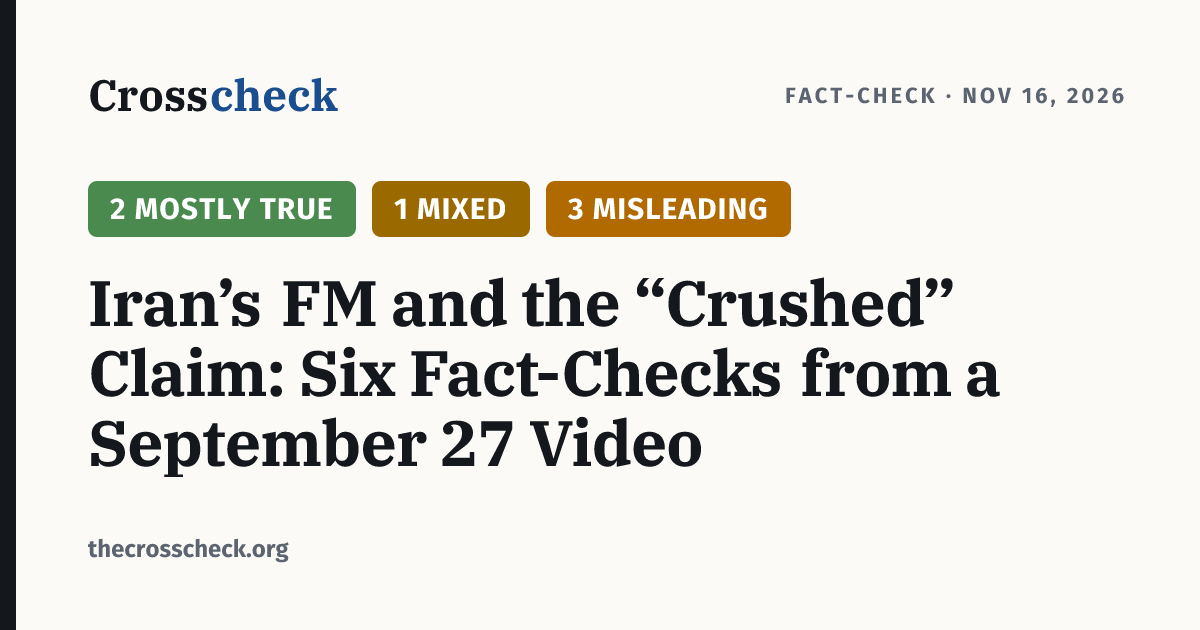
On September 27, 2026, conservative commentator Benny Johnson posted a video on YouTube arguing that Iran’s foreign minister was desperately trying to make a peace deal. Johnson said this was because President Trump had crushed Iran’s military and economy. This fact-check rates Johnson’s main claim and five related claims.
Background: What happened between the US and Iran?
The 2026 Iran war started on February 28, 2026. The United States and Israel launched airstrikes on Iran. Iran then blocked the Strait of Hormuz, the narrow waterway used to ship about 20% of the world’s oil. The US set up a naval blockade around Iran in response. A temporary peace deal was signed on June 17, 2026. It fell apart on July 8 when Iran attacked commercial ships again. By late September, negotiations were continuing through middlemen from Qatar, Pakistan, and Russia, with no deal reached.
Main claim: Iran’s FM is “desperately seeking” a deal — Verdict: Misleading
Iran’s Foreign Minister Abbas Araghchi has been pursuing negotiations. That part is true. But “desperately seeking” is not how he describes it. On the same day as the Johnson video, Araghchi told reporters Iran is “fully prepared for the time for the war to be resumed” and would fight “even if it comes to a doomsday war.” He also said Iran enters negotiations “with the utmost caution and complete distrust.”
Johnson says Trump “crushed Iran militarily.” Iran has not surrendered, disarmed, or accepted any US demands. It still controls the Strait of Hormuz and has proxy forces in Lebanon, Iraq, and Yemen.
Johnson says Trump “crushed Iran economically.” This part is closer to accurate. The IMF projected Iran’s inflation would reach 68.9% in 2026. Iran lost at least one million jobs. The estimated war damage is $144 billion, about 40% of what Iran’s economy was worth before the war. But economic damage alone has not forced Iran to accept US terms.
Claim 2: Iran rejected the nuclear deal and won’t give up its uranium — Verdict: Mostly True
Iran’s national security chief said Iran “will not remove even a single particle of enriched uranium from the country.” The US wanted Iran to completely dismantle its nuclear program and hand over its uranium stockpile. Iran refused that specific demand. However, Iran’s foreign minister left the door open to future nuclear talks, as long as the US first stopped the blockade and unfroze Iran’s money. Iran has refused the specific US terms, not all nuclear diplomacy. That is a real difference.
Claim 3: Oil flows are at 92%; China froze assets; Iran has no leverage — Verdict: Misleading
The 92% figure: This picks the most favorable data. Oil tanker tracking firm Kpler found only 43% of pre-war oil was moving directly through the strait in September. The US energy secretary said 80 to 90%, but that includes alternate pipeline routes. No named public source shows 92% as a confirmed number. The video itself showed a different graph saying “two-thirds” (66%) in the same segment.
“China froze assets”: This did not happen. Iran keeps tens of billions of dollars in Chinese banks from oil sales. Those funds are not formally frozen by China. US secondary sanctions put pressure on Chinese banks, so they stopped making new loans to some Iranian oil buyers. But Iran and China still trade oil through a shadow banking network. China also issued an order telling its companies not to comply with US sanctions.
“Iran has no leverage”: Iran still controls the Strait of Hormuz and can disrupt oil shipping at low cost through mine-laying and attacks. Shipping insurance remains expensive because of this. If Iran truly had no leverage, the US would have no reason to negotiate at all.
Claim 4: Iran threatened “devastating blows” with no geographic limits — Verdict: Mostly True
Iran’s national security secretary did say “we will inflict devastating blows on the aggressor using new weapons.” Iran’s supreme leader ordered the military to plan responses with no geographic limitations. Both statements are confirmed and came from senior Iranian officials. The minor qualification: they came from two different officials in October and November 2026, after the September 27 video was published. The pattern of threats is accurate.
Claim 5: Iran set seven conditions and refuses to discuss its nuclear program — Verdict: Mixed
Iran’s parliament speaker confirmed on October 4, 2026 that the Strait would stay closed until the US met seven conditions from the Islamabad memorandum. The conditions include ending the blockade, releasing frozen assets, and stopping the war. That part of the claim is confirmed.
But “refuses to discuss its nuclear program” goes too far. Iran’s foreign minister said nuclear talks could happen once the main conditions are met first. Iran refused the specific demand to dismantle its nuclear program, not all future discussion of the topic.
Claim 6: Trump is “desperately begging” mediators while Iran dictates terms — Verdict: Misleading
This claim is the mirror image of the main video’s framing. Trump is using multiple go-betweens. No deal has been reached. After the midterm elections, Trump faces political pressure to end the war. These parts are true. But Trump publicly rejected Iran’s latest proposal and threatened new strikes. Iran’s demands have been rejected, not accepted. Neither side has gotten what it wants. This is a stalemate, not Iran dictating terms.
What the video implies
The video implies Iran is so weak it must accept whatever the US offers. The evidence does not support this. Iran retains leverage through the Strait of Hormuz and its proxy networks. The video also implies China has switched sides and abandoned Iran. This is not supported. China is under US pressure but still buying Iranian oil through workaround networks.
Implications
If the “Iran is crushed” framing spreads, it could encourage US officials to demand more than Iran will accept, making a deal harder. If the opposite framing (Trump is desperately begging) spreads, it could encourage Iranian hardliners to hold out for terms the US cannot agree to. Both framings push toward a longer stalemate. The evidence shows both sides face real pressure and both sides have real leverage. A deal is possible but requires compromises neither side has yet publicly accepted.
What to watch
- Whether indirect US-Iran talks in late September or early October 2026 produced any framework.
- Whether diesel and jet fuel shipments through the Strait recover. Crude has partially recovered; refined products are still at only about 19% of pre-war levels.
- Whether Chinese banks actually stop financing Iranian oil sales, or continue finding workarounds.
- Whether economic hardship in Iran leads to large protests that change Iran’s negotiating position.
- Whether a deal can be reached on nuclear monitoring short of full Iranian dismantlement, which appears to be the only agreement both sides could accept.
Sources
- Benny Johnson — “Iran’s FM is desperately seeking a deal” (YouTube)
- Iran’s foreign minister says Tehran ready for ‘doomsday’ war with U.S., but leaves diplomacy on the table
- Iran ‘fully prepared’ for war to resume but diplomacy not over yet, Foreign Minister Abbas Araghchi says
- US says Hormuz oil flows recover to 14 million bpd despite Saudi attacks
- Crude oil exports through the Strait of Hormuz hit prewar levels, but fuel shipments remain constrained
- 2026 Iran war
- Iran plays down hope for deal to end war after new U.S. strikes on eve of midterm elections
- Where Iran’s $100 Billion Is Frozen: China, India, Iraq and the Global Battle Over Sanctions and Oil Money
- Trump’s Iran sanctions have a China problem
- Iran threatens ‘devastating blows’ with new weapons if attacked
- Iran says Hormuz to remain closed until US meets conditions
- 2026 Iran war ceasefire
- Iran emerges from war with its economy in free fall and inflation on some necessities above 400%
- US midterms open door to Iran diplomacy. Can a deal be struck?
- 2026 Strait of Hormuz crisis
- Putin Agrees to Help Trump Broker Nuclear Talks With Iran