Fact-check · Russia · Ukraine · Iran
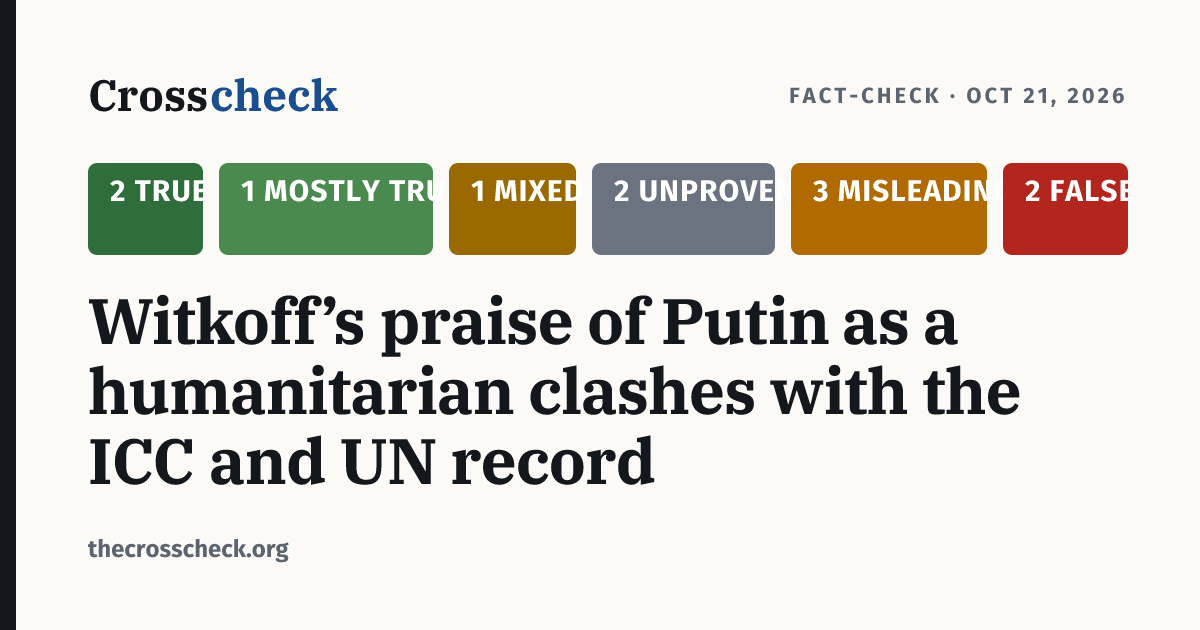
Verdicts
- FalseWitkoff’s description of Putin as a humanitarian: “You are a humanitarian also, sir, and I salute that. I commend you.”Witkoff said it; the footage and three transcripts confirm the words. What fails is the description. An ICC arrest warrant, a UN finding of crimes against humanity over deported children, and the highest September civilian casualties of the war contradict it. Freeing one American whom Russia itself had wrongfully held does not change that record.
- TrueWitkoff: Hubbard’s release “was not part of an exchange.”As of Oct. 21, no prisoner went to Russia in return, unlike the Marc Fogel case in 2025, whose swap terms surfaced the next day. That is a narrower statement than “nothing was given.”
- MisleadingTrump: the U.S. “was not required to give anything in return.”There was no prisoner swap. But Trump waived new Russia sanctions and tariffs five days earlier, and on the day of the release he wrote that imposing them would have halted the negotiations over Hubbard.
- FalseTrump: “we have been pretty happy with Russia that they have not gotten involved with Iran.”The chairman of the Joint Chiefs told the Senate in April that Russia is assisting Iran “to some extent,” and his Defense Secretary said Russia and China are, at different levels, “enabling” Iran. Russia has sent no troops, but by his own officials’ account it is involved.
- MisleadingImplied: releasing Hubbard was a humanitarian act by Putin.“Humanitarian release” is a standard diplomatic term, and freeing Hubbard early was humane. But Russia detained him in 2022 on charges the U.S. calls fabricated, and ending a detention Russia itself imposed does not show humanitarian character.
- UnprovenImplied: Trump’s push to end the Ukraine war is driven mainly by humanitarian concern.Motive cannot be read off the public record. Trump has called the war “brutal and terrible” and announced an energy ceasefire before winter. His administration also framed its October Russia moves around diesel prices and American consumers. Nothing public ranks the two.
- MixedReader question: the U.S. and Russia are fighting proxy wars against each other in Ukraine and Iran.They back opposite sides in both wars. But the U.S. is a direct combatant against Iran, so there it is Russia that backs a proxy. In Ukraine, the U.S. sells weapons Europe pays for and shares intelligence, and Washington has threatened to cut both.
- TrueReader claim: Witkoff and Kushner are negotiating over Ukraine alongside a Russian oil deal involving investors tied to their families.Putin raised a sale of Lukoil’s foreign assets with both envoys, who agreed to work on it, and a senior official confirmed they helped negotiate terms for the federal government’s planned stake. The leading bid includes Gulf investors in business with Kushner and with World Liberty Financial, co-founded by Witkoff and partly run by his son.
- UnprovenImplied: Witkoff and Kushner are exploiting the talks for private gain.The Times found no evidence either man profits personally, and Witkoff says he has no financial stake. The investors tied to their families, and a federal agency’s planned stake, are documented. Personal gain is not, and no sale has been approved.
- MisleadingReader claim: the U.S. is “giving aid to Russia” while it attacks Ukraine.No U.S. money or weapons have gone to Russia. Washington has given sanctions and tariff relief and a diesel license, which help Russia’s oil revenue and which critics call aid. The word blurs relief with assistance.
- Mostly TrueReader claim: Russia is telling the Iranians where U.S. bases are and where to hit.The Washington Post and Wall Street Journal reported in March that Russia was giving Iran targeting information, a senior U.S. official told CBS the same, and the Joint Chiefs chairman confirmed Russian help “to some extent.” The specifics rest on anonymous officials and Ukraine, and the one specific imagery report Reuters cites, before a July strike in Jordan, named Chinese entities.
The quote
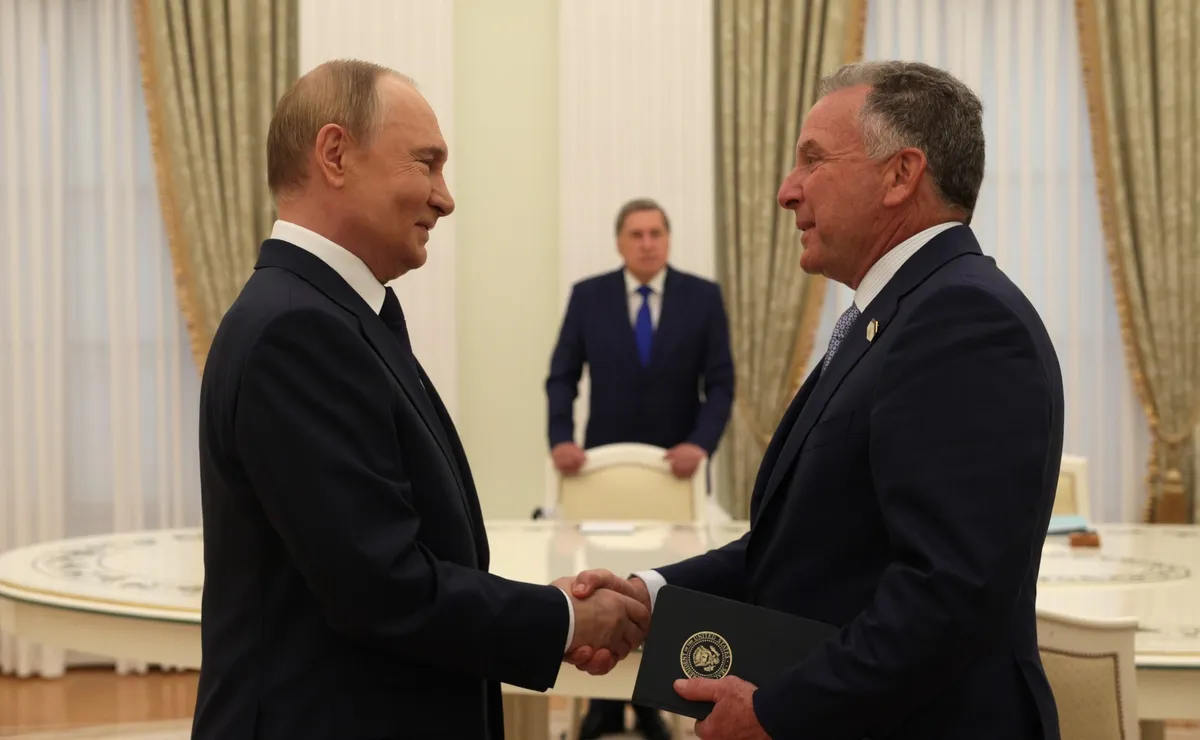
“You talk so much about my president, President Trump, being a humanitarian. You are a humanitarian also, sir, and I salute that. I commend you.”
The wording is confirmed. Spectrum News, ABC News and the Washington Post transcribed the first two sentences identically.[1][2][3] European Pravda’s transcription adds the closing “I commend you.”[4] RT, the Russian state-controlled network, posted the video on X, so Russian state media chose to air the moment.[1] No one in the administration has disputed the words. Trump and Vice President JD Vance defended them.[1][2]
We checked the remark and the statements Witkoff and Trump made about the release that day. We also checked what the remark implies, and a question readers asked us: whether the two countries are adversaries at all.
What happened in St. Petersburg
Stephen Hubbard, a retired teacher from Michigan, was detained by Russian forces in eastern Ukraine in April 2022. Russian prosecutors accused him of fighting as a mercenary, which he denied.[2][3] The State Department designated him wrongfully detained.[4] He was released Wednesday, about 54 months after his capture, and Witkoff met him before the talks with Putin.[2]
Before the remark, Witkoff thanked Putin: “The president sends his thanks. Because of you, he’s going home to his family.”[2] Putin, in turn, said Trump’s attention to Ukraine was driven primarily by humanitarian reasons.[4] Witkoff said afterward that Putin had agreed to resume three-way talks with Ukraine. Russia still has not agreed to a ceasefire.[1]
The criticism came from both parties. “No. Putin is (a) stone cold killer,” wrote Sen. John Cornyn, a Texas Republican. Sen. Mark Kelly, an Arizona Democrat, asked, “In what world is Putin a ‘humanitarian’?” Sen. Thom Tillis, a North Carolina Republican, wrote “WTF, Steve?”[1] and called the statement “embarrassing and outrageous.”[2]
Is Putin a humanitarian?
A humanitarian is someone who works to reduce human suffering. Putin’s documented record runs the other way, and the main findings come from an international court and a UN inquiry, not from his adversaries’ governments.
The ICC warrant
On March 17, 2023, the International Criminal Court’s Pre-Trial Chamber II issued a warrant for Putin’s arrest. The judges found reasonable grounds to believe he bears individual criminal responsibility for the war crimes of unlawful deportation and unlawful transfer of children from occupied Ukraine to Russia, both through his own acts and through his failure to control subordinates.[5] The warrant has been outstanding for 43 months. Russia does not recognize the court.
The UN inquiry
On March 12, 2026, the UN’s Independent International Commission of Inquiry on Ukraine concluded that Russian authorities committed crimes against humanity: the deportation and forcible transfer of children, and their enforced disappearance. It verified the cases of more than 1,200 children from five regions and found that 80 percent had not been returned. The Commission said the deportations followed “a policy conceived and executed at the highest level” of Russia’s leadership, and that Putin’s involvement “has been visible from the outset.”[6] Russia says it evacuated children from a war zone.
Civilian deaths this year
The UN Human Rights Monitoring Mission in Ukraine verified that 328 civilians were killed and 2,105 injured in September 2026. The mission called that the highest for September since the full-scale invasion began, and 85 percent above September 2025. From January through September, 2,570 civilians were killed, and total casualties ran 59 percent above the same period last year.[7] Russia kept bombing civilian targets in Ukraine the week of Witkoff’s visit. Tillis said Putin is “already ordering infrastructure hits, trying to freeze the Ukrainians to death.”[1]
Character claims are usually beyond a fact-check. This one can be tested because the record it contradicts is adjudicative: a court warrant and a UN inquiry that names Putin. Measured against that record, the statement is false. The narrower reading, that releasing Hubbard was a humane act, is examined under what the remark implies. Witkoff did not say the narrower thing. He said “You are a humanitarian.”
What the release cost
Witkoff wrote on X that Hubbard’s release “was not part of an exchange.”[2] No reporting describes a prisoner going to Russia in return, and the Kremlin has not claimed one. That differs from February 2025, when Marc Fogel came home and the U.S. released Alexander Vinnik, a Russian who had pleaded guilty to money laundering.[19] Fogel’s swap terms surfaced the day after his release, so this rating holds as of Oct. 21. On the narrow question of a swap, Witkoff is correct.
Trump went further. He wrote that the U.S. “was not required to give anything in return,” calling it “an unprecedented situation for Russia.”[2] The sequence of events complicates that. On Oct. 9 Trump announced a deal to increase Russian diesel supplies, and Treasury then waived sanctions on Russian diesel sales through April 2027.[13][14] On Oct. 16 he signed an order waiving the Graham Act’s 500 percent tariff on Russian goods and its tariffs on major buyers of Russian oil, two days before they would have taken effect.[13] Putin’s economic envoy, Kirill Dmitriev, called the move “historic.”[13] On Oct. 21 Trump wrote, of the discussions over Hubbard’s release: “If sanctions would have been placed, certainly those negotiations would have come to a complete and total halt.”[2][3] The administration’s official rationale for the waivers is different: the national interest, and a diesel supply crunch caused by the Iran war. Existing sanctions under earlier orders remain in place.[13][14]
Nothing public settles whether the waiver bought Hubbard’s freedom, eased fuel prices, or both. Trump’s own words make it misleading to say nothing was given.
Is Trump’s diplomacy humanitarian?
Witkoff’s line opened with Putin’s praise of Trump. A person’s character cannot be fact-checked, so we tested the specific claim Putin made in the room: that Trump’s Ukraine effort is driven mainly by humanitarian concern.[4]
The evidence points both ways. Trump has called the war “brutal and terrible” and framed releases like Fogel’s as steps toward ending it.[19] He has brought detained Americans home from Russia at least twice. On Oct. 11 he announced what he called an “energy ceasefire” between Russia and Ukraine, which would spare Ukrainian power plants heading into winter, and Russian refineries too, if both sides keep it.[12] His October moves on Russia were also explained in economic terms. A U.S. official told CNN that negotiators told Kyiv it should not take actions that hurt American consumers, and that Ukraine’s refinery strikes were part of what led Trump to strike the diesel deal. Two European officials told CNN the administration threatened to suspend intelligence sharing and weapons purchases unless Ukraine stopped hitting Russian energy sites.[12] CNBC notes that high fuel prices are a sensitive issue for voters before the Nov. 3 midterms, now 13 days away.[13] Trump has also suggested Ukraine should replace Zelensky.[3][12]
Readers also asked about Trump’s wider humanitarian record. It is context here, not evidence about his Ukraine motives. The administration closed USAID on July 1, 2025, and U.S. foreign-aid disbursements fell from $68 billion in 2024 to $32 billion in 2025, a drop of about 53 percent, based on government data reported in December 2025.[21] A Lancet study projected that if the cuts continue through 2030, about 14 million people who would otherwise have lived could die.[20] That figure is a model projection, not a count.
Humanitarian aims are part of what Trump says, and economic aims are part of what his administration says. Putin said humanitarian reasons come first (“primarily”), so that is the test. On a weaker reading, that humanitarian concern is one real motive among several, the record would support it. Motive is not observable and nothing public ranks the two, so we rate the claim as stated Unproven. A documented choice in which the humanitarian option cost Trump something he otherwise wanted, such as accepting higher fuel prices to protect Ukrainian energy sites, would settle it.
Are the U.S. and Russia adversaries?
Readers asked how an envoy can praise the leader of a country the U.S. is fighting through proxies. The premise is half right, and the wrong half matters.
Iran
The U.S. and Israel began striking Iran on Feb. 28, 2026, 235 days ago.[8] The U.S. is not fighting a proxy war there; it is fighting Iran directly, and Russia is the outside power backing a combatant. Gen. Dan Caine, chairman of the Joint Chiefs, told the Senate Armed Services Committee on April 30 that Russia is assisting Iran “to some extent,” declining to give details in a public hearing: “There’s definitely some action there.” The committee’s Republican chairman, Roger Wicker, said Russia “is taking serious action to undermine our efforts for success in Iran.”[10] The Middle East Institute, a think tank that favors a harder line on Moscow, compiles reporting from the Wall Street Journal, the AP and others describing satellite targeting data for strikes on U.S. forces, drone technology and arms deliveries.[9] Russia has sent no troops, and no large-scale arms transfers were confirmed during the war’s active phase.[8]
As of mid-October the war is deadlocked. A June ceasefire collapsed over control of the Strait of Hormuz, the U.S. keeps a naval blockade on Iran’s southern ports, Iranian attacks on shipping are at their highest level of the war, and indirect talks continue through Pakistan and Qatar. Trump has said he will not attack Iran before the Nov. 3 midterms.[30]
By late July, 18 U.S. service members had been killed in the Iran war, several of them in Iranian strikes on bases in Kuwait, Jordan and Saudi Arabia.[11]
On the day of the release, Trump said: “We have been pretty happy with Russia that they have not gotten involved with Iran. So, the last thing I want to do is upset an apple cart where we’re getting close to settling a war.”[2] In March he had said Putin might be helping Iran.[10] In July he wrote that Putin had assured him Russia was not participating. On Oct. 12 he posted that if Russia and China are helping, “it’s at a very low level, but I don’t believe they are at all.”[28] Days earlier, his own Defense Secretary had told Congress that Russia and China are “enabling some of the things Iran is doing.”[11] If “involved” means sending troops, Trump is right. Supplying targeting help and missiles to a country firing on U.S. bases is involvement in any ordinary sense, and the top U.S. military officer has said it is happening. We rate the statement False.
Ukraine
Here the proxy label fits better, but the U.S. role has shrunk. European purchases of U.S. weapons for Ukraine, including Patriot interceptors, run through PURL, a mechanism under which allies buy American arms for Kyiv. A NATO official said this month that those supplies continue to flow. Washington also shares intelligence that helps Ukraine locate Russian missile launchers.[12] This month the administration threatened to suspend both if Kyiv kept striking Russian energy sites.[12] The U.S. still supplies one side, and it is also pressing that side to stop.
Because the two countries back opposite sides in both wars, “adversaries” is a fair word, and on a loose definition of proxy war the premise is close. It is not exact, which is why we rate it Mixed. In one war the U.S. is a combatant. In the other it is an arms seller pushing for a settlement on terms Kyiv resists.
The oil deal beside the talks
A reader asked us to check a related charge: that Witkoff and Jared Kushner are negotiating Ukraine’s fate alongside a Russian oil deal involving investors tied to their families, and that taxpayers, troops and Ukrainian lives are being exploited for private gain. We split it into what is documented and what is implied.
What is documented
The New York Times reported on Oct. 3, citing eight people familiar with the talks, that negotiations over ending the war had expanded to a sale of Lukoil’s international assets: oil fields, refineries and gas stations, including stations in New Jersey.[23][27] Putin raised the sale with Witkoff and Kushner at the Kremlin on Sept. 5, pitching it as proof that Russia could do business with the U.S. again, and the envoys agreed to work on it.[23] A senior administration official confirmed that Witkoff and Kushner helped negotiate the terms of the federal government’s investment, to secure “a substantial upfront payment and profits interest for the United States.”[24]
The leading bid, led by Todd Boehly, who has given $2 million to Trump-aligned causes, includes:[23][25]
- The Al-Khayyat family of Qatar, which is working with Kushner and Ivanka Trump on a luxury resort in Albania, a tie to Kushner’s family rather than Witkoff’s.[23]
- A fund controlled by Emirati royal Sheikh Tahnoon bin Zayed Al Nahyan, who has financial ties to Kushner’s private equity firm. Another fund he controls bought a major stake in World Liberty Financial, the Trump family crypto venture co-founded by Witkoff and now run partly by Witkoff’s son.[23][24]
- The U.S. International Development Finance Corporation, a federal agency, expected to take an equity stake of about 15 percent.[25]
U.S. approval would release the assets from American sanctions, which the Times says would instantly increase their value to the buyers.[23] No sale has been approved, and any sale also needs Moscow’s consent.[23] Treasury’s license permitting sale negotiations, due to expire Oct. 22, was extended to Nov. 21, and any transaction still needs separate approval.[26] Treasury has already blocked sales to Gunvor and Xtellus, the review runs through the National Security Council and the State and Energy departments, and a Saudi-backed rival, Midad, has signed a term sheet.[25] Witkoff is a sworn special envoy. Kushner holds no comparable federal post, but he sits on Trump’s Board of Peace executive board and has traveled on U.S. government aircraft for the talks.[24] The first half of the reader’s claim is True.
What is not documented
The Times found no indication that Witkoff or Kushner personally stands to profit.[23][24] Witkoff’s spokeswoman said he “takes no salary,” travels on his own plane at his own expense, and “has no conflict of interest and no financial stake in this matter.” The DFC said the investment would “lower energy prices for everyday Americans.”[24] A federal agency would hold a stake if the sale is approved, so public money would be involved. Whether the DFC pays for that stake, and on what terms, has not been disclosed; the only stated term is a payment and profits interest flowing to the U.S.[24][25] We found no reporting connecting the deal to U.S. troops or to battlefield and civilian outcomes in Ukraine.
The overlap is real. The envoys negotiating the end of a war are also shaping a sanctions decision whose beneficiaries, if it is approved, would include business partners of their families. Hui Chen, a former Justice Department prosecutor, told the Times it is “an alarming and very concerning set of entanglements.” Witkoff’s office says there is no conflict, and the envoys’ stated aims are goodwill with Moscow and lower energy prices.[23][24] We read “private gain” as gain to the two men. Benefit to their families’ business partners is documented as relationships, not payouts, and whether either man gains personally is not shown by any public record. We rate the implied claim of private gain Unproven. Disclosure of the final investor list and terms, and of any Affinity Partners or World Liberty stake in the buying vehicle, would settle it.
“Aid to Russia” and targets for Iran
A widely shared reaction put the two threads in one sentence: “The fact that we are giving aid to Russia at a time where they are attacking Ukraine, at the same time that Russia is telling the Iranians where our bases are and where to hit, is the most absurd betrayal.” We could not confirm who first said it, so we rate its two factual parts without attribution. “Betrayal” is a judgment, and we leave it to readers.
Is the U.S. giving aid to Russia?
Not in the usual sense. No U.S. money, weapons or loans have gone to Russia; the proposed DFC stake in buying Lukoil’s foreign assets is unapproved, and how sale proceeds would be handled is not public.[25] What the administration has given is relief: a Treasury license allowing Russian diesel sales through April 2027, an Oct. 16 waiver of the Graham Act’s 500 percent tariff and its penalties on buyers of Russian oil, and the extension of the license to negotiate a Lukoil asset sale.[13][14][26] Existing sanctions remain.[13] Relief still has value to Moscow, whose war is funded by oil revenue, and Putin’s economic envoy called the waiver historic.[13] Critics call it aid. A Crooks and Liars roundup quotes former prosecutor Andrew McCarthy, writing in the conservative National Review, that Trump “has sided with the totalitarian aggressor.”[29] Read as foreign assistance, “aid” is wrong. Read as help, it points to real relief. The word blurs the two, so we rate the characterization Misleading.
Is Russia telling Iran where to hit U.S. bases?
Mostly, by the best available reporting. The Washington Post and the Wall Street Journal reported in March that Russia was providing Iran with targeting information.[28] A senior U.S. official with direct knowledge told CBS six days into the war that Russia was giving Iran intelligence on U.S. positions.[11] Gen. Caine confirmed Russian help “to some extent” without details, and Defense Secretary Hegseth said Russia and China are, “at different levels, enabling some of the things Iran is doing.”[10][11] Zelensky said Russian satellites surveilled U.S. bases in Bahrain, Jordan and Kuwait and claimed a correlation with Iranian strikes.[11] The record has gaps. In March, U.S. analysts were still investigating whether Russia supplied targeting data, and the one specific imagery report Reuters cites, before a July strike in Jordan that killed three U.S. troops, named Chinese entities.[28] No U.S. official has publicly confirmed a specific base or strike, so we rate the claim Mostly True rather than True.
How U.S. officials have described Putin
Compared against: public descriptions of Putin by U.S. presidents and their senior envoys since 2001 that we could document. We searched news coverage on Oct. 21, 2026 and found no earlier case of a senior U.S. official calling Putin a humanitarian. That is the result of one search, not proof that none exists.
| When | Who | What they said or did |
|---|---|---|
| June 2001 | President George W. Bush | “I looked the man in the eye, I found him to be very straightforward and trustworthy … I was able to get a sense of his soul.”[17] |
| March 2022 | President Joe Biden | Called Putin a “war criminal” after strikes on “apartment buildings, maternity wards, hospitals.”[18] |
| Feb. 2025 | President Trump | Called the Fogel release “a show of good faith from the Russians.”[19] |
| March 2025 | Steve Witkoff | Told Tucker Carlson, “I don’t regard Putin as a bad guy.”[15] |
| Aug. 2025 | Steve Witkoff | Delivered a Russian Order of Courage from Putin to the family of an American killed fighting for Russia, the son of a CIA official. Witkoff, who lost a son himself, framed it as about grieving parents.[22] |
| Oct. 2025 | Steve Witkoff | Advised Putin’s aide Yuri Ushakov on how Putin should pitch Trump, according to a call recording Bloomberg obtained.[16] |
| Oct. 2026 | Steve Witkoff | “You are a humanitarian also, sir, and I salute that.”[4] |
Warm words for Putin have precedent, and Bush’s are the best known. Bush spoke about a year into Putin’s presidency, years before the war in Georgia, the annexation of Crimea or the 2022 invasion. Witkoff spoke 43 months after an international court issued a warrant for Putin’s arrest. The remark fits Witkoff’s own pattern more than any earlier administration’s.
What the remark implies
The defense from Trump and Vance relies on a narrower claim: that freeing Hubbard was itself a humanitarian act. Trump said Putin could be called one “for that particular purpose,” then added, “I wouldn’t say anything one way or the other.”[2] Trump had asked Putin for the release in a phone call the week before.[2] “Humanitarian release” is a recognized diplomatic term, and freeing a 74-year-old early, with no swap, was a humane act. That framing leaves out who held Hubbard. Russian forces captured him, a Russian court imprisoned him, and the State Department called the detention wrongful.[2][4] Releasing him ended a harm Russia’s own system created, and Trump himself wrote that the sanctions decision kept the release talks alive.[2] We rate the implication Misleading. Hubbard’s family has every reason to be grateful, but the release does not show humanitarian character.
The second implication, that Trump’s own diplomacy is humanitarian at its core, is rated Unproven above. The third, that the envoys are profiting, is rated Unproven in the oil-deal section.
Two more reader claims tie the threads together: that the U.S. is giving aid to Russia, and that Russia is pointing Iran at U.S. bases. They are rated in the next section; the characterization “betrayal” is an opinion and is not rated.
The strongest case for each side
For Witkoff
Negotiators flatter. Vance argued that the outcome is what counts: “we should all be celebrating that, not be complaining about what Steve Witkoff said in order to get it done.”[2] An American held for four and a half years is going home, and Putin agreed to resume three-way talks.[1] ABC reports the administration is close to a deal covering several more Americans held by Moscow.[2] If praise in a meeting helps bring them home too, it can be defended as a tactic.
Against
The meeting was not private. RT published the footage, which suggests Russian state media saw value in the line.[1] The praise followed U.S. sanctions relief rather than preceding it, and Russia still refuses a ceasefire.[1][13] Republican senators, including Cornyn and Tillis, objected the same day.[1] The tactic argument carries a cost of its own: if public praise is part of the price for freeing a wrongfully detained American, every government holding one can see the price. That last point is analysis, not a documented effect.
What it means for Americans
This section is analysis. Each point says what the evidence supports and where it stops.
- Fuel prices. The global crude benchmark was about $104 a barrel on Oct. 15, up from about $72 the day before the Iran war began, with the Strait of Hormuz still contested.[30] The administration’s stated reason for easing Russian energy sanctions is lower diesel prices.[13][14] Oil revenue also funds Russia’s war, and the Iran war has already raised Russia’s oil income.[8][13] Whether the relief lowers prices at the pump is not yet measurable.
- U.S. troops. Russia is helping Iran, a country whose strikes have killed U.S. service members this year, and the top U.S. general has said so in public.[10][11] Praising Putin while denying Russia is involved in Iran risks telling Moscow that this help carries no visible cost.
- Americans detained abroad. Hubbard’s release is good news. The pattern is transactional, though: a prisoner swap for Fogel, sanctions relief before Hubbard.[3][19] Whether that pattern encourages more detentions is a forecast, not a finding.
- Allies. Zelensky called the waiver “wrong” and predicted more relief would follow, and the European Commission asked to be briefed on the talks.[4][13] Whether European governments that fund Ukraine’s American weapons change course is not yet visible.
- A federal stake. If the Lukoil sale goes ahead, a federal agency, the DFC, would hold an equity stake of about 15 percent alongside investors tied to the envoys’ families.[25] The administration says the U.S. would receive an upfront payment and a profits interest; whether the DFC also puts money in has not been disclosed.[24] Who gains most from lifting sanctions on the assets depends on terms that are not public.
What to watch
- Whether the three-way talks Witkoff announced take place, and whether Russia moves toward a ceasefire.[1]
- Whether Trump waives the Graham Act’s remaining sanctions on Russian officials and banks, as Zelensky predicts.[13]
- The Nov. 3 midterms, 13 days away, and the April 2027 expiry of the diesel waiver.[13]
- New U.S. assessments of Russian help to Iran, and whether the White House keeps saying there is none.[9]
- Further American releases, which ABC reports are under negotiation.[2]
- Nov. 21, when the extended Treasury license for negotiating a sale of Lukoil’s foreign assets expires. Any sale still needs separate approval.[26]
Parties affected
| Party | Outcome | Why |
|---|---|---|
| Stephen Hubbard and his family | Gains | Freed after about 54 months in detention the State Department called wrongful[2][4] |
| Other Americans held in Russia | Unclear | ABC reports a deal covering several more is close; none is announced[2] |
| Russia | Gains (analysis) | Public praise from a U.S. envoy aired on its state media, sanctions and tariff waivers, a diesel license, and a possible Lukoil sale, with the gain depending on how proceeds are handled[1][13][23] |
| Ukraine | Costs | Context, not caused by the remark: record September civilian casualties; Zelensky called the waiver “wrong”; U.S. threats to cut intelligence and weapons purchases[7][12][13] |
| U.S. service members in the Middle East | Costs (analysis) | Context, not caused by the remark: Russia is aiding Iran, whose strikes have killed U.S. troops, while the White House says Russia is not involved[2][10][11] |
| U.S. fuel buyers | Unclear | The waivers are meant to ease diesel prices; no effect is measurable yet[13] |
| U.S. taxpayers (DFC) | Unclear | A planned 15 percent federal stake; whether it costs or earns public money depends on undisclosed terms[24][25] |
| Rival Lukoil bidders (Midad, Carlyle) | Costs if the Boehly bid wins | Carlyle’s deal lapsed without approval; Midad has a term sheet[25][26] |
| Lukoil bidders tied to the envoys’ families | Gains if approved | U.S. approval would lift sanctions on the assets and raise their value[23] |
| Republican Russia hawks (Cornyn, Tillis) | Mixed (analysis) | Publicly broke with their own administration’s envoy[1] |
Sources
- Witkoff calls Putin ‘humanitarian’ after prisoner release
- Witkoff lauds ‘humanitarian’ Putin as Russia releases detained American
- Trump’s special envoy calls Vladimir Putin a ‘humanitarian’
- Witkoff calls Putin a humanitarian during St Petersburg talks
- Situation in Ukraine: ICC judges issue arrest warrants against Vladimir Vladimirovich Putin and Maria Alekseyevna Lvova-Belova
- Commission of Inquiry on Ukraine: deportation and forcible transfer of children are crimes against humanity (press release)
- Russian attacks killed 328 civilian Ukrainians during September
- Russia in the 2026 Iran war
- Russia’s Wartime Support for Iran
- U.S. acknowledges Russia is helping Iran in war
- Zelenskyy accuses Russia of assisting Iran with satellite imagery of U.S. bases in Middle East
- US threatens to suspend intel sharing, weapons purchases if Ukraine continues Russia energy strikes, sources say
- Trump waives broad new Russia sanctions, Zelenskyy condemns it as ‘wrong’
- Trump Waives New Russia Sanctions One Week After Diesel Deal
- Trump’s special envoy says Putin is not a ‘bad guy’
- Witkoff advised Kremlin aide on Ukraine plan and how to pitch Trump
- Bush–Putin news conference, rush transcript, June 16, 2001
- Biden says Putin is a “war criminal”
- Russian national released in exchange for Marc Fogel’s freedom
- Study: 14 million lives could be lost due to Trump aid cuts
- After a year of big cuts, where does US aid stand going into 2026?
- Witkoff delivered Russian medal from Putin to family of American who was killed fighting for Russia in 2024
- Trump Negotiators’ Business Ties Collide With Multibillion-Dollar Russian Oil Deal: NYT
- Putin Links Oil Deal to Ukraine Talks
- Boehly-led consortium backed by US and Gulf investors bids for Lukoil’s international assets
- U.S. OFAC extends Lukoil’s license to sell foreign assets until Nov 21
- US and Russia reportedly negotiate multibillion-dollar deal on Lukoil assets
- Trump says he does not believe China and Russia are helping Iran
- International Backlash Mounts Over Russia Aid, Betrayal Of Ukraine
- US-Iran stalemate: What are Trump’s next military options?