Fact-check · Ukraine · Starlink
Verdicts
- MixedMusk: “Starshield systems are owned and controlled by the US government.”The government pays for the service, controls who gets it, and owns some dedicated Starshield satellites. The network Ukraine uses runs on SpaceX’s Starlink constellation under Space Force service contracts, and SpaceX operates it.
- MisleadingMusk: “Any limits on speed or usage are decided by the US military and ultimately POTUS.”The Pentagon’s own secretary says it issued no directive and that Starlink can set limits itself. Three outlets report Musk proposed or ordered the cap. Even Reuters’ White House-origin account has SpaceX carrying it out.
- ContestedTrump: “It wasn’t me, and I don’t think it was Elon.”The Journal, CBS and the Telegraph all place Musk in the decision. Whether Trump approved it is reported both ways by anonymous officials, and no document has surfaced.
- FalseTrump: Ukraine’s access is “the same as it’s always been.”Ukraine’s Defense Ministry, Zelenskyy and an outside analyst all describe a 160 km/h ceiling that did not exist before Oct. 14 and remained in place after Trump spoke.
- ContestedRubio: “No one at the White House ordered anyone to slow down internet or slow down speed.”Two U.S. officials and a Western official told Reuters the order came from inside the White House. Other officials told the Journal and CBS that Musk acted on his own.
- MisleadingRubio: Ukraine does “not have access to [Starshield] at this moment.”Space Force contracts have put 3,000 Ukrainian terminals on Starshield since 2024. Kyiv, Reuters’ sources and Musk all describe the throttled service as Starshield. Rubio may mean a separate request to use it inside Russia.
- MisleadingRubio: the service has been restored to its previous level.Service improved from the first night’s dropouts, and a Ukrainian diplomat said so on Oct. 15. The same day Rubio spoke, Zelenskyy said the cap stood at 161 km/h, and an analyst told the Journal on Oct. 20 it still did.
- UnprovenHegseth: “We haven’t pulled anything back ... We haven’t made any directives.”Consistent with the Journal’s and CBS’s sources. Reuters’ sources say Pentagon leaders received a White House message that the service needed to be slowed. No record either way is public.
- TrueZelenskyy: “Technically, SpaceX did it.”Every account, including the ones most favorable to Musk, has SpaceX implementing the cap. Kyiv’s Defense Ministry says SpaceX imposed it, and Hegseth says Starlink had the option to.
- UnprovenZelenskyy: “It was the message from American government to limit this speed.”Kyiv was told by U.S. officials it was a White House decision, and Reuters’ sources agree. White House officials told Kyiv they do not control SpaceX, and Zelenskyy himself says he does not know who sent it.
- FalseImplied: the slowdown was a technical glitch rather than a decision.The cap had a precise threshold, applied inside Ukraine but not in the EU, and was acknowledged by SpaceX at 100 mph according to the senators’ letter. Every reported account describes a choice.
- UnprovenImplied: Ukraine violated Starlink’s terms of service, which justified the cap.Hegseth invoked the terms without naming a violation. Starlink’s terms bar offensive use, but the throttled product is Starshield, the military service, and Zelenskyy says Ukraine does not use Starlink for strikes inside Russia.
The post
“Starshield systems are owned and controlled by the US government. Any limits on speed or usage are decided by the US military and ultimately POTUS. Starlink is a commercial service owned and controlled by SpaceX. Usage of Starlink is limited to civilian or defensive activities and cannot be used for offensive military action, as doing so would be inappropriate for a commercial company.”
Musk posted this the day Ukrainian drone units reported their satellite links dropping at speed. It is the only statement SpaceX or its chief executive has made on the matter; the company did not respond to the Journal, CBS, Reuters or CNBC.[3][4][5][8] It also set the terms of the week that followed, because it assigned the decision to the U.S. government, and every senior U.S. official who has since spoken has declined to accept it.
We checked that post, the denials from Trump, Rubio and Hegseth, Zelenskyy’s account, and the two things the statements imply without saying. We did not try to resolve what no public document can yet resolve, which is whether anyone in the White House authorized the cap. The Pentagon inspector general has been asked to find that out by Nov. 1.[15]
Twelve days
- Oct. 9Trump announces a deal with Vladimir Putin to import Russian diesel; Treasury issues a general license allowing Russian-origin diesel sales through April 7, 2027. In Miami, Jared Kushner and Steve Witkoff tell Ukrainian officials Washington is frustrated with strikes on Russian refineries.[5][13]
- Oct. 10Trump says he has told Zelenskyy to stop hitting refineries. Musk replies to a White House video: “Zelensky has gone too far.”[8]
- Oct. 13 to 14, overnightTerminals on Ukrainian hardware moving faster than about 100 mph (160 km/h) lose their connection, with some units reporting drops at lower speeds. Ukrainian officials say SpaceX imposed the restriction Tuesday night, and Zelenskyy’s adviser says the armed forces got no warning.[8][13][14]
- Oct. 14Musk posts that limits are decided by the military and the president. Poland’s foreign minister asks Musk whether he is “playing politics with your products again.” Sen. Thom Tillis asks Musk on X to confirm the disruptions were unintended, warning that degrading Ukraine’s defenses “might be construed as aiding and abetting a mass murderer.”[7][8][13]
- Oct. 15Reuters reports the order “came from inside the White House,” citing two U.S. officials and a Western official; a senior U.S. official responds that “no such request was ever made by the president.” Nine senators from both parties ask the Pentagon inspector general to investigate. Ukraine’s Defense Ministry says terminals work in motion again, but only up to 100 mph.[5][15]
- Oct. 16The Telegraph reports Musk proposed the slowdown to Trump, who “agreed.” Trump tells reporters: “It wasn’t me, and I don’t think it was Elon.” Late that night he waives most of the Russia sanctions in a law he signed a month earlier.[6][8][13]
- Oct. 17Zelenskyy says the maximum speed is 161 km/h and that terminals tested at 180 km/h inside the EU kept their connection. Rubio says “no one at the White House ordered anyone to slow down internet,” that Ukraine does not have Starshield access, and that the service was restored.[10][13]
- Oct. 18Zelenskyy tells NBC the limit remains at 161 km/h and that “technically SpaceX did it” on a message from the U.S. government. Treasury Secretary Scott Bessent calls that charge “very reckless.” Rep. Mike Turner and Sen. Kevin Cramer, both Republicans, call for an investigation.[11][16]
- Oct. 19Trump: “I don’t know who it was, but I’d like to find out.”[4]
- Oct. 20The Journal reports Musk ordered the slowdown; CBS reports the same. Hegseth says the Pentagon issued no directives and that Starlink can act under its terms of service. SpaceX reports quarterly earnings minutes before the Journal story; the call does not mention Ukraine.[1][2][4][12][22]
What the cap did
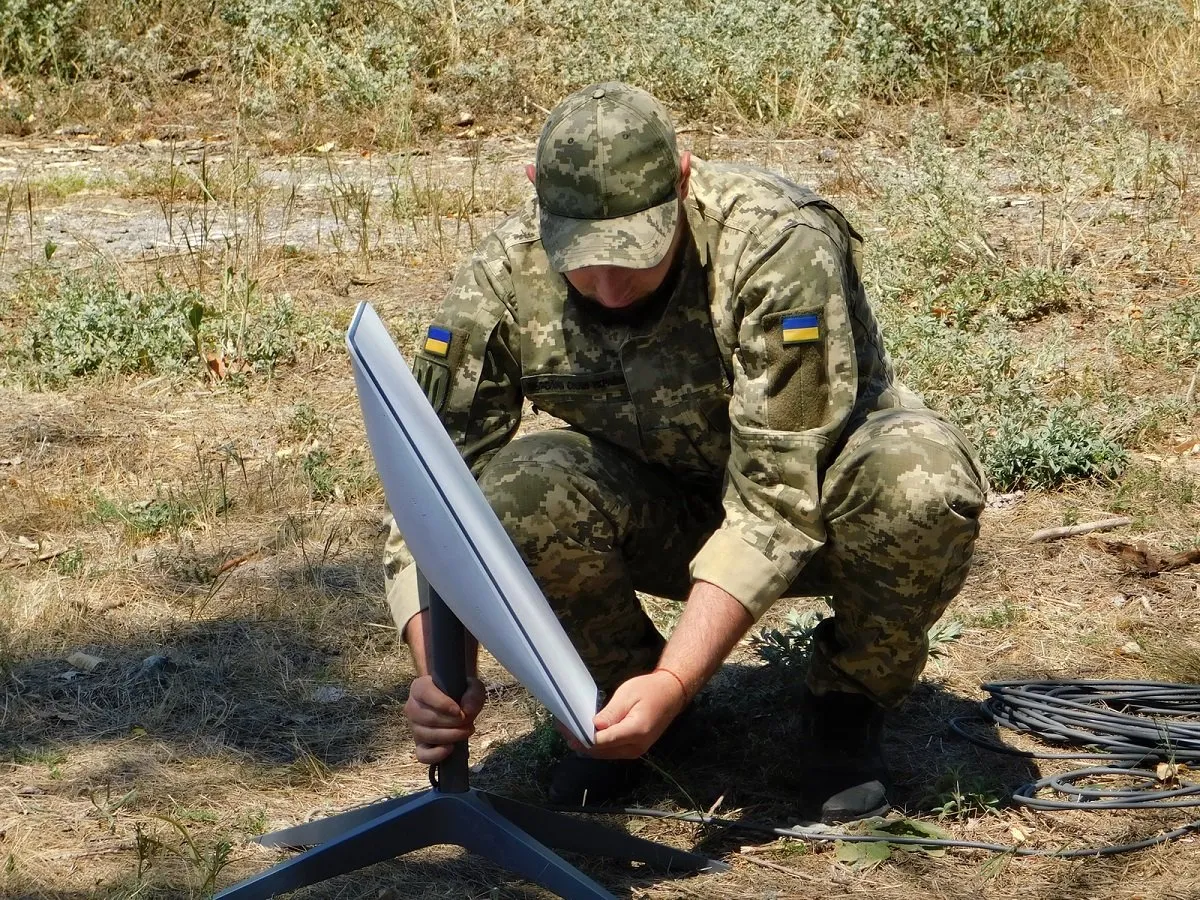
Ordinary Starlink terminals stop working in a vehicle above about 70 km/h. Starshield, the version SpaceX sells to governments, has no artificial speed cap and is known to work at 160 km/h or more, which is why Ukraine’s mid-range strike drones and its interceptor drones depend on it.[4] Serhii Beskrestnov, a defense technology adviser to Zelenskyy, said the restriction applied to Starshield’s military service package and cut connections above 100 mph. Ukraine’s 7th Rapid Response Corps reported drops of 10 to 20 seconds at 110 to 120 km/h, and the activist Serhii Sternenko, citing military reports, claimed drops as low as 60 to 70 km/h.[13] The senators’ letter puts the Ukrainian test result at “approximately 63 miles per hour” and says SpaceX “reportedly acknowledged a service restriction at 100 miles per hour.”[15]
The effect was on defense as much as offense. Ukraine hunts Russia’s jet-powered Shahed drones with interceptor drones that must outrun a target flying up to 370 km/h. “When the speed was reduced, we were unable to intercept some of the jet-powered Shaheds,” Zelenskyy said in Brussels on Oct. 16. “We were unable to use a tool to protect civilians.”[6] Dimko Zhluktenko, a drone pilot and analyst in Ukraine’s armed forces, estimated losses in the tens of millions of dollars.[4]
Trump’s remark on Oct. 16 that “from what I understand, it’s the same as it’s always been” does not survive the record.[8] The day before, a person in Ukraine’s Defense Ministry told Reuters the terminals worked in motion again “but only at speeds of up to 100 miles per hour.”[5] The day after, Zelenskyy said the maximum was 161 km/h and that “after exceeding it, Starlink shuts down, and we lose the drone,” adding that the limit applied in Ukraine and not in EU countries where his specialists tested terminals at 180 km/h.[13] A service that had no cap before Oct. 14 and a 160 km/h cap afterward is not the same as it has always been.
Rubio’s claim that the service had been restored to its previous level needs the same qualification.[10] Service did improve. On Oct. 15, Ukraine’s chargé d’affaires in Washington, Denys Sienik, told NBC that Starshield “has resumed at previous speeds for the moment.”[21] But Zelenskyy said on Oct. 17 and again on Oct. 18 that the 161 km/h limit remained,[11][13] and on Oct. 20 Michael Kofman of the Carnegie Endowment told the Journal that strike and interceptor drones were still throttled at 160 km/h, with the link in practice holding only below about 130 km/h.[3] Restored from the first night’s outage, yes. Restored to an uncapped service, no.
Four accounts
Four senior figures have spoken on the record. Their statements are listed in the order they were made.
| Who, when | What they said | What it rules out |
|---|---|---|
| Musk, Oct. 14[7] | Starshield is government-owned; limits are “decided by the US military and ultimately POTUS.” | A SpaceX decision. |
| Trump, Oct. 16[8] | “I don’t know if it was anybody because it wasn’t me, and I don’t think it was Elon.” | A presidential decision; doubts a Musk decision. |
| Rubio, Oct. 17[10] | “No one at the White House ordered anyone to slow down internet.” Reports to the contrary are “categorically false.” It “wasn’t deliberate.” | A White House decision; any deliberate decision. |
| Hegseth, Oct. 20[12] | “We haven’t pulled anything back. There are terms of service that ultimately need to be complied to, and that’s where Starlink has the option to make those decisions ... We haven’t made any directives.” | A Pentagon decision; points at SpaceX. |
Read together, the four leave no one holding the decision. Musk says the military and the president decide; the president and the secretary of defense say they did not. Rubio says it was not deliberate at all; Hegseth says Starlink had the option to make it. The statements are not all compatible, and the one thing they share is that none of the three officials disputes Musk’s premise that the cap was a choice someone made.
Trump’s “it wasn’t me, and I don’t think it was Elon” has two halves with different evidence behind them. He added, per Reuters, that any limit on Ukraine’s Starshield access “was not imposed by the United States.”[8][9] On Musk, the Journal reported that “Musk ordered the slowdown,” CBS reported separately that “a decision by Elon Musk led to restrictions,” the Telegraph reported that Musk brought the idea to Trump, and sources in Ukraine’s Defense Ministry told CBS that SpaceX imposed the restrictions unilaterally.[1][4][6] No published account says Musk was a bystander. On Trump, the record splits. One of the Journal’s sources said Musk and Trump discussed the matter before the cap; a Telegraph source said Trump “agreed” to it; Reuters’ three officials put the order inside the White House.[2][5][6] Against that, other officials told the Journal that Musk acted unilaterally and that Trump “didn’t specifically order any retribution against Ukraine,” officials told CBS that neither Trump nor the Pentagon ordered limits meant to disrupt drone operations, and a senior official told Reuters the president never made such a request.[3][4][5] We rate the statement Contested because credible reporting, all anonymously sourced, lands on both sides of the Trump half, and nothing on the record resolves it.
Rubio’s “no one at the White House ordered anyone” is the same dispute stated more broadly, and it gets the same rating.[10] Reuters’ sources said “leaders at the Defense Department received a message that the SpaceX Starshield service for the Ukrainian military needed to be slowed,” and a senior Ukrainian official said Kyiv called the White House, State Department and Pentagon and “was told it was a White House decision.”[5] Axios reported the opposite exchange on Oct. 14: White House officials told Zelenskyy’s advisers they “don’t have control over SpaceX.”[14] Rubio’s further claim that the slowdown “wasn’t deliberate” is treated below, under what the statements imply.
Hegseth’s account is the narrowest and the hardest to contradict. The Pentagon “haven’t made any directives,” he said, and Starlink “has the option” under its terms of service.[12] That is consistent with the Journal’s and CBS’s sources, who describe a Musk decision, and with Axios’s report that U.S. officials initially pointed to a technical malfunction.[4][14] It sits awkwardly with Reuters’ report that Pentagon leaders received a message from the White House that the service needed to be slowed, which would make the Pentagon a conduit even if it signed nothing.[5] It also sits awkwardly with Musk, who named the U.S. military as the body that decides. No directive, contract clause or message has been published, so the statement is Unproven rather than contradicted. The senators have asked the inspector general to preserve “technical directives” and “communications between the Department of Defense, SpaceX, and other relevant agencies,” which is where an answer would come from.[15]
What the reporting says
Four news organizations have published accounts of the decision. None is on the record, and they do not agree.
| Outlet, date | Finding | Sourcing |
|---|---|---|
| Reuters, Oct. 15[5] | The order “came from inside the White House”; Pentagon leaders received a message that the service needed to be slowed. Who in the White House decided is unspecified. | Two U.S. officials, one Western official; a senior U.S. official denies the president requested it |
| The Telegraph, Oct. 16[6] | Musk “approached Donald Trump with the idea” and Trump agreed; “the reality is that they were both in it.” | Four sources; two Ukrainian sources and a senior European official confirmed, per the paper |
| The Wall Street Journal, Oct. 20[1][2][3] | “Elon Musk ordered the slowdown.” Musk and Trump discussed it by phone soon after it became public; one source says also before. Some officials say Musk acted unilaterally. SpaceX later sought “a unified understanding and subsequent message” with the White House. | U.S. officials and people familiar with the matter |
| CBS News, Oct. 20[4] | “A decision by Elon Musk led to restrictions.” He held multiple conversations with administration officials first and “wanted clarity on the president’s thinking.” Some officials were surprised; it is unclear how the order was executed. | People familiar with the matter; Ukrainian Defense Ministry sources |
The accounts can be reconciled only one way: Musk raised the idea with administration officials, got something he read as assent or at least no objection, and SpaceX imposed the cap, after which the government disowned it. That is a reading, not a finding. It is also close to what Zelenskyy told NBC on Oct. 18.
“Technically, SpaceX did it,” Zelenskyy said.[11] On that point there is no dissent. The Journal and CBS say Musk ordered it; the Telegraph says he proposed it; Reuters’ version has the government asking that “the SpaceX Starshield service” be slowed, which SpaceX would have to execute; Ukraine’s Defense Ministry says SpaceX imposed it; and Hegseth says Starlink had the option to make the decision.[1][4][5][6][12] The restriction also applied inside Ukraine and not in EU countries, which Zelenskyy cited as the mark of a decision rather than a fault: “it’s limited because it’s a decision.”[13]
Zelenskyy’s other claim, that “it was the message from American government to limit this speed,” is what Kyiv was told and what Reuters’ officials say, but Zelenskyy himself qualified it: “I don’t know from whom, what cabinet, and etc.”[5][11] White House officials told his own advisers they do not control SpaceX.[14] Bessent called the charge reckless and said Trump and Rubio “have categorically said that no one in the Trump administration did that.”[11] A categorical denial from officials who have given four accounts is not evidence either, so the claim stays Unproven.
Who owns Starshield
Musk’s first sentence, that Starshield systems are “owned and controlled by the US government,” has a history. In September 2023, defending himself over the Crimea episode in Walter Isaacson’s biography, Musk wrote that SpaceX “is building Starshield for the U.S. government” and that “that system will be owned and controlled by the U.S. government.”[20] Some of it is. The Pentagon has bought dedicated Starshield satellites, including a spy constellation for the National Reconnaissance Office, and it is Starshield’s biggest customer.[5] The government pays to use the service and controls who can access it; use has been limited to Ukraine and the occupied territories and is not available in Russia.[4]
The service Ukraine uses is a different thing from a government-owned satellite. It runs on the Starlink constellation as its backbone.[5] In 2023 the Pentagon agreed to buy Starlink service for Ukraine and declined to give the price, scope or timeline.[18] In August 2024 the Space Force awarded a second contract that put 2,500 existing Ukrainian Starlink terminals onto Starshield, on top of 500 already connected. “A total of 3,000 terminals are provided service via the two contracts,” the Space Systems Command’s commercial satellite office said, both “to facilitate Internet connectivity in Ukraine.”[17] The senators describe the same arrangement: “at least some relevant services are provided through contractual arrangements administered by the U.S. Space Force,” and Ukraine’s arrangement before the cap was “access to unlimited speeds.”[15] CBS describes Musk as licensing the technology to the government.[4] A service contract gives the customer the right to the service. It does not make the customer the operator of the network, and nothing published says the Space Force holds the controls that set a speed threshold. We rate the ownership claim Mixed: true of some satellites and of access decisions, not of the network that was throttled.
Musk’s second sentence, that limits “are decided by the US military and ultimately POTUS,” is the claim the rest of the week turned on. As a statement of who may decide, it has support: the government controls access, and SpaceX’s president said in 2023 that “there are things that we can do and have done” to limit Ukraine’s offensive use of Starlink.[4][18] As a statement of who did decide this cap, it is contradicted by the only official Musk named. Hegseth said the Pentagon made no directives and that the option to set limits under the terms of service lay with Starlink.[12] Three outlets report Musk ordered or proposed the cap, and a Telegraph source said Musk “tweeted out that he was innocent and that it was the U.S. administration that did it. The reality is that they were both in it.”[1][4][6] Even if Reuters’ account is the accurate one and the request originated in the White House, SpaceX executed it, and Musk’s post omitted that. Facts arranged to leave the impression that SpaceX had no hand in the decision, when every account gives it one, is what we rate Misleading. The case against that rating is that an inspector general could find a written government instruction, which would move the claim toward Mostly True. None has been reported.
Rubio’s statement that Ukraine does “not have access to [Starshield] at this moment” and that its request “is under conversation” contradicts the contract record and his own colleagues.[10] The Space Force said 3,000 Ukrainian terminals receive Starshield service.[17] Ukraine’s presidential adviser said the cap applied to Starshield’s military package, Reuters’ officials called it “the SpaceX Starshield service for the Ukrainian military,” and Musk’s post addressed Starshield as the relevant product.[5][7][13] Rubio framed the request as access “in order to conduct deep strikes inside of Russia,” and Starlink does not work inside Russia, so he may have meant a request for an expanded geography rather than the service Ukraine already has.[3][4] Zelenskyy says Ukraine does not use Starlink for deep strikes at all.[6] Taken as spoken, the statement leaves the impression that Ukraine never had Starshield, which the Space Force’s own statement refutes. The contracts the Space Force described ran “into 2025,” and whether they were renewed on the same terms is not public, which is the strongest case for Rubio.[17]
Hegseth’s terms-of-service framing implies that Ukraine was out of compliance and that the cap was a contractual response.[12] Starlink’s terms, as Musk describes them, bar “offensive military action,” and SpaceX has said since 2023 that Ukraine used Starlink in ways “not part of any agreement.”[7][18] But the throttled product is Starshield, which Musk’s own post treats as the military service with no such limit, and the drones most affected were interceptors defending Ukrainian cities.[6][13] Hegseth named no term and no violation. Until someone does, the implication is Unproven.
Is anyone on the hook
The question readers ask next is whether throttling an ally’s drones carries consequences for the person who did it. The short answer is that Ukraine has few, Congress has some, and the clearest exposure for everyone involved is the record of what they said.
Musk and SpaceX
Ukraine is not a party to the Space Force contracts, and the 2024 U.S.-Ukraine bilateral security agreement “does not expressly guarantee that Ukraine will receive unrestricted Starshield access”; its dispute clause provides for consultation, and its annex disclaims creating legal rights or obligations, according to a legal analysis published this month.[23] The same analysis finds substantial government involvement but no established breach of contract or of international law, because the governing contract terms have not been disclosed. That leaves the Pentagon as the party with a claim, if the contract set service levels and SpaceX cut them on its own. The senators asked the inspector general exactly that: “whether such restrictions were consistent with applicable U.S. government contracts, and what actions, if any, the Department of Defense took in response.”[15] Hegseth’s answer, that Starlink had the option under its terms of service, is the government saying in advance that it does not see a breach.[12]
There is a precedent for how this ends. In September 2023, after Isaacson reported that Musk had declined to extend Starlink coverage for a Ukrainian attack near Crimea, Sens. Jeanne Shaheen, Elizabeth Warren and Tammy Duckworth asked the defense secretary whether anything in the Pentagon’s contracts “prohibits the companies from impeding services,” and Armed Services Chairman Jack Reed said “neither Elon Musk, nor any private citizen, can have the last word when it comes to U.S. national security.”[19] We found no published outcome of that inquiry in our search of news coverage, and the contract whose terms the senators asked about then is the one whose terms they are asking about now. Musk also advises the Pentagon on technology through Project Meridian, a role CNBC noted the week of the cap.[8]
Trump
The president’s exposure runs in both directions. If Musk’s account is right and the White House set or approved the limit, then the Oct. 16 denial was false, and the administration degraded a capability the Space Force pays for during Russian strikes on Ukrainian cities, in the same weeks it licensed Russian diesel and waived Russia sanctions.[8][13] In 2020 the Government Accountability Office found that the Office of Management and Budget broke the Impoundment Control Act by withholding appropriated Ukraine security assistance in 2019 for policy reasons.[24] Whether that precedent reaches a throttled service depends on which appropriation paid for it and on whether a speed cap counts as withholding budget authority, and the public record establishes neither; we note the analogy as analysis, not as a finding. If instead the Journal’s unilateral-Musk sources are right, the president has a defense contractor adjusting an ally’s air defenses after a phone call, the contractor’s company coordinating a “unified understanding and subsequent message” with his staff afterward, and his own statement five days later that he does not know who did it.[3][4]
What the statements imply
That it was a glitch
None of the three officials said the word, but Rubio said the slowdown “wasn’t deliberate” and “sort of happened,” Trump said it was “the same as it’s always been,” Axios reported that U.S. officials initially pointed to a technical malfunction, and Sen. Kevin Cramer said on Oct. 18 that “it may very well have been some sort of a technical glitch.”[8][10][14][16] A reader of those statements would take away that no one chose anything. The evidence says otherwise. The restriction had a threshold, about 100 mph, that SpaceX itself reportedly acknowledged.[15] It applied inside Ukraine and not inside the EU, where the same terminals held a link at 180 km/h.[13] SpaceX had gated Starlink by speed deliberately once before, in January, to stop Russian drones.[3] And every published account of the decision, from the outlets that blame Musk to the one that blames the White House, describes a choice.[1][4][5][6] Zelenskyy’s formulation on Oct. 18 was that “it’s limited because it’s a decision.”[13] The implied glitch is False.
The second implication, carried by Hegseth’s terms-of-service remark, is that Ukraine brought the cap on itself by misusing the service. That is assessed above under the Starshield section and rated Unproven, because no one has named a term or a violation.
The strongest case for each side
For Musk’s account
Reuters is not a minor outlet, and its three officials said the order came from inside the White House and that Pentagon leaders were told the service needed to be slowed.[5] Kyiv was told the same by U.S. officials.[5] The Telegraph’s version has Trump agreeing to the idea.[6] The timing fits a government motive: Trump had demanded that Ukraine stop striking refineries, called for Zelenskyy’s replacement, and, according to Reuters, had officials threaten to cut off missile-launch intelligence.[5][21] Zelenskyy said U.S. intelligence on ballistic launches was in fact blocked for three days.[11] If the government was willing to withhold warnings, a government-blessed speed cap is not far-fetched, and a contractor who cleared it with the White House first could fairly say the limit was the government’s to decide. What this case cannot explain is why the defense secretary, the secretary of state and the president all deny it, or why Musk, who could end the dispute by saying who asked him, has said nothing since Oct. 14.
For the administration’s account
The Journal and CBS, reporting separately, both land on a Musk decision, and some of their sources say he acted alone.[1][4] Musk had motive of his own: he posted that Zelenskyy had “gone too far” four days before the cap and “time for Zelenskyy to go” the night after, and CBS’s sources say he dislikes SpaceX being seen as profiting from the war.[4][8][21] White House officials told Zelenskyy’s advisers the day it happened that they do not control SpaceX, and CBS’s sources say the restrictions surprised some officials inside the administration.[4][14] SpaceX has throttled Ukraine on its own before, by its president’s account in 2023.[18] On this reading Hegseth’s answer is simply accurate: the company had the option and used it. What this case cannot explain is Reuters’ three officials, the Journal’s source who says Musk spoke to Trump before acting, or a White House that, if it was blindsided by a contractor disabling an ally’s air defenses, has said nothing critical of the contractor.
Implications
The finding that holds regardless of which account is right is that a speed cap on an ally’s military network was set, by a private company, without notice, and that no part of the U.S. government will say it authorized it. If Musk is right, the administration’s denials are false. If the administration is right, a contractor made war policy and the administration has not objected. The senators’ letter treats both as failures of “the Department of Defense’s contractual oversight,” which is the frame that survives the dispute.[15]
For the fact pattern readers are likely to see argued, two of the claims checked here carry the weight. The “same as it’s always been” and “restored” statements are the ones that would let the administration say nothing happened; both fail against Ukraine’s own measurements. The “decided by the US military and ultimately POTUS” statement is the one that would let SpaceX say it was following orders; it fails against the Pentagon’s own denial and three outlets’ reporting, unless the inspector general finds the order. Anyone building an argument on either should wait for Nov. 1.
What to watch
Three dated events would move these verdicts. The senators asked the Pentagon inspector general for written confirmation and an initial briefing by Nov. 1, including whether any official “directed, authorized, approved, or had advance knowledge” of the change; a written directive would resolve the Contested claims, and its absence would strengthen the case that Musk acted alone.[15] The midterm elections follow on Nov. 3, 13 days from publication, and Trump has tied his pressure on Kyiv to energy prices ahead of them.[5] And Ukraine was, as of Oct. 20, “still waiting for an official answer from the Pentagon and SpaceX on what happened and whether the connection has been restored or will be,” in Sienik’s words; a restoration to uncapped service, or a renewed Space Force contract that specifies one, would be the first on-record evidence of who controls the setting.[3]
Parties Affected
How the documented facts above leave each party. Rows marked analysis are our inference from the record.
| Party | Effect | Why |
|---|---|---|
| Ukraine’s military | Costs | Interceptor and strike drones lost their link above 160 km/h; losses estimated in the tens of millions of dollars; missed Shahed intercepts during a week of Russian strikes[4][5][6] |
| Elon Musk and SpaceX | Mixed | Three outlets report he ordered or proposed the cap; a bipartisan IG request names SpaceX and its contract; shares fell about 11% in the week of the cap; the Q3 call avoided the subject[1][8][15][22] |
| The White House | Costs (analysis) | Denials from Trump, Rubio and Bessent now sit against Reuters’ sources, the Telegraph’s sources and one Journal source; Trump’s “same as it’s always been” is contradicted by Kyiv’s measurements[5][6][8] |
| The Pentagon | Unclear | Hegseth disclaims any directive, but the Space Force administers the contract and the IG has been asked whether the restriction was consistent with it[12][15] |
| Senate Republicans (Tillis, Collins, Cornyn, Murkowski, Cramer) | Mixed (analysis) | Signed or endorsed an IG probe of their own administration two weeks before the midterms; Tillis warned of “aiding and abetting a mass murderer”[13][15][16] |
| Russia | Gains (analysis) | Fewer intercepts of jet-powered drones and slower Ukrainian strikes on logistics in occupied territory during the cap; diesel license and sanctions waiver in the same fortnight[5][13] |
| Poland and other European buyers | Costs | Poland paid for tens of thousands of the terminals affected; its foreign minister publicly challenged Musk[13] |
Sources
- Musk Ordered Starlink Slowdown That Blindsided Ukraine
- Elon Musk ordered Starlink slowdown for Ukraine: Report
- WSJ Says Musk Ordered Ukraine’s Starlink Cap. Musk Said POTUS Decides
- Musk chose to restrict Ukraine’s access to SpaceX satellite network, sources say
- Order to limit Starshield for Ukraine came from inside White House, sources say
- Musk asked Trump to restrict Ukraine’s Starlink service, Telegraph reports
- Elon Musk on X: “Starshield systems are owned and controlled by the US government…”
- Trump denies Musk claim he ordered Starlink restrictions in Ukraine
- Trump says neither he nor Musk responsible for Ukraine loss of Starlink access
- Rubio says Ukraine without access to Starshield, future ‘under discussion’
- Meet the Press, Oct. 18, 2026 (full transcript)
- Hegseth Claims U.S. Hasn’t Pulled Back Ukraine’s Access To Musk’s Starlink Amid WSJ Report
- Ukraine’s drones lose their Starlink link above 100 mph. Musk, Rubio, and Trump all say it wasn’t them
- Ukraine’s Starlink restrictions raise suspicions of Musk, Trump retaliation
- Letter to the Department of Defense Inspector General regarding Starlink over Ukraine (PDF)
- GOP Rep. Mike Turner calls for investigation into Ukraine Starlink disruptions
- SpaceX wins US contract to expand Ukraine’s access to Starshield satellite network
- Pentagon awards SpaceX with Ukraine contract for Starlink satellite internet
- Senators ask Pentagon whether Musk restricted Ukraine’s Starlink access
- Elon Musk on X: “SpaceX is building Starshield for the U.S. government … That system will be owned and controlled by the U.S. government.”
- Ukraine resumes strikes on Russian oil refineries as anger mounts with Trump
- SpaceX (SPCX) Q3 2026 Earnings Call Transcript
- Starshield Ukraine: Who Controls Musk’s Satellites Under International Law?
- Office of Management and Budget: Withholding of Ukraine Security Assistance, B-331564