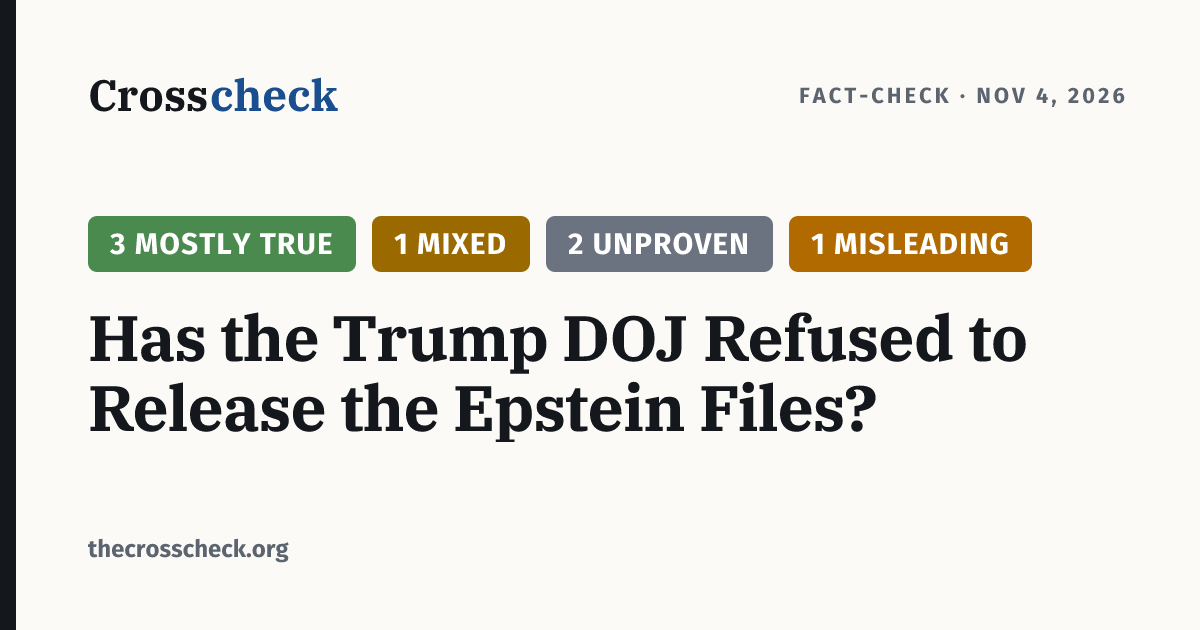
The Claims Under Review
A post circulating on Reddit’s r/politics community, titled “We finally know why Trump has tried so hard to [hide the Epstein files],” links to reporting on a November 2026 House Judiciary Committee minority staff report alleging that the Justice Department has covered up Epstein-related files to protect President Trump. The post and its linked article make five checkable claims, examined here in order of their precision and verifiability.
The sourcing context matters: the Reddit post itself is not a primary source, and the linked article aggregates claims from a partisan congressional minority staff report. This fact-check goes to the primary record where possible — court documents, DOJ press releases, federal statute, and wire-service reporting from NPR and PBS NewsHour — rather than relying on partisan characterizations of that record.
Background: The Epstein Files Transparency Act
Jeffrey Epstein, the financier and convicted sex offender, died in federal custody in August 2019 while awaiting trial on federal sex-trafficking charges. His associate Ghislaine Maxwell was convicted in 2021 of sex trafficking and related crimes. The case generated an enormous volume of investigative records held by the DOJ and FBI. For years, advocates, journalists, and survivors pushed for public disclosure of those records.
On November 19, 2025, President Trump signed the Epstein Files Transparency Act (EFTA) into law. The House had passed it 427-1; the Senate passed it by unanimous consent the same day.[1] The EFTA requires the Attorney General to make all unclassified DOJ records related to Epstein publicly available in a searchable, downloadable format within 30 days. The law expressly prohibits withholding materials on the basis of “embarrassment, reputational harm, or political sensitivity” to any official or public figure. Victim privacy protections are written into the law: the Attorney General may redact the identities and personal information of Epstein’s victims.[1]
That 30-day window placed the statutory deadline on December 19, 2025.
What the DOJ Has Released and Withheld
At the time of the EFTA’s signing, Pam Bondi was Attorney General; Todd Blanche was Deputy Attorney General and the operational face of the DOJ on this release. Bondi was dismissed in April 2026; Blanche became Acting AG and was confirmed as full Attorney General in July 2026.[3]
The DOJ’s December 19, 2025 first release met the statutory deadline on its face but contained approximately 3,965 files totaling 3 GB — a fraction of the full record. Blanche announced a staggered rollout and cited the volume of material: approximately 6 million pages of records. By January 30, 2026, after five staggered releases, the DOJ had released approximately 3.5 million pages and declared the review “over.”[2]
That declaration drew immediate legal challenge. An NPR investigation in February 2026 found that the public database was missing at least 53 pages of interview documents and notes related to allegations against Trump — pages whose serial numbers appeared in a document log but whose content was absent from the public release.[4] When NPR asked the DOJ about the specific missing files, what they contained, and why they were absent, the department declined to answer on the record.[4]
In June 2026, U.S. District Judge Emmet G. Sullivan issued a 48-page ruling in Phang v. Blanche noting that Blanche had conceded the DOJ violated the EFTA. Sullivan ordered the DOJ to either release unredacted Epstein records or formally justify each withholding by July 2, 2026.[3] In September 2026, Judge Sullivan warned Blanche of possible contempt of court for missing court-ordered deadlines.[3] The DOJ then sought to stall review of foreign-language documents in the Epstein archive, arguing it lacked the capacity to translate them. That stall attempt is the subject of Claims 3 and 4 below.
Verdict: “Refused to Release” the Epstein Files
The verb “refused” implies total non-disclosure, which the record does not support: millions of pages are publicly available. What is established is that the DOJ unilaterally declared the review complete before courts found compliance, withheld specific Trump-related materials identified by NPR, and fought court orders to continue reviewing foreign-language documents. A court found the DOJ violated its own statutory obligations. That is a meaningful pattern of non-compliance, but it is not the same as refusing to release anything.
Verdict: DOJ Cover-Up to Protect Trump
The House Judiciary Committee minority report, released in November 2026, alleges that DOJ officials under Blanche “actively obstructed” disclosure of files implicating Trump and shut down investigations into Epstein’s co-conspirators.[10] Democrats cite the NPR investigation as corroboration: files specifically mentioning Trump were absent from the public database, and the DOJ refused to explain why.[4] The White House denied all allegations in the report.[10]
The documented evidence establishes that the DOJ withheld files specifically relating to Trump allegations. It does not establish why. Courts found EFTA violations; they did not find that those violations were directed by Trump or motivated by criminal intent. “Covering up a child sex-trafficking ring to protect Trump” imports a motivational claim and a characterization of ongoing criminal activity that no court has found and no independent investigation has concluded. The factual core of this claim — the DOJ withheld specific Trump-related files and courts found the DOJ violated the law — earns a Misleading rather than False rating, because those underlying facts are real. The characterization layered on top of them is not established.
Verdict: Appeals Court Rejected DOJ Delay
On October 28, 2026, a three-judge panel of the U.S. Court of Appeals for the D.C. Circuit denied Attorney General Blanche’s emergency motion to pause a district court order requiring the DOJ to begin reviewing foreign-language Epstein documents. The panel wrote that “the government has failed to show that it is irreparably harmed by merely initiating review of foreign-language documents under the Epstein Files Transparency Act.”[8] The ruling kept a lower-court directive in place. The claim is accurate in its headline; a reader should know it addresses a specific subset of the Epstein archive rather than the entire document release.
Verdict: 3-0 Panel Ruling on Foreign-Language Documents
The three judges were Chief Judge Sri Srinivasan and Circuit Judges Cornelia Pillard and Florence Pan.[9] The ruling was unsigned (per court convention for motions orders) and unanimous. The underlying dispute: Katie Phang, a journalist and attorney who sued the DOJ under the Administrative Procedure Act, argued the DOJ had not reviewed or released any of the thousands of foreign-language Epstein documents. The DOJ argued it lacked the capacity to translate them. The district court rejected that argument and ordered the review to begin; the DOJ sought an emergency stay from the appeals court.[8] The appeals court denied the stay. That means the district court’s order stands while the appeal continues. The panel did not issue an order saying “translate these documents” — it refused to pause an order that the review begin. The difference matters for precision; the practical result is the same.
Verdict: Officials Cited Victim Protection
The DOJ press release announcing the 3.5 million-page release stated that reviewers received “clear instructions that the redactions were to be limited to the protection of victims and their families.”[2] At a press conference, Blanche said: “We took great pains, as I explained on Friday, to make sure that we protected victims.”[6] He also said the DOJ treated all women depicted in images as victims when deciding whether to redact pornographic material.
The specific phrase “respect for victims and families” does not appear verbatim in any DOJ statement found in research for this article. The substance, however, is accurately captured. The caveat: courts found that the victim-protection rationale did not account for all withheld materials, and the DOJ declined to explain the specifically missing Trump-related files. A stated reason for redactions and a full explanation for all withholdings are not the same thing.
The Better Question
What the Post Implies
Implications
The documented facts support a narrower, more precise story than the viral framing suggests. The DOJ did not refuse to release the Epstein files — it released millions of pages while also missing deadlines, making contested redactions, and withholding specific materials related to Trump allegations without explanation. Courts found statutory violations. That is a significant accountability story about a law the president himself signed.
What the broader framing adds to that story is a motivational claim: that the withholding was deliberate, directed, and criminal. That claim may ultimately prove accurate. The House Democrats’ minority report, the NPR investigation, and the court record are all consistent with it. But “consistent with” is not “established by.” A fact-check is not a prediction. The documented story — partial EFTA compliance, selective gaps around Trump materials, repeated court findings of violations, and a DOJ that consistently declined to explain the gaps — is damaging on its own terms without requiring the reader to accept unproven inferences about intent.
The October 28 appeals court ruling is the most concrete and verifiable event in this timeline. It establishes that the DOJ’s attempt to slow-walk even the review of foreign-language documents failed a “stringent” legal standard for emergency relief. The court did not find that the DOJ acted in bad faith; it found that the DOJ failed to demonstrate it would be irreparably harmed by simply beginning to read documents it was legally required to review. That finding, combined with the court-conceded EFTA violation and the specific missing Trump-related pages, constitutes the strongest documented case that the DOJ’s actions went beyond good-faith processing problems.
The Strongest Defense of DOJ’s Position
The DOJ’s most credible argument is about scale. Processing 6 million pages of documents — including thousands of videos, tens of thousands of images, and records in multiple foreign languages — is a difficult logistical challenge. Blanche noted that redaction errors affected approximately 0.001% of all released materials, which is a low error rate across a document set that large.[6]
The EFTA itself permits redaction of victim identifying information. Some of the most contested withheld materials involve cases where, as Blanche noted, some individuals were both victims of Epstein’s conduct and participants in it — a legally difficult category to adjudicate under victim-privacy rules. The court that denied the foreign-language stay also noted that “production does not appear to be imminent,” suggesting the judges saw no urgent need to override normal process.[8]
This defense earns a 3 on the adversarial scale: it identifies real practical constraints and legal nuance. It does not reach a 4 because it cannot explain why specifically Trump-related materials are absent while the DOJ declined to account for the gap, nor why the DOJ declared the review “over” before courts found compliance. The argument works for processing errors; it does not work for systematic omissions of one category of material.
Parties Affected
| Party | Effect | Why |
|---|---|---|
| Epstein survivors | Mixed | Some survivors have had identifying information inadvertently published despite promised redactions. Others support full disclosure to establish the scope of the network. Advocates are divided on the balance between transparency and privacy. |
| President Trump | Mixed | Signed the EFTA (political benefit) while files implicating him are specifically documented as missing from the public release (significant political and legal exposure if contents are eventually produced). |
| AG Todd Blanche | Costs | Found by a court to have conceded EFTA violations. Warned of contempt. His emergency stay attempt failed a “stringent” test. Subject of a House Democrats minority report alleging obstruction. |
| Katie Phang (plaintiff) | Gains | Won the district court injunction and the appeals court denial of stay. Her lawsuit is the primary legal vehicle forcing continued DOJ review. |
| House Judiciary Democrats | Mixed | Released a 53-page report with significant allegations; the report’s evidentiary basis is a minority staff document, not a committee finding, limiting its legal weight while maximizing its political impact. |
| Congress (bipartisan EFTA authors) | Costs | Passed a law 427-1 that the DOJ’s own court filings concede it violated. The law’s clear statutory directive has not produced the full disclosure its authors intended. |
| American public | Unclear | Nominally the beneficiary of the EFTA’s transparency mandate. The partial release is publicly accessible; the withheld materials remain unknown in scope. |
What to Watch
Background
Jeffrey Epstein was a wealthy man who sexually abused many young women and girls. He died in a New York City jail in 2019 while waiting for trial. His partner, Ghislaine Maxwell, was convicted in 2021 of helping him. The Justice Department (DOJ) holds millions of pages of records about Epstein and his crimes.
In November 2025, Congress passed the Epstein Files Transparency Act (EFTA). President Trump signed it. The law told the DOJ to release all its Epstein records to the public within 30 days. It said the records could only be kept private to protect the names of victims — not to protect politicians from embarrassment.
What the DOJ Did
The DOJ released files in several batches between December 2025 and January 2026, totaling about 3.5 million pages. Then Todd Blanche, who leads the Justice Department, said the review was “over.” An NPR investigation found that at least 53 pages of FBI interview notes related to accusations against Trump were missing from the public database. The DOJ refused to explain why these specific pages were absent.
Courts got involved. In June 2026, a federal judge ruled that the DOJ had broken the law. By September 2026, that same judge warned Blanche he could be held in contempt of court for missing deadlines. The DOJ’s handling of foreign-language files led to another court fight, described in Claims 3 and 4 below.
Claim 1: “The DOJ Refused to Release the Epstein Files” — Mixed
This is partly right and partly wrong. The DOJ did not simply refuse — it released millions of pages. But it also missed its legal deadline, made many contested redactions, withheld specific files related to Trump, and was found by a court to have broken the law. “Refused” is too strong. The documented pattern is partial release combined with selective withholding of materials mentioning Trump.
Claim 2: “The DOJ Is Covering Up for Trump” — Misleading
House Democrats released a report in November 2026 saying the DOJ was hiding files to protect Trump. The NPR investigation did confirm specific Trump-related files were missing, and the DOJ refused to explain the gap. Those facts are real. But “covering up a child sex-trafficking ring to protect Trump” goes further than what the evidence shows. Courts found legal violations; they did not find a criminal cover-up directed by Trump personally. The core facts are real — the stronger allegation is not yet proven.
Claim 3: “An Appeals Court Rejected the DOJ’s Delay” — Mostly True
On October 28, 2026, three appeals court judges rejected the DOJ’s request to pause a court order. That order told the DOJ to begin reviewing Epstein documents written in foreign languages. The court said the DOJ had not shown any real harm from simply starting that review. The claim is accurate, but applies specifically to the foreign-language files, not the entire Epstein archive.
Claim 4: “A 3-0 Panel Ruling Required DOJ to Translate Foreign-Language Files” — Mostly True
Three judges (Chief Judge Sri Srinivasan, Judge Cornelia Pillard, and Judge Florence Pan) all agreed in blocking the DOJ’s delay. The ruling was unanimous. The word “translate” slightly overstates what the court specifically ordered. The court did not say “go translate these documents” — it blocked the DOJ’s attempt to pause the review. Translation would be needed to do that review, so the practical effect is the same, but the precise legal action was different.
Claim 5: “Officials Cited Victim Protection as the Reason” — Mostly True
DOJ officials did use victim protection as their stated reason for withholding certain materials. The DOJ’s official press release said redactions were “limited to the protection of victims and their families.” Blanche also said at a press conference that the DOJ “took great pains to protect victims.” The exact phrase “respect for victims and families” does not appear word-for-word in DOJ statements, but the same idea does. Critics argue this explanation does not account for the specifically missing Trump-related pages.
What the Post Implies
Implied: Trump personally told the DOJ to hide files about him. Unproven. The missing files are documented. A direct order from Trump causing the gap is not.
Implied: The hidden files would prove Trump committed crimes. Unproven. The released files contain allegations and interview notes — not court-established facts.
The post also implies DOJ officials could face criminal charges for obstructing the law. No court has made that determination yet, so this cannot be rated.
What to Watch
The court case about foreign-language Epstein documents continues. The DOJ must now begin reviewing those files. If it withholds any, there will be more court fights. House Democrats are calling for an independent special counsel to investigate the DOJ’s handling of the files. As of November 2026, no special counsel has been named.
Sources
- Epstein Files Transparency Act
- Department of Justice Publishes 3.5 Million Responsive Pages in Compliance with Epstein Files
- Todd Blanche & The Epstein Files: A Timeline
- DOJ removed, withheld Epstein files related to accusations about Trump
- Investigation reveals DOJ withheld Epstein files mentioning Trump
- Deputy AG Blanche defends Epstein files release as survivors slam administration over redaction failures
- Todd Blanche says it was ‘horrible’ Epstein victims’ details were made public
- Katie Phang Scores Major Appeals Court Win as Judges Reject Trump DOJ’s Epstein Files Delay
- Todd Blanche’s DOJ flunks ‘stringent’ test as court refuses to halt Epstein files review
- House Democrats say DOJ hiding Trump-Epstein assault evidence
- Katie Phang
- Justice Department withheld and removed some Epstein files related to Trump