Background: Alaska’s Two Dan Sullivans
Alaska’s 2026 Senate race features Republican incumbent Senator Dan S. Sullivan running for a third term against Democrat Mary Peltola, who served as Alaska’s at-large House member before losing re-election in 2024. In late May 2026, a retired Petersburg teacher named Daniel J. Sullivan Jr. filed to run as a Republican — three days before the June 1 deadline — creating a ballot with two candidates sharing nearly the same name.[1]
An Alaska elections official initially tried to remove Daniel J. Sullivan Jr. from the ballot, finding his candidacy was designed “to confuse or mislead.” Superior Court Judge Thomas A. Matthews reversed that decision in June, finding no legal basis to exclude a candidate based on name similarity. The Alaska Supreme Court affirmed on July 2, requiring the teacher be listed as “Sullivan, Daniel J. Jr.” without party affiliation.[1]
In the nonpartisan primary, Peltola finished first (49.5%), Sen. Sullivan second (41.4%), and Daniel J. Sullivan Jr. third (2.5%), with all three advancing to the November 3 general election.[1]
On October 28, 2026, the New York Times published an investigation reporting that aides to Peltola’s campaign and senior officials at the Democratic Senatorial Campaign Committee participated in a ballot composition project that included searching for Alaskans named Dan Sullivan to recruit into the race.[2]
On November 1, 2026 — two days before the general election — President Trump posted the following to Truth Social:
“The Fake Daniel J. Sullivan, Jr., has DISAPPEARED! Nobody can find him, including Law Enforcement. He knows that he committed a Criminal Act, but he also knows that there are those around him who, in a certain way, were far worse, like Lawyer Marc Elias, and Liberal Radical Left Activist ‘Lawyer’ Norm Eisen. Others that are really bad, and corrupt, in so many ways, include Political Activists and Lowlives, Reid Hoffman, and Neville Roy Singham. These are CRIMINALS who totally abuse the Laws of our Land, and are destructive to our Country at levels never thought possible before.”
The Better Question
The claim submitted here asks whether the NYT “revealed/admitted the Democratic election-rigging scheme.” That framing presupposes the answer to a legal question prosecutors and courts have not settled: whether the recruitment of a same-name candidate constitutes election fraud.
The better question is: what specifically did Peltola campaign operatives do, and does that conduct violate any law? The evidence shows the recruitment happened; whether it crossed a legal line is contested and unresolved. Election attorneys have called the tactic “unsavory but not illegal under any Alaska law that I’m aware of.”[3] The analysis below rates each specific claim against that evidentiary record.
Claim 1: The NYT “Revealed/Admitted” a Democratic Election-Rigging Scheme
The NYT did publish an investigation, on October 28, 2026, finding that people working with Peltola’s campaign and the DSCC participated in recruiting a candidate with the same name as the incumbent Republican senator.[2] That is a real report, based on interviews, text messages, and documents.
What the NYT did not do is characterize the conduct as an “election-rigging scheme.” The Times reported facts. Election attorney Scott Kendall, cited in reporting on the investigation, called the tactic “unsavory” but said he was unaware of any Alaska law it violated.[3] Legal scholars cited in coverage of the administration’s subsequent lawsuit called the DOJ’s legal theory one of “the weakest lawsuits” they had seen.[3]
The word “admitted” is also misleading. The NYT did not confess to anything; it investigated and reported. The Peltola campaign’s former manager, Elisa Rios, confirmed the recruitment effort to the Times, but later sought to retract those statements.[4] That is a source acknowledging facts, not a partisan organization “admitting” to wrongdoing.
The NYT report confirms the recruitment occurred. It does not confirm that the recruitment was illegal, constituted “rigging,” or was directed by Peltola personally. The claim overstates what the Times reported and applies a legal characterization the report itself does not support.
Claim 2: DOJ Opened a Criminal Investigation, Grand Jury Subpoenas
The criminal investigation is real. Alaska’s chief federal prosecutor confirmed a probe “several months” before the Times article was published, and the investigation accelerated sharply after the October 28 report. The Justice Department issued more than 100 subpoenas and sent at least 20 target letters to Democratic operatives, including an official at the DSCC and attorney Marc Elias.[5]
The claim says subpoenas are “expected.” By the time the claim circulated, the subpoenas had already been issued in substantial numbers. The core fact — a federal criminal investigation with grand jury process — is accurate. The “expected” framing understates the investigation’s current state.
One important qualifier: a target letter tells a person they are the focus of a federal investigation and may be charged. It does not mean charges will follow. As of November 4, 2026, nobody involved in the Alaska Senate matter has been indicted.[5]
Claim 3: Peltola’s Campaign and Allied Operatives Were Behind the Scheme
That operatives tied to Peltola’s campaign participated in recruiting Daniel J. Sullivan Jr. is documented. The Times reported that people working with the campaign and the DSCC ran what operatives called a “ballot composition project,” which involved searching for Alaskans named Dan Sullivan who might be persuaded to file for the Senate.[2] Former campaign manager Elisa Rios told the Times that Peltola was “definitely aware” of the project, though Rios subsequently tried to walk back those statements.[4]
What is disputed is Peltola’s own direct role. Peltola has denied any personal involvement: “I knew nothing about any other candidate on the ballot except for me and the incumbent.”[6] The campaign initially denied participation in any recruitment effort, then acknowledged before the article was published that it had no involvement with the candidate’s actual campaign. These denials are contested by Rios’s initial statements and the Times’s reporting.
The claim is accurate about “allied operatives.” It overstates when it implies Peltola personally directed the scheme. The evidence distinguishes between what campaign aides did and what Peltola herself knew or authorized, and that distinction remains disputed — Peltola denies it, while her fired campaign manager’s own statements are on record.
Claim 4: The Scheme Is a Criminal Conspiracy Warranting Peltola’s Disqualification
No criminal charges have been filed against anyone in connection with the Alaska Senate recruitment effort as of November 4, 2026.[5] An ongoing investigation is not a conviction, and a grand jury subpoena does not establish that any crime occurred.
Courts have rejected attempts to use the recruitment allegations to block the election. U.S. District Judge Sharon L. Gleason dismissed the Justice Department’s lawsuit seeking to segregate Alaska ballots, finding the government “provides no workable plan” and “failed to satisfy its burden to show that its alleged injury is redressable by a court order.”[7] A separate Trump lawsuit seeking to prevent certification if Peltola won was also dismissed on November 1.[7]
There is no legal mechanism for “disqualifying” a Senate candidate based on her campaign’s allegedly improper tactics. The U.S. Constitution sets the qualifications for Senate membership (age, citizenship, residency); campaign conduct is not among them. Even if criminal charges were eventually filed against campaign operatives, that would not automatically invalidate an election result or remove a senator-elect from office.[1]
Election law scholars called the administration’s legal theory one of the weakest they had seen.[3] The claim conflates an investigation (ongoing) with a conviction (nonexistent) and asserts a legal remedy (disqualification) that courts have already declined to impose.
Claim 5: “Democrats Are Trying to Rig the U.S. Senate Race in Alaska”
The word “rig” implies systematic illegal manipulation of the election outcome. The evidence establishes that some Democratic operatives recruited a same-name candidate, which election lawyers describe as legally gray territory — “unsavory” but not established as a crime.[3] Ballot stacking, the practice of recruiting candidates with similar names to split an opponent’s votes, has been used by operatives of both parties and in most cases has not resulted in prosecution.[8]
The claim’s framing also elides an important technical point. Alaska uses ranked-choice voting in general elections. Under RCV, a voter who ranks the wrong Sullivan first still has their vote counted toward their second-choice candidate — the decoy’s spoiler potential is structurally mitigated by the ballot format. Trump’s post does not acknowledge this.[3]
There is a documented recruitment effort by some Democratic operatives. Calling that effort “rigging” presupposes a legal conclusion courts and prosecutors have not reached, and applies the word to conduct that experts describe as within the range of normal (if objectionable) campaign tactics.
Claim 6: Sullivan Disappeared, Committed a Criminal Act, Elias and Eisen Responsible
This post makes three distinct sub-claims, each requiring separate assessment.
Sullivan “disappeared.” Daniel J. Sullivan Jr. left his hometown of Petersburg, Alaska, before the Times story published. CBS News reported he was observed boarding a flight to Anchorage, but his ultimate destination was not confirmed.[9] No law enforcement agency stated he was missing or could not be located. His departure from Petersburg, apparently in advance of significant media attention, is documented. Characterizing that departure as “disappearing” — with the implication that law enforcement is actively searching for a fugitive — goes beyond what the reporting establishes.
Sullivan “committed a criminal act.” No criminal act by Daniel J. Sullivan Jr. has been confirmed. No charges have been filed, no arrest warrant has been issued, and law enforcement sources cited in coverage have not publicly identified him as a suspect.[9] Filing to run for public office, even under contested circumstances, is not on its face a crime. This claim is unproven.
Marc Elias and Norm Eisen “among those responsible.” Elias, a prominent Democratic election lawyer whose firm represented the Peltola campaign, received a DOJ target letter as part of the investigation.[10] His firm’s involvement in the recruitment effort has not been specifically documented in mainstream investigative reporting, and Elias denied wrongdoing, calling the investigation “a sham” driven by political retaliation.[10] A target letter is a notification, not a charge.
Norm Eisen, co-founder of Democracy Defenders Action, is not mentioned in any mainstream investigative reporting on the Alaska spoiler recruitment. No reporting from the Times, NPR, CBS, PBS, CNBC, Alaska Public, or any other outlet reviewed for this fact-check connects Eisen to the Alaska ballot composition project. His name appears in Trump’s post and in right-wing commentary that appears to follow Trump’s post, but not in source-based reporting. This claim is unsubstantiated.
Ballot Stacking in Historical Context
Compared against: documented same-name or spoiler-candidate schemes in U.S. elections, including the 1930 Nebraska Senate primary (George W. Norris vs. a recruited doppelganger), JFK’s 1946 congressional primary (a second Joseph Russo entered the race), Florida’s 2020 state Senate race (Frank Artiles recruited a namesake Rodriguez), and Washington’s 2024 attorney general race (a Republican activist funded two additional Bob Fergusons).
The practice of recruiting same-name or spoiler candidates to split an opponent’s vote is not new and has been deployed by operatives of both parties. What distinguishes cases that resulted in prosecution from those that did not is usually the presence of payments to the recruited candidate. Frank Artiles was convicted in the Florida case because he allegedly paid the decoy candidate $50,000. In Alaska, no payment to Daniel J. Sullivan Jr. has been publicly documented as the basis of a criminal charge.[8]
The Alaska situation involves a larger organizational apparatus — a campaign and a national party committee, rather than a single operative — which may bear on how prosecutors assess the case. But the historical record shows that the underlying tactic, absent illegal financing or fraud, has rarely resulted in federal prosecution.
The Strongest Case That This Matters
The documented evidence is real: Peltola campaign aides ran a formal “ballot composition project,” the DSCC participated, and the fired campaign manager said Peltola was personally aware. Even if the tactic is legal, coordinating the recruitment of a spoiler candidate through a Senate campaign and national party structure is different in scale and organization from a freelance operative writing a check. If the FBI has followed donation trails from Democratic donors to Sullivan Jr.’s campaign filing fees, and if any party in that chain misrepresented the nature of the transaction, criminal liability for conspiracy or donor fraud becomes plausible. The investigation is real, the subpoenas are real, and the target letters were sent on Election Day — a timing that itself reflects the seriousness with which federal prosecutors have treated the matter.
This steelman earns a score of 3 on the adversarial scale: it identifies a genuine legal theory that prosecutors are pursuing. It does not reach a score of 4 or higher because the theory is unproven, courts have rejected the most aggressive legal claims against the election, and “ballot stacking is probably illegal in this case” is not the same as “ballot stacking is established election-rigging.” The verdict stands: the claims as stated are either misleading or false. The underlying story — that campaign operatives recruited a spoiler candidate and that prosecutors are investigating — is real and significant.
What the Post Implies
What This Means
The Times investigation documented a real effort by some Democratic operatives to shape the ballot in Alaska — that is established. What the post does with that documented finding is load it with legal conclusions (criminal conspiracy), unsupported allegations (Eisen’s role), and factual overstatements (Sullivan “disappeared”) that collapse the distinction between what is known and what is alleged.
The investigative record supports a story about campaign aides crossing into ethically questionable, possibly illegal territory. It does not support the story of an organized criminal plot whose masterminds are fleeing law enforcement. Those are different stories, and the difference matters: one is a legitimate accountability question that prosecutors are actively examining; the other is a pre-election narrative designed to cast doubt on the legitimacy of any Peltola victory before votes are counted.
The timing of the DOJ’s target letters — issued on Election Day, November 3 — also warrants attention. Former DOJ officials noted that sending target letters to named Democratic operatives on Election Day itself is unusual and raises questions about whether law enforcement resources are being deployed to influence an ongoing election rather than to build a prosecutable case.[10]
What to Watch
Parties Affected
| Party | Effect | Why |
|---|---|---|
| Mary Peltola (D-AK candidate) | Costs | Campaign aides’ documented recruitment exposed by Times; denial of personal involvement contested by former manager; under state and federal investigation. |
| Sen. Dan S. Sullivan (R-AK) | Mixed | Benefits from spotlight on opponent’s operatives; loses the narrative advantage if investigation produces no charges before certification. |
| Marc Elias / Elias Law Group | Costs | DOJ target letter issued; legal practice and advocacy work disrupted by federal investigation. No charges filed. |
| Norm Eisen | Unclear | Named in Trump’s post but no investigative reporting connects him to the Alaska scheme. Reputational exposure without documented basis. |
| DSCC | Costs | Officials reportedly participated in recruitment; received DOJ target letters; denial of involvement contradicted by reporting. |
| Alaska voters | Mixed | Primary ballot confusion was real; RCV in the general election mitigated spoiler risk. Competing lawsuits and investigations dominated pre-election coverage. |
| DOJ / Federal prosecutors | Unclear | Investigation is active, but issuing target letters on Election Day drew criticism from former DOJ officials about appearance of political interference. |
What happened in Alaska
Alaska’s 2026 Senate race has three people on the November 3 ballot. One is Republican Senator Dan Sullivan, who has held the seat since 2015. One is Democrat Mary Peltola. The third is Daniel J. Sullivan Jr., a retired teacher from Petersburg, Alaska. The teacher shares nearly the same name as the senator.
On October 28, 2026, the New York Times published an investigation. It found that people who worked with Peltola’s campaign and the Democratic Senatorial Campaign Committee ran a project to recruit a candidate with a similar name to the Republican senator. The goal was to confuse some voters and split votes away from the incumbent.
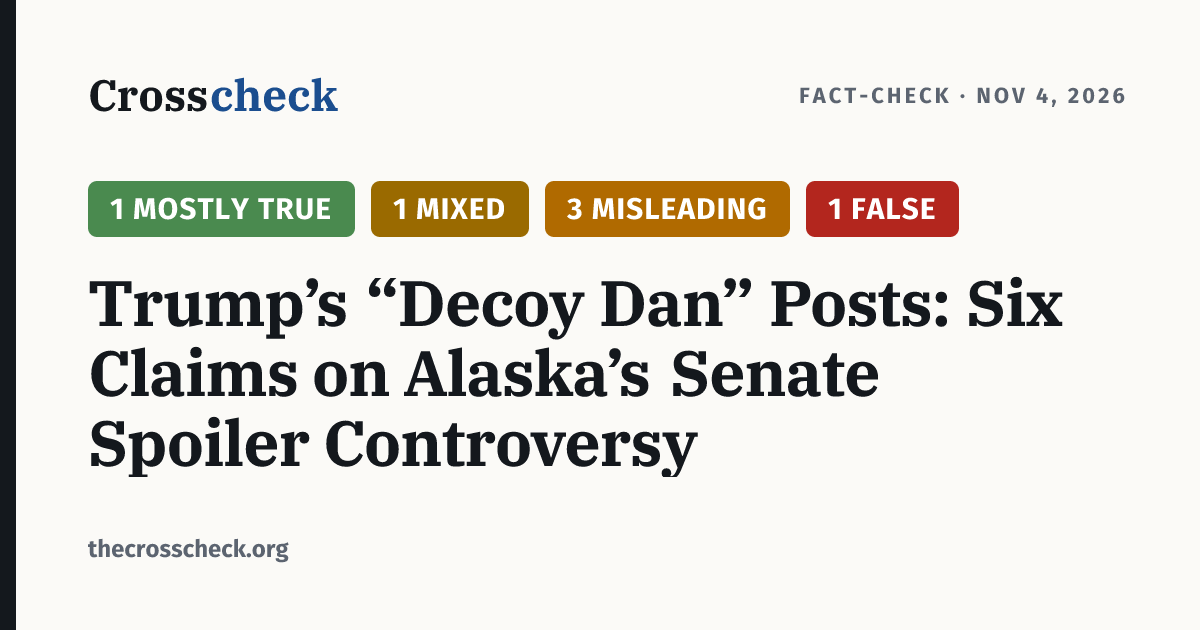
On November 1, 2026, President Trump posted about this on Truth Social. He made several claims. This fact-check rates each one.
Claim 1: The NYT Revealed a Democratic Election-Rigging Scheme
Verdict: Misleading.
The Times did report on the recruitment effort. That part is true. But the Times did not call it an “election-rigging scheme.” Election lawyers who reviewed the case said recruiting a same-name candidate is “unsavory but not illegal.” The word “admitted” is also wrong. The Times investigated and published what it found. That is not an admission of anything.
Claim 2: DOJ Opened a Criminal Investigation with Grand Jury Subpoenas
Verdict: Mostly True.
The DOJ did open a criminal investigation. Federal prosecutors issued more than 100 grand jury subpoenas and sent at least 20 target letters to Democratic operatives. That investigation is real. The claim says subpoenas were “expected,” but by the time it was posted, the subpoenas had already been sent. No one has been charged with a crime.
Claim 3: Peltola’s Campaign and Operatives Were Behind the Scheme
Verdict: Mixed.
Peltola’s campaign aides and the DSCC did run a ballot composition project that included searching for people named Dan Sullivan to recruit into the race. Peltola’s former campaign manager told the Times that Peltola was “definitely aware” of this. But the former manager later tried to take those words back. Peltola herself says she knew nothing about other candidates besides herself and the incumbent. The aides’ involvement is documented. Peltola’s personal role is disputed.
Claim 4: This Is a Criminal Conspiracy That Should Disqualify Peltola
Verdict: False.
No charges have been filed against anyone. Courts have dismissed two lawsuits that tried to block the election results or delay certification. Election scholars called the administration’s legal argument one of the weakest they had seen. There is no legal rule that lets a court remove a Senate candidate because of what campaign aides did. This claim goes far beyond what the evidence supports.
Claim 5: Democrats Are Trying to Rig the Race
Verdict: Misleading.
Some Democratic operatives did recruit a same-name candidate. But “rig” means illegal tampering. Election lawyers say ballot stacking is a legal tactic, used at times by both parties. It is controversial, but not established as a crime. Also, Alaska uses ranked-choice voting in the general election. Under that system, if a voter accidentally ranks the wrong Sullivan first, their vote still counts toward their second choice. The spoiler effect is weaker than Trump’s post suggests.
Claim 6: Sullivan Disappeared, Committed a Crime, and Elias and Eisen Are Responsible
Verdict: Misleading.
Three separate sub-claims are bundled here.
Sullivan “disappeared”: He left his hometown before the Times story published. A witness saw him board a flight to Anchorage. His final destination was unknown. No law enforcement agency said he was missing or could not be found.
Sullivan “committed a criminal act”: No criminal act has been confirmed. No charges have been filed. No arrest warrant has been issued.
Marc Elias and Norm Eisen are responsible: Marc Elias, a Democratic election lawyer who worked for the Peltola campaign, received a DOJ target letter. His specific role in the recruitment is not documented by any investigative reporting. He denied wrongdoing and called the probe a “sham.” Norm Eisen appears in no mainstream investigative reporting on the Alaska spoiler recruitment. The only source naming him in connection to Alaska is Trump’s own post. This sub-claim about Eisen is not supported by any evidence.
What the Post Implies
The post implies Sullivan is a fugitive being hunted by law enforcement. He is not. He left town voluntarily. The post implies Elias and Eisen are criminal masterminds worse than Sullivan himself. No evidence supports this for Eisen. For Elias, only a target letter exists. The post also implies the decoy candidate could change the outcome of the race. In the primary, Sullivan Jr. received 2.5% of the vote. Even if all those votes had gone to Senator Sullivan, he still would have trailed Peltola. In the general election, ranked-choice voting reduces the decoy’s impact further.
What This Means
The recruitment effort documented by the Times is real and significant. Democratic operatives did try to shape the ballot to help their candidate. That is a legitimate story. But Trump’s post mixes those documented facts with unsupported claims about disappeared persons, confirmed crimes, and specific individuals who have no documented Alaska connection. The result is a mix of true elements and false ones, which makes the overall post misleading.
What to Watch
Alaska must certify its election results by December 3, 2026. The DOJ appealed the court ruling that dismissed its lawsuit. Watch for whether any criminal charges are actually filed, and whether any evidence surfaces connecting Norm Eisen or Marc Elias to the specific recruitment of Daniel J. Sullivan Jr.
Sources
- 2026 United States Senate election in Alaska
- Peltola campaign and national Dems recruited spoiler candidates, including Petersburg Sullivan, according to New York Times report
- Explaining the Case of the Two Dan Sullivans on Alaska’s Ballot
- NYT report: Peltola team accused of searching for Dan Sullivans to be on Senate ballot
- Justice Department identifies potential targets as it escalates Alaska Senate criminal probe
- Peltola denies knowing about Alaska spoiler candidate as Justice Department escalates investigation
- Judge tosses DOJ lawsuit seeking to delay certification of Alaska Senate race
- Alaska’s two ‘Dan Sullivans’: How common is ballot stacking, does it work?
- Daniel J. Sullivan left his Alaska hometown before Senate election, sources say
- Democratic attorney and Trump foe Marc Elias is a target of DOJ’s Alaska ballot investigation, sources say
- Alaska Senate: Peltola campaign aides helped recruit second Dan Sullivan, NYT
- Alaska’s governor orders a probe into Peltola’s Senate campaign over spoiler candidate controversy
- Three Bob Fergusons and two JFKs: A brief history of same-name ballot shenanigans
- Trump Truth Social post, Status 117542836979977717