Context and Sourcing
Todd Blanche was confirmed as the 87th Attorney General in August 2026 after serving as Acting AG following Pam Bondi’s dismissal on April 2, 2026. He appeared on NBC’s Meet the Press on August 16, 2026, in what was his first comprehensive television interview as the nation’s top law-enforcement officer. The full transcript is published by NBC News.[1]
All broadcast quotations in this fact-check are drawn directly from the NBC News full transcript published at the URL above.[1] Forbes[2] and Salon[3] are cited for secondary context on select points. The Bulwark piece discussed in commentary was not read (paywalled); only its headline and deck are known, and neither is cited here. Will Saletan’s commentary is characterized from its headline framing, not its body.
A. “Stunning Admission” on DOJ Independence
The exchange is confirmed. Welker asked: “Can you pledge that the Justice Department will always act independently of the White House?” Blanche answered: “No, I’m not going to pledge that. And no attorney general should ever pledge that.”[1]
Calling this a “stunning admission” raises two problems. First, the word “admission” implies that Blanche conceded something he would prefer to conceal. He was making an affirmative constitutional argument: that a blanket pledge of independence from the White House would prohibit lawful presidential policy direction. His example: “If President Trump says, ‘I want the Department of Justice to go after every violent criminal in this country’ ... what you’re saying to me is I should say, ‘No sir, I’m not gonna do it.’“[1]
Second, and more importantly, the question as posed cannot be answered “yes” by any sitting attorney general without disclaiming lawful presidential authority over departmental priorities. Every AG who has served under every president takes policy direction from the executive. The historical norm that watchdogs defend is something narrower: independence from case-specific prosecution orders targeting or shielding named individuals. Welker’s question collapsed that distinction, and Blanche’s refusal to pledge “always” is not the same as claiming he will accept case-specific prosecution orders.
Frame correction: The better question (which the interview reached but did not fully land) is whether Blanche will refuse to act on case-specific direction to prosecute or protect individuals based on their relationship to the president. That question is addressed under Claim H. The “stunning admission” framing makes the exchange appear more significant than it was on its stated terms, while missing the question that would be damning.
B. “Pardoned Everyone … 172 Assault Pleas”
The 172 figure is accurate. Just Security’s comprehensive January 6 pardon analysis found that 172 defendants pleaded guilty specifically to assaulting law enforcement officers, and all received clemency in the January 2025 action.[4]
“Pardoned everyone,” however, is imprecise. Of approximately 1,583 total January 6 defendants, all but 14 received full pardons. The 14 exceptions — all convicted of seditious conspiracy, drawn from Oath Keepers and Proud Boys leadership — received commutations (sentence reductions to time served) rather than outright pardons. A pardon wipes a criminal record; a commutation does not. The difference is legally significant.[4]
On proportional terms, 14 out of ~1,583 is under one percent, and all 14 did leave prison. “Pardoned everyone” conveys the practical reality; the technical inaccuracy is the distinction between pardon and commutation for a small fraction of recipients. The number 172 is fully supported and Welker’s framing of scale is accurate; the “everyone” qualifier is what pulls the overall verdict to Mixed.
C. Biden “Pardoned Hundreds and Hundreds” of Violent Offenders
Three errors combine in one sentence, and none can be corrected to salvage it.
The January 17 action (three days before Trump’s inauguration, satisfying “a few days before”) was approximately 2,490 commutations for people convicted of non-violent drug offenses serving “disproportionately long sentences.”[5] PBS NewsHour, the DOJ’s own clemency records, and Biden’s announcement all characterize the recipients explicitly as non-violent.[6] They were also commutations, not pardons.
The only Biden clemency involving violent offenders was the commutation of 37 of 40 federal death sentences to life in prison without parole, issued on December 23, 2024: 28 days before the inauguration, not “a few days.”[6] It also involved 37 people, not “hundreds and hundreds.”
No single Biden clemency action was simultaneously (a) within days of January 20, (b) in the hundreds, and (c) predominantly violent. Blanche combines two separate actions, mischaracterizes the nature of the larger one, inflates timing for the smaller one, and uses “pardoned” when both were commutations. The overall claim is false.
D. Anti-Weaponization Fund: “No Fund, No Money, No Commissioners”
All three specific claims are accurate as of August 16, 2026. On August 3, 2026, Acting AG Blanche formally rescinded the $1.8 billion anti-weaponization fund established by a May 2026 executive order, which had been designed to compensate individuals Trump considered political targets. The written rescission confirmed: no members appointed to the fund’s commission, no funds transferred from the Treasury, no claims paid.[7][8] The rescission secured Republican Senators Thom Tillis and John Cornyn, who had placed a hold on Blanche’s confirmation, and cleared the path for his Senate confirmation vote.
What Blanche did not answer is notable. Welker asked whether a January 6 defendant could be compensated through other channels, specifically naming the DOJ judgment fund and the Federal Tort Claims Act. Blanche declined to rule that route out. A rescission of the specific fund does not extinguish other statutory compensation pathways, and the rescission itself is revocable by any future Attorney General without congressional action. Trump has continued to publicly state that those he views as unjustly targeted deserve compensation, leaving the durability of this rescission uncertain.
E. DOJ “Has Lost 22 Cases” on Voter Rolls
The University of Wisconsin Law School State Democracy Research Initiative tracks all DOJ lawsuits seeking state voter registration data.[9] As of the date of this fact-check (August 18, 2026), the tracker shows 23 district court dismissals across 23 states — one more than Welker cited. The discrepancy likely reflects a dismissal entered in the two days between broadcast (August 16) and this check, or a slightly different counting methodology. The Sixth Circuit’s August 14 affirmance of Michigan’s dismissal (denial of en banc rehearing) was an appellate ruling, not a new district dismissal, and may or may not be what either Welker or the tracker counts as a “case.”
The bigger context both participants missed: the Department of Justice settled with Oklahoma on March 24, 2026, with the state agreeing to hand over its complete voter registration database. That is the one outcome in the entire campaign where DOJ obtained the data it sought.[10] A “0-for-everything” narrative — implied by “lost 22 cases” — omits this. Seven suits remain pending at the district court level; multiple circuit appeals are unresolved.
Welker’s claim is approximately right on the loss count. Its framing obscures DOJ’s one affirmative result.
F. The Reflecting Pool Exchange
The facts underlying this exchange require some unraveling. In July 2026, the DOJ moved to dismiss a felony indictment against former U.S. Olympic canoeist David Hearn for allegedly vandalizing the Lincoln Memorial Reflecting Pool. The dismissal followed a renovation project that installed a new liner under a $14 million contract with a July 4 deadline for America 250 celebration events. After the liner began peeling, prosecutors reviewed the evidence and concluded the damage stemmed from contractor error.
The DOJ filing, as reported by CBS News and NPR, stated the damage was “the result of flawed installation by the contractor, Atlantic Industrial Coatings, and the rush to complete the project prior to events associated with the America 250 celebration.”[11] A National Park Service employee reportedly noticed peeling sealant shortly after the pool was refilled, before Hearn’s visit. Prosecutors also wrote that the Interior Department “had provided less than fulsome information at the outset of this case.”[12]
Blanche’s “all of the damage” qualifier is a semantic hedge. The filing characterizes the damage as resulting from the contractor (a causal attribution, not a partial one) without using the word “all.” His claim that the media was “getting some of the reporting wrong” for omitting “all” is technically possible but requires crediting a distinction the filing itself does not draw. The separate filing language noting it was “difficult to attribute the widespread damage to vandalism, let alone establish that fact beyond a reasonable doubt” further undercuts the “all” hedge.
On witnesses: while there are reports of individuals splashing in the pool, the filing’s own standard (“difficult to attribute”) does not match Blanche’s confidence that “we know there was vandalism.” The case against other Reflecting Pool defendants was also dropped. This portion of his statement is unverified and conflicts with the DOJ’s own assessment. Overall: Mixed. The “all” qualifier has thin defensibility; the witnesses claim is not supported by the filing.
G. “I Absolutely Support U.S. Attorney Pirro — As Does President Trump”
Trump posted to Truth Social on August 1, 2026: “I disagree 100% with Jeanine Pirro, the U.S. Attorney for the District of Columbia, on the Reflecting Pool. I don’t know what she was thinking? To me, it was a pure case of VANDALISM.”[13] Interior Secretary Doug Burgum also publicly rejected the DOJ’s conclusions about the Reflecting Pool damage. Trump did not fire Pirro after the post.
A president can maintain confidence in an official generally while disagreeing with a specific decision, and Blanche may have meant “support” in that broader institutional sense. In the context of the Reflecting Pool exchange, however, the natural reading of “as does President Trump” is that Trump endorses Pirro’s handling of the case, a reading directly contradicted by Trump’s own public statement. Blanche’s “absolutely” is unearned given the record.
The fairest reading is that Trump supports Pirro as a U.S. Attorney overall, evidenced by not firing her. That does not excuse asserting Trump’s agreement with a specific decision Trump publicly called wrong.
H. Trump “Has Never” Directed Prosecutions
This is the central claim of the interview, and the public record directly contradicts it.
On September 20, 2025, Trump posted to Truth Social what a White House official later confirmed was intended as a private direct message to then-AG Pam Bondi. The post, addressed to “Pam,” named James Comey, Adam Schiff, and Letitia James: “They’re all guilty as hell, but nothing is going to be done … We can’t delay any longer, it’s killing our reputation and credibility.”[14] White House aides told NBC News that Trump “was surprised to learn he had actually posted the message to his Truth Social account.”
What followed: Comey was indicted 5 days later on September 25, 2025, charged with lying to Congress.[15] James was indicted 19 days later on October 9, 2025, charged with mortgage fraud.[16] Both moved to dismiss on grounds of vindictive prosecution, citing the Truth Social post. DOJ defended the post in its court filings. Both indictments were dismissed on November 24, 2025 — not on the merits, but because the presiding judge found that interim U.S. Attorney Lindsey Halligan had been unlawfully appointed under the Appointments Clause of the Constitution.[17] DOJ appealed, and Bondi was fired April 2, 2026, with reporting citing her failure to deliver prosecutions of the president’s opponents among the precipitating factors.[18]
The strongest defense: Blanche said Trump doesn’t “call me,” a phrase that grammatically limits the claim to phone calls to himself. Nothing in the record establishes that Trump has phoned Blanche and named a prosecution target. The Bondi episode predates Blanche’s tenure as AG. A reasonable reading of “calls ME” is a first-person account limited to Blanche’s own interactions.
That defense does not rescue the unqualified “he has never done that” and “he will never do that.” Those phrases assert that Trump has never, in any form, directed the Justice Department toward specific individuals, a claim the documented September 2025 post and its aftermath contradict. One question before the “never” denial, in the exchange that immediately preceded Welker’s Barr question, Blanche had said: “Will I take the president of the United States’s view on something into consideration? Yes, of course. And I hope every attorney general in history would not answer that question differently.” He continued: “So if he has a view on that, he talks about it on social media … That’s certainly something that I listen to.”[1] The gap between saying he takes the president’s view on specific cases into consideration and saying the president has never directed him to prosecute anyone is precisely what the interview left unresolved.
This fact-check does not assert that Blanche was consciously alluding to the Bondi episode. That is an intent claim not knowable from the transcript. Welker, for her part, never raised the September 20 post during the exchange.
I. Barr “Told Him” Claims Were “Detached from Reality” in 2020
The phrase “detached from reality” is authentic Barr language, but the source and mode of delivery require precision. The phrase appeared in Barr’s videotaped deposition testimony to the House January 6 committee, played publicly at the committee’s June 13, 2022 hearing.[19] In that testimony, Barr described his private thought at a December 2020 Oval Office meeting after Trump cited an “amateurish” report about Dominion voting machines: “I thought, boy, if he really believes this stuff, he has lost contact with — he’s become detached from reality.”
That is a description of Barr’s internal reaction, not a statement Barr made to Trump’s face. “Told him” implies a direct communication that the record does not document for those specific words. What Barr did say to Trump in 2020 is well-documented: in an AP interview on December 1, 2020, Barr stated the Justice Department had found no evidence of fraud “on a scale that could have affected a different outcome in the election,” calling specific claims about Dominion machines “crazy stuff.” He said directly to Trump in multiple meetings that fraud allegations were unsupported.
The substance of Welker’s point is accurate and well-sourced: Barr directly contradicted Trump’s election fraud claims. The attribution “told him [his claims were] detached from reality” conflates Barr’s public testimony about his private thought with a direct statement to the president. Rate: Mostly True. Substance right, attribution slightly off.
Analysis: Blanche’s Posture and the DOJ Independence Standard
This section compares Blanche’s stated posture to the documented independence standard. The comparison is normative, not factual; the sources below are primary materials, but the weighing is editorial.
The Levi-Bell tradition
The modern DOJ independence framework was built after Watergate by two attorneys general. Edward Levi (1975–1977), the University of Chicago law professor Gerald Ford chose to restore Justice’s credibility, said at his swearing-in: “Nothing can more weaken the quality of life or more imperil the realization of the goals we all hold dear than our failure to make clear by words and deed that our law is not an instrument of partisan purpose.”[20] Levi created the Office of Professional Responsibility, codified the federal prosecution guidelines, and established the original White House contacts policy — which limited communication between the White House and the Justice Department on pending cases.
Griffin Bell (1977–1979) called for DOJ to be a “neutral zone in the Government” and described the principle that “they must be perceived by the American people as being free” to exercise professional judgment.[21] The Justice Manual’s current language on impartiality descends from this tradition, requiring that charging and investigative decisions be “free from partisan considerations.”
On this standard, Blanche’s posture departs from the Levi-Bell framework. When he said “that’s certainly something I listen to” about the president’s social media views on prosecutions, he described a practice the Levi-Bell framework was designed precisely to prevent: political signals reaching specific cases.
The counterweight: Trump v. United States (2024)
Blanche’s position, however, tracks the current constitutional doctrine more closely than the Levi-Bell tradition does. The Supreme Court’s 6–3 ruling in Trump v. United States (2024) held that a president has absolute immunity for acts within his “conclusive and preclusive” constitutional authority, and explicitly treated a president’s discussions with the Department of Justice about investigations as falling within that core.[22] Sotomayor’s phrase “king above the law” appeared in the dissent, and it did not carry the day. Independence is a departmental norm, not a statute. The AG serves at the president’s pleasure and can be dismissed without cause, as Bondi’s removal illustrates. Blanche’s argument that a blanket pledge of independence would disable lawful presidential policy direction is constitutionally coherent under current doctrine.
The Levi-Bell framework and the current Court’s immunity framework are in genuine tension. Blanche occupies the doctrinal ground; critics occupy the normative ground built over fifty years of practice.
The White House contacts policy: a verification gap
One question this fact-check cannot fully close is whether the White House contacts policy (originally established under Levi and codified in the Justice Manual at Section 1-8.600) remains operative. At his October 2025 Senate confirmation hearing, Criminal Division nominee Tysen Duva stated that a “blanket memo” at the start of the administration had “rescinded prior policies, including the contacts policy,” and that a replacement was “forthcoming.”[23] Duva subsequently sent a corrective letter saying he had “inadvertently misspoken,” and that the Biden-era contacts policy “remains in force.” As of August 2026, Bloomberg Law found no published replacement policy.
The practical significance: if the contacts policy technically remains in force (per Duva’s correction), then Blanche’s statement that he “listens to” Trump’s social media views on prosecutions may implicate the existing policy. If the policy was effectively suspended without a replacement, Blanche is operating where the written guardrail no longer exists. This fact-check flags the ambiguity; the answer depends on internal DOJ communications not in the public record.
The “loyalist” question: a characterization, not a rated claim
Commentary has characterized Blanche as a “loyalist” rather than an independent law-enforcement officer. This is a characterization, not a fact, and the record runs both ways.
Items supporting the characterization: U.S. District Judge Kathleen Williams referred Blanche and Associate AG Stanley Woodward to the New York and D.C. bars for potential discipline after finding his May 2026 congressional testimony about a tax audit settlement that shielded Trump, family, and businesses from certain federal claims was “at best, misleading and, at worst, disingenuous.”[24] The New York City Bar Association formally opposed his AG nomination, citing concerns about commitment to impartiality. A bar complaint backed by 101 former judges was filed. As Deputy AG, Blanche conducted a nine-hour interview of Ghislaine Maxwell on July 24–25, 2025, having previously served as Trump’s personal defense attorney; Maxwell was transferred to minimum-security prison within days of that interview.[25]
Items against the characterization: Blanche rescinded the $1.8 billion fund Trump wanted and did so to secure his own confirmation, a case where institutional interest aligned with independence. His own U.S. Attorney (Pirro) dropped the Reflecting Pool case over Trump’s explicit public objection, and Blanche did not override her. He stated in the interview: “if there’s something that he wants to do, that he needs to know that there’s a challenge or that we can’t do it, of course, I will tell him. It happens all the time with all of his leaders.”[1] No specific instance of such pushback has been made public, which leaves the claim unverifiable on its own terms. These are, at minimum, constraints on the simple loyalist framing.
What happened
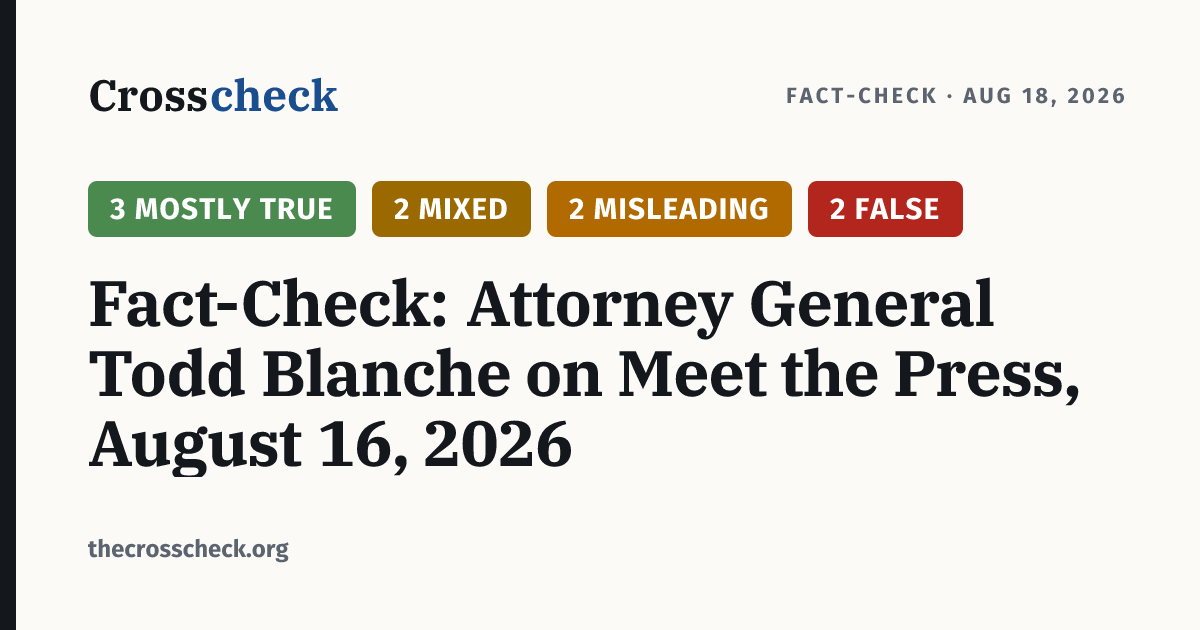
Todd Blanche became Attorney General (the nation’s top law enforcement officer) in August 2026 after the previous AG, Pam Bondi, was fired. On August 16, he appeared on NBC’s Meet the Press, where host Kristen Welker asked him about the Justice Department’s relationship with the White House, January 6 pardons, and other topics. We checked nine specific things they each said.
A. Did Blanche make a “stunning admission”? — Misleading
Welker asked Blanche to promise that the Justice Department would “always act independently of the White House.” He said no. Some commentators called this a “stunning admission.”
That framing is misleading. The question as written was one no attorney general could honestly answer “yes” to, because the president is allowed to set priorities for the Justice Department — like focusing on violent crime. The real concern is whether the president directs specific prosecutions of named individuals. That’s a different question, and it was addressed separately (Claim H below).
B. Were 172 Jan. 6 defendants who pleaded guilty to assaulting police pardoned? — Mixed
The number 172 is accurate. That many people who pleaded guilty to assaulting police officers did receive clemency from Trump. But “pardoned everyone” is slightly off. Of roughly 1,583 January 6 defendants, 14 received commutations (a lesser form of relief that reduces a sentence but does not wipe the criminal record) rather than full pardons. All 14 were leaders of the Proud Boys or Oath Keepers convicted of seditious conspiracy.
C. Did Biden “pardon hundreds of violent criminals” days before leaving office? — False
This is false. Three days before leaving office (January 17, 2025), Biden did issue about 2,490 commutations, but all were for non-violent drug offenders. The only Biden clemency that involved violent offenders (commuting 37 death sentences) happened on December 23, 2024 — 28 days before the inauguration, not “a few days.” It also covered 37 people, not “hundreds and hundreds.” Both actions were commutations, not pardons.
D. Was the “anti-weaponization fund” shut down with no money moved? — Mostly True
Blanche formally ended Trump’s $1.8 billion fund on August 3, 2026, which was meant to pay people Trump considered political targets. He was correct that no money had been transferred and no board members had been appointed. But Welker asked whether January 6 defendants could still be paid through other legal channels — Blanche did not rule that out, and the rescission can be reversed by a future Attorney General.
E. Has DOJ “lost 22 cases” on voter rolls? — Mostly True
Approximately right. The Justice Department sued 31 states and Washington, D.C. to get access to voter registration data. As of August 18, 2026, 23 states had courts rule against the DOJ — one more than Welker said. But she missed the one state where DOJ succeeded: Oklahoma settled on March 24, 2026, and gave DOJ its voter data. Seven states’ cases are still in court.
F. What did the Reflecting Pool filing actually say? — Mixed
The DOJ dropped a case against Olympic canoeist David Hearn, who had been accused of vandalizing the Lincoln Memorial Reflecting Pool. The DOJ’s own filing said the damage came from faulty installation by a contractor, not vandalism. Blanche said the filing didn’t say that “all” the damage was from the contractor — but the filing attributes the damage to faulty work without using the word “all.” His separate claim that “witnesses” prove there was vandalism conflicts with the same filing, which said it was “difficult to attribute” the widespread damage to vandalism.
G. Does Trump support U.S. Attorney Pirro? — Misleading
Blanche said both he and Trump “absolutely support” Pirro. But on August 1, 2026, Trump posted publicly that he disagreed “100% with Jeanine Pirro” on the Reflecting Pool case, adding “To me, it was a pure case of VANDALISM.” Trump did not fire Pirro, so he may support her as a U.S. Attorney generally. But saying Trump supports her on this specific case is misleading given his public statement.
H. Has Trump “never” directed Blanche to prosecute someone? — False
This is the most important claim in the interview, and it’s false on the broader record. On September 20, 2025, Trump posted what he meant to be a private message to then-AG Pam Bondi, naming James Comey, Adam Schiff, and Letitia James and saying “They’re all guilty as hell, but nothing is going to be done … We can’t delay any longer.” Five days later, Comey was charged with a crime. Nineteen days later, James was charged. Both cases were later thrown out because the prosecutor Trump had pressured Bondi to use (Lindsey Halligan) had been appointed illegally. Bondi was fired in April 2026. The DOJ itself defended the Truth Social post in court filings in both cases.
Blanche’s specific words were that Trump doesn’t “call me,” limiting the literal claim to phone calls to Blanche himself. Nothing shows Trump has called Blanche on the phone and named a target. But Blanche also said Trump has “never” done it in general, and the Bondi episode contradicts that broader claim. In the exchange one question before the “never” denial, Blanche had said: “Will I take the president of the United States’s view on something into consideration? Yes, of course.” He also said Trump “talks about it on social media … That’s certainly something that I listen to.” So in the same interview, he affirmed taking presidential views into consideration on cases, then denied the president has ever directed him — the gap between those two statements was never bridged.
I. Did Barr tell Trump his election claims were “detached from reality” in 2020? — Mostly True
The phrase “detached from reality” is real and it came from Bill Barr, but it appeared in his congressional testimony in 2022, describing what he privately thought in 2020, not something he said to Trump’s face. What Barr told Trump in 2020 was that the fraud claims weren’t supported by evidence. That supports Welker’s point. The specific phrase she used describes Barr’s private thought, not words he spoke aloud to the president.
The bigger picture
Blanche’s position has real legal support: the Supreme Court’s 2024 ruling in Trump v. United States treated presidential discussions with the Justice Department as within the president’s core authority. But the 50-year tradition built after Watergate by Attorneys General Levi and Bell was designed precisely to protect specific cases from political pressure. These two standards are in genuine tension, and Blanche’s interview put him clearly on the constitutional-authority side of that line.
Sources
- Meet the Press – August 16, 2026
- Todd Blanche Refuses to Pledge DOJ Independence From Trump
- Todd Blanche’s dangerous lie sets the stage for more DOJ abuses
- What Just Happened: Trump’s January 6 Pardons and Assaults on Law Enforcement Officers By The Numbers
- Biden commutes sentences of nearly 2,500 people convicted of nonviolent drug charges
- Commutations Granted by President Joseph Biden (2021–2025)
- Blanche rescinds $1.8B anti-weaponization fund in push for confirmation
- Acting AG Todd Blanche reaches deal with holdout senators to scrap $1.8B ‘anti-weaponization’ fund
- Tracker: DOJ Lawsuits Seeking States’ Sensitive Voter Data
- Drummond enters settlement with DOJ to safeguard voter registration data
- DOJ moves to dismiss Reflecting Pool vandalism charges against David Hearn
- After his Reflecting Pool vandalism case is dismissed, David Hearn looks for closure
- Trump rebukes Jeanine Pirro over decision to drop Reflecting Pool vandalism case
- Trump accidentally posted message pressuring Pam Bondi to charge his enemies, source says
- Former FBI Director James Comey indicted following pressure from Trump
- New York State Attorney General Indicted
- Judge dismisses cases against James Comey and Letitia James after finding prosecutor was unlawfully appointed
- Trump fires Pam Bondi as attorney general
- Barr calls Trump’s fraud claims ‘detached from reality’ in Jan. 6 panel testimony
- Remarks for Swearing-In Ceremony of Edward Levi, Attorney General
- Former U.S. Attorney General Griffin Bell speaks on DOJ
- Trump v. United States
- Trump DOJ to Soon Update Policy on Contacts With White House
- Judge refers Trump’s attorneys for potential disciplinary action over IRS lawsuit
- DOJ Interview Transcript — Ghislaine Maxwell, July 24, 2025 (Redacted)