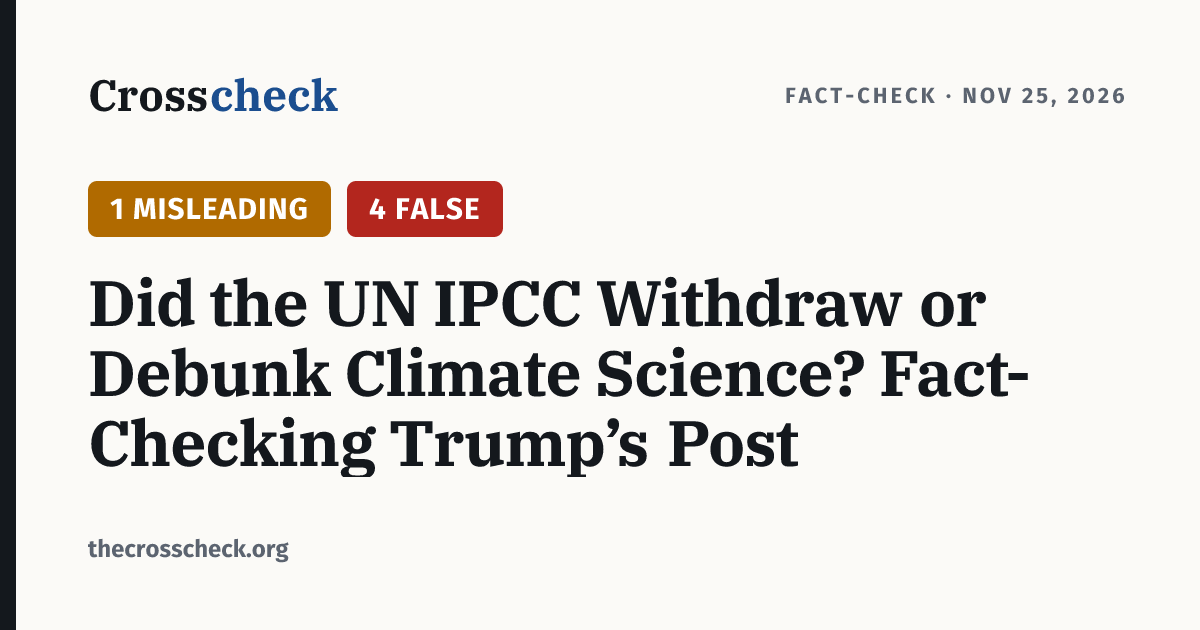
The Post
On November 23, 2026, one day after the UN climate conference COP31 collapsed in Antalya, Turkey, President Donald Trump posted the following on Truth Social:
This is not the first time Trump has made this claim. He posted a nearly identical assertion in May 2026, when the underlying scientific paper was published.[2] The November post amplifies and broadens those earlier claims, asserting a wholesale collapse of climate science rather than a revision to one scenario family. The November version also adds the claim that the IPCC “determined they are not reliable” — language that did not appear in the May posts.
Below is a verdict summary, followed by a full analysis of each claim.
| Claim | Verdict |
|---|---|
| The UN IPCC debunked, withdrew, and took down its climate projections | False |
| The IPCC determined its projections “not reliable” | False |
| “No more catastrophic predictions” from the IPCC | False |
| Climate scientists “always” called their assumptions “settled science” | Misleading |
| Implied: The scientific consensus on human-caused warming has collapsed | False |
What Actually Happened
To evaluate Trump’s post, it helps to understand what the underlying development actually was.
On April 7, 2026, a team of climate modelers led by Prof. Detlef van Vuuren of Utrecht University published a paper in the journal Geoscientific Model Development.[4] The paper designed a new set of emissions scenarios for CMIP7 (Coupled Model Intercomparison Project 7), the international modeling framework whose outputs are used in IPCC assessment reports. In that paper, the authors concluded that the previous high-end scenario, known as SSP5-8.5 (also called RCP8.5), had “become implausible” for this century, based on declining costs of renewable energy, emerging climate policy, and actual emissions trends. The authors dropped SSP5-8.5 from the new scenario set and replaced it with a lower high-end scenario projecting roughly 3.3–4°C of warming by 2100 (versus the old scenario’s 4.3–4.5°C).
Three things about this development are essential context for evaluating Trump’s post:
First, the IPCC did not make this decision. The CMIP7 ScenarioMIP paper is the work of independent researchers coordinated by the WCRP (World Climate Research Programme). The IPCC assessed the scenarios produced by others; it neither created nor retired them. The IPCC issued an explicit statement in May 2026: “The IPCC does not conduct its own research, run models or make measurements. It does not own the scenarios described in the mentioned paper, nor does it own any of the scenarios assessed in the sixth assessment report.”[2]
Second, no IPCC report was withdrawn. The AR6 (Sixth Assessment Report), completed in 2023 and representing the most comprehensive review of climate science ever published, remains fully in force. Its central finding, that “human activities, principally through emissions of greenhouse gases, have unequivocally caused global warming,” has not been revised, retracted, or questioned by the IPCC or any major scientific body.[5]
Third, the scenario was retired because the world has partially succeeded at emissions reduction, not because the underlying climate physics were wrong. Van Vuuren explicitly noted that the world is now “on a trajectory to 2.5–3°C of warming” — still severe, though lower than the old worst-case.[3]
Claim 1: “Their Climate Science has now been debunked, withdrawn, and taken down by the UN IPCC”
Claim 1
False“Their Climate Science has now been debunked, withdrawn, and taken down by the UN IPCC.”
This is false on two separate grounds.
The IPCC has not withdrawn any climate science. The organization’s most recent comprehensive output, the AR6 Synthesis Report (2023), is current and unretracted. The IPCC is in the process of preparing AR7, whose first working group reports are expected to be reviewed starting in 2027. Work on that report is active, not suspended.[6]
The IPCC also did not make the scenario revision that Trump references. That revision was made by a team of independent climate scientists (van Vuuren et al.) under CMIP7, coordinated by the WCRP. The IPCC has explicitly stated it did not own or produce those scenarios. AR7 lead author Zeke Hausfather responded to Trump’s claim directly: “I have absolutely no idea what our president is talking about here. We have not ‘withdrawn’ any climate science that I’m aware of.”[7] IPCC AR7 Working Group I co-chair Dr. Robert Vautard clarified separately: “IPCC does not produce scenarios. CMIP7 will be [one] set of scenarios assessed by IPCC [for AR7], but there will be many others.”[3]
Even Commerce Secretary Howard Lutnick’s characterization that “the international scientific community has rejected and withdrawn its most extreme assumptions” is disputed by the scientists who actually did the work, who emphasized the revision reflected improved emissions trajectories, not a repudiation of climate science’s core findings.[8]
Claim 2: “The same organization that published these projections as ‘settled science’ has now determined they are not reliable”
Claim 2
False“The same organization…has now determined they are not reliable and have withdrawn them.”
The IPCC has never described its own projections as “not reliable.” This characterization appears nowhere in any IPCC statement or report. The IPCC’s standard practice is to assign confidence levels (such as “virtually certain,” “very likely,” or “likely”) to findings, and its core conclusions on human-caused warming carry the highest possible confidence rating: “unequivocal.”
The retirement of SSP5-8.5 by CMIP7 scientists was not framed as a correction for unreliability. Van Vuuren noted that RCP8.5 “is a low-probability, high-risk scenario and it was always meant like that” and that it was “never a likely outcome.”[3] Dr. Chris Smith of IIASA explained that the new scenarios represent partly good news: “We’ve actually bent the curve enough to eliminate that possibility” of the extreme high-end. But he also noted the world “remains on a trajectory to 2.5–3°C of warming.”[2]
Labeling these projections as “not reliable” inverts the actual reason for the update: a worst-case-scenario path was retired because real-world trends moved away from it. The basic physics of CO₂-induced warming, and the IPCC’s assessments of it, are unaffected.
Claim 3: “No more catastrophic predictions. GONE! GONE! GONE!”
Claim 3
False“No more catastrophic predictions.”
The new CMIP7 high-emissions scenario still projects approximately 3.3–4°C of warming by 2100.[4] Every scenario in the new framework still exceeds the Paris Agreement‘s 1.5°C target. Johan Rockström of the Potsdam Institute stated that even at the lower warming projections, “we enter danger.”[9]
The IPCC AR6’s findings that “every increment of global warming will intensify multiple and concurrent hazards” and that “roughly 40% of the global population is considered highly vulnerable” remain fully intact. AR6 projected that heatwaves could occur 4–9 times more frequently at just 1.5°C of warming compared to the pre-industrial baseline. The retirement of one extreme scenario has not removed these findings from the scientific record.
The claim that there are “no more catastrophic predictions” has no basis in anything the IPCC, CMIP7, or any mainstream scientific body has published.
Claim 4: “Climate Change activists always described their Extreme Climate Science assumptions as ‘settled science’“
Claim 4
Misleading“Climate Change activists always described their Extreme Climate Science assumptions as ‘settled science.’“
The phrase “settled science” is a political shorthand, not an IPCC formulation. The IPCC does not use it. The organization uses a formal calibrated-uncertainty language (Table SPM.1 of AR6 defines terms from “virtually certain” to “unlikely”), reflecting the nuanced confidence levels in a complex scientific field.
Some politicians and advocates have used “settled science” loosely to defend the consensus on human-caused warming. That phrase, when applied to the core finding of anthropogenic greenhouse gas forcing, reflects the actual state of agreement: studies find 97–99% of actively publishing climate scientists accept that humans are causing current warming, with the highest-publication researchers reaching 100% agreement.[10]
But there are two problems with Trump’s framing. First, “settled science” was typically used to defend the core finding of human-caused warming, not the specific scenario of SSP5-8.5, which was always labeled a worst-case pathway, not a prediction. Second, the claim conflates “climate science” (the physics of warming) with “emissions scenarios” (projections of future human behavior). The former is settled to the degree any empirical science is; the latter has always been explicitly conditional on future energy and policy choices.
The claim is misleading rather than outright false because it rests on a real (if imprecise) communication pattern — some advocates have overstated scientific certainty about specific outcomes. But the post weaponizes this communication shortfall to imply that the fundamental science of human-caused climate change has been discredited, which is not supported by the evidence.
The Case for Trump’s Reading
The strongest version of the argument Trump’s post is making does not depend on the IPCC formally withdrawing anything. It goes like this: for more than a decade, RCP8.5 was the scenario most prominently used in academic papers, policy documents, news coverage, and activist messaging. If that scenario was always labeled “low-probability,” that label was not communicated to the public. Research has since documented that many peer-reviewed studies used RCP8.5 as a central or default case rather than as a tail risk. Some climate scientists, including Zeke Hausfather (who is himself an AR7 lead author), have written critically about this overuse. The retirement of SSP5-8.5 represents a belated correction to a scenario that did function in public discourse as a de facto prediction of catastrophe, even if it was not scientifically framed that way.
This argument scores 3 out of 5 on the adversarial rubric: it identifies a real communication failure and a real overcorrection in public scenario use. But it does not support the specific claims in Trump’s post: that the IPCC withdrew anything, that projections were “not reliable,” or that there are “no more catastrophic predictions.” It supports a narrower claim — that the most extreme scenario family was misapplied in some high-profile contexts. That is not what the post asserts.
Who Is Involved and What Is at Stake
The timing of Trump’s post is not incidental. It was published on November 23, 2026 — the day after COP31 collapsed in Antalya, Turkey, without reaching a final agreement for the first time since the Copenhagen conference in 2009.[1] COP31 broke down because negotiators could not agree on whether to explicitly name fossil fuels as the driver of climate change. The EU, Pacific island states, and others rejected a final draft text that removed all fossil-fuel language, while oil-producing states resisted stronger commitments.
The IPCC itself is separately in institutional crisis. Its 65th session in Addis Ababa (October 2026) ended without agreement on the AR7 timeline for the sixth consecutive time since 2024. India, Russia, Saudi Arabia, and Kenya have opposed the schedule that would deliver AR7 reports in time to inform the second global stocktake at COP33 in 2028. The IPCC has been forced to shift in-person meetings to virtual sessions due to budget constraints.[6]
What is at stake is not primarily a scientific question — the physics of CO₂ forcing are not disputed by any credentialed national meteorological institution, and over 99% of peer-reviewed literature agrees on human causation. What is at stake is the political and policy use of that science. If the scenario revision can be successfully characterized as a wholesale repudiation of climate science, it weakens the scientific argument for emissions reduction at a moment when international climate diplomacy is already under stress.
The US under the current administration has sought to withdraw from IPCC participation and from the UNFCCC. Trump’s post appeared in a context where undermining the IPCC’s credibility serves a stated policy goal.
Precedent: Has the IPCC Ever Retracted a Report?
Compared against: the full 36-year publication record of the IPCC (Assessment Reports AR1–AR6, plus Special Reports), and the history of major scientific consensus revisions.
In its 36-year history, the IPCC has never withdrawn a full assessment report. AR1 (1990) through AR6 (2021–2023) remain in the scientific record. Individual errors have been acknowledged and corrected — most notably the “Himalayagate” episode during AR4 (2007), when a paragraph projecting Himalayan glacier disappearance by 2035 was acknowledged as an error and corrected. But that correction applied to one paragraph in one chapter; the report itself was not retracted, and the core findings were unaffected.
By comparison, the kind of wholesale repudiation Trump describes — an institution declaring its own published work “not reliable” and withdrawing it — has no precedent in IPCC history. It would have no precedent in the history of any major intergovernmental scientific body. Scientific consensus revisions do occur: the shift on stomach ulcers (H. pylori, 1980s–90s) and the evolution of dietary fat science are frequently cited examples. In both cases, the revision came through accumulating new evidence published over years, not through an institution declaring its own prior work unreliable in one announcement.
Trump’s post implies the former occurred. It did not.
What the Post Implies
Beyond its explicit claims, a reasonable reader of Trump’s post would likely take away two additional things the post never states directly:
Implied 1: The scientific consensus on human-caused climate change has collapsed or been officially abandoned.
Implied Claim
FalseImplied: The scientific consensus on human-caused climate change has collapsed.
This is false. The IPCC AR6 (2023) states that human-caused warming is “unequivocal” — the highest confidence designation in IPCC usage. Studies find 97–99% of actively publishing climate scientists agree on human causation.[10] No major national meteorological institution, national academy of science, or intergovernmental scientific body has reversed or qualified its position on anthropogenic warming. The scenario revision leaves the basic atmospheric physics and attribution science completely intact.
Implied 2: Trump’s withdrawal from the Paris Agreement and IPCC process is vindicated by science.
This is a political and policy inference that no scientific body can settle. Whether policy choices follow or diverge from the scientific record is a matter of democratic judgment, not factual determination. No rating is assigned; the factual claims underlying the policy argument are addressed in claims 1–4 above.
What This Means Going Forward
The retirement of SSP5-8.5 by CMIP7 scientists does represent a meaningful scientific update. The world’s emissions trajectory has improved from the absolute worst-case path, which is a genuine positive development. That the most extreme scenario has become implausible is itself evidence that some climate policy has had measurable effect — a point climate advocates could and should make.
What this finding does not do is change the remaining projected warming of 2.5–3°C under current policies, the IPCC’s core findings about human causation and ongoing impacts, or the relationship between future emissions and future temperature. The gap between Trump’s characterization and the actual development is so wide that it represents a category error: treating a scenario update as the equivalent of an institutional retraction of core scientific findings.
For the ongoing AR7 process, Trump’s post creates additional political pressure on a body already in administrative deadlock over its publication schedule. The IPCC’s credibility as a source of scientific synthesis rests on its independence from political interpretation; claims that it has discredited its own work, made without basis, complicate that position for member governments that have used it as political cover to resist timeline pressure.
For the public, the distinction that matters is this: scenarios are maps of possible futures based on assumed human choices. When one map is updated because actual choices changed, that is scientific progress. It does not invalidate the physics of the terrain. Trump’s post conflates the map revision with the terrain disappearing.
Parties Affected
| Party | Effect | Rationale |
|---|---|---|
| IPCC and CMIP7 scientists | Costs | Their actual work — retiring one scenario because emissions improved — is mischaracterized as a wholesale retraction. This creates reputational risk and additional pressure on the already-deadlocked AR7 timeline. |
| Climate policy advocates | Costs | The false characterization, if accepted, undermines the scientific grounding for emissions reduction policy at a moment when COP31 has already failed to produce a fossil-fuel agreement. |
| Fossil fuel–producing governments | Gains | A narrative that climate science has been self-discredited weakens the scientific case that underpinned COP31 demands to name fossil fuels as the driver of warming. |
| US administration | Gains | Provides a scientific-sounding rationale for existing policy positions on IPCC withdrawal and Paris Agreement exit — positions that predate the scenario update. |
| Climate-vulnerable populations | Costs | Countries most exposed to warming impacts rely on IPCC science to advance financing and adaptation claims in international negotiations. Post-COP31, those claims are already weaker. (Analysis row.) |
Effect labels: Gains = party benefits from this narrative circulating; Costs = party is harmed. Labels describe effects of the false narrative, not of the underlying scenario revision.
What to Watch
- IPCC AR7 timeline resolution. The IPCC’s 65th session failed to agree on a schedule for the sixth consecutive time. A virtual continuation meeting is planned. Watch for whether India, Saudi Arabia, and Russia agree to a timeline that would deliver reports before COP33 in 2028. Failure to agree would leave the next major climate assessment without a delivery date.
- US IPCC participation. The Trump administration has signaled intent to withdraw from IPCC meetings. A formal withdrawal would be the first by any major economy and would remove US author contributions from AR7.
- CMIP7 scenario publication. The first full batch of CMIP7 climate model runs using the new scenario framework is expected in 2027. When those results appear, they will give the clearest picture yet of projected warming under updated emissions pathways. Watch for whether the new high-end scenario still crosses 4°C.
- COP32 emergency session or COP33 preparations. With COP31 producing no agreement, the UN has called for consultations to restore a path forward. Watch for whether a bridging decision on fossil-fuel language can be reached in a consultative process before the next full COP.
What this fact-check is about
On November 23, 2026, President Trump posted on Truth Social that the UN’s IPCC had “debunked, withdrawn, and taken down” climate science. He said the IPCC found its own projections “not reliable” and that there are “no more catastrophic predictions.” This fact-check rates whether those claims are true.
What actually happened
In April 2026, a team of climate scientists published a paper. In that paper, they said one specific emissions scenario — called RCP8.5 — had become implausible. This scenario assumed the world would keep burning lots of fossil fuels with no climate policy. Because renewable energy has gotten cheaper and some climate policies have taken effect, the scientists decided the extreme end of that scenario no longer made sense. They replaced it with a slightly lower worst-case.
That team of scientists was not the IPCC. They worked under a separate program called CMIP7, run by the World Climate Research Programme. The IPCC said clearly in May 2026: “The IPCC does not conduct its own research, run models or make measurements. It does not own the scenarios described in the mentioned paper.”
Claim 1: The IPCC debunked, withdrew, and took down climate projections
Verdict: False.
The IPCC has not withdrawn any climate report. Its last big report, AR6, came out in 2023 and is still fully active. A lead author of the next IPCC report said: “I have absolutely no idea what our president is talking about here. We have not ‘withdrawn’ any climate science that I’m aware of.” The IPCC also told reporters it did not create or own the scenarios being discussed. It was independent scientists — not the IPCC — who retired one extreme scenario.
Claim 2: The IPCC said its projections are “not reliable”
Verdict: False.
The IPCC never said this. The scientists who retired RCP8.5 said that specific scenario had become implausible because actual emissions were trending lower. They did not say climate projections as a whole are unreliable. In fact, the reason they updated the scenario was good news: the world has made enough progress on clean energy that the absolute worst-case path became less likely. The core finding that humans are causing climate change — which the IPCC rates as “unequivocal” — was not changed or questioned.
Claim 3: “No more catastrophic predictions”
Verdict: False.
The new worst-case scenario still projects about 3.3–4°C of warming by 2100. All the new scenarios still exceed the Paris Agreement‘s 1.5°C target. The IPCC’s AR6 found that roughly 40% of the world’s population is highly vulnerable to climate change. Those findings are still on the books. No major scientific body has removed any warning about climate risk.
Claim 4: Climate scientists “always” called their work “settled science”
Verdict: Misleading.
“Settled science” is a phrase used by politicians and advocates, not by the IPCC itself. The IPCC uses careful language like “very likely” and “unequivocal” to describe how confident scientists are in each finding. Some climate advocates have used “settled science” to defend the core fact that humans are causing warming — and that core fact is backed by 97–99% of actively publishing climate scientists. But the specific scenarios like RCP8.5 were always labeled as conditional — things that might happen depending on future choices, not predictions. Trump’s post conflates the two, which is misleading.
What the post implies
Implied: The scientific consensus on climate change has collapsed. This is False. Studies show 97–99% of actively publishing climate scientists agree that humans are causing warming. No major science organization has reversed that position. The IPCC’s core finding of human-caused warming remains “unequivocal.”
Whether Trump’s withdrawal from climate agreements was correct is a political question. This fact-check covers only factual claims, not policy judgments.
Background: Why the timing matters
Trump’s post came one day after COP31, the annual UN climate summit, collapsed in Turkey. For the first time since 2009, the summit ended with no agreement. Countries could not agree on whether to even mention fossil fuels in the final document. The IPCC is also struggling internally. Its member countries have failed six times in a row to agree on a schedule for its next big report, AR7.
What to watch next
- IPCC AR7 schedule: Will member countries agree on a timeline so the report can be ready for the next global climate review in 2028?
- US participation in IPCC: The Trump administration has signaled it may formally leave the IPCC. That would remove US scientists from the next report.
- New climate models: The first full batch of climate model runs using the updated scenarios is expected in 2027. Watch for the new temperature projections.
- Path after COP31: With the summit collapsed, the UN is trying to restart talks. Watch for whether countries can agree on fossil-fuel language before the next full COP.
Sources
- 2026 United Nations Climate Change Conference (COP31)
- Fact-checking Trump’s false claims about the IPCC and ‘RCP8.5’ climate scenario
- Why the IPCC Seems Poised to Eliminate Its Most Extreme Emissions Scenario
- The Scenario Model Intercomparison Project for CMIP7 (ScenarioMIP-CMIP7)
- IPCC Sixth Assessment Report
- Ongoing failure to agree AR7 timeline is ‘unprecedented’ in IPCC history
- Scientist Smacks Down Trump’s Latest Climate Lie
- Trump Again Declares Extreme Climate Science Debunked
- Trump says climate science ‘has now been debunked’ by the UN climate panel
- Scientific consensus on climate change