Fact-check · Memorial Circle arch
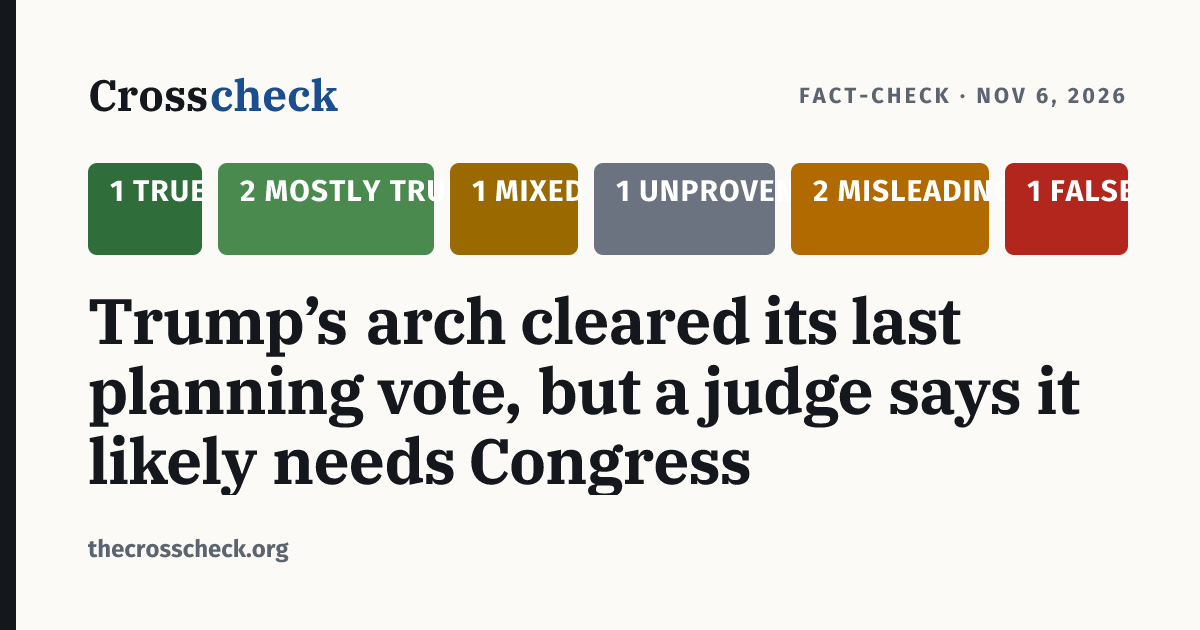
Verdicts
- MisleadingTrump: “We don’t need anything from Congress.”The administration’s position rests on a 1925 bridge law that authorized two 166-foot columns, never built. The only court to weigh it found the arch likely needs authorization Congress has not given.
- Mostly TrueTrump: the arch will top the Arc de Triomphe “by, I think, a lot.”At 250 feet it would stand about 86 to 88 feet taller. But 84 feet of the total is a gilded statue group. The masonry arch itself, 166 feet, is about the Paris arch’s height.
- MixedNCPC chair Mark Paoletta: it would be “the grandest arch ever built by mankind.”Counting statuary, it would pass Mexico City’s 220-foot monument as the tallest triumphal arch. It would not be the tallest arch: St. Louis’s Gateway Arch is 630 feet.
- TrueCritic at the hearing: the administration is “spending taxpayer dollars to site, plan, and design” the arch.The humanities endowment’s spend plan reserves $2 million plus $13 million in matching funds for the arch, and federal agencies did the environmental and planning work.
- UnprovenThe Architect’s Newspaper: the arch is “estimated to cost approximately $400 million.”The administration has released no cost estimate. We found no named source for $400 million; a 2025 report put the arch near $100 million, and $300 million to $400 million is the ballroom’s figure.
- Mostly TruePlaintiffs: the arch would obstruct the line of sight between the Lincoln Memorial and Arlington.NCPC’s staff report says it would fully block the reciprocal view from the Lincoln Memorial terrace and Arlington House, while framing the view at street level.
- FalseImplied: the commission’s final approval cleared the arch to be built.Interior issued its decision the same day, and the court enjoined construction within the hour. The planning vote was a required step, not the last word.
- MisleadingImplied: the federal design and planning approvals show the arch passed independent review of its legality.NCPC said it relies on the applicant to decide whether the Commemorative Works Act applies. The Fine Arts Commission said many objections were outside its purview.
What happened Thursday
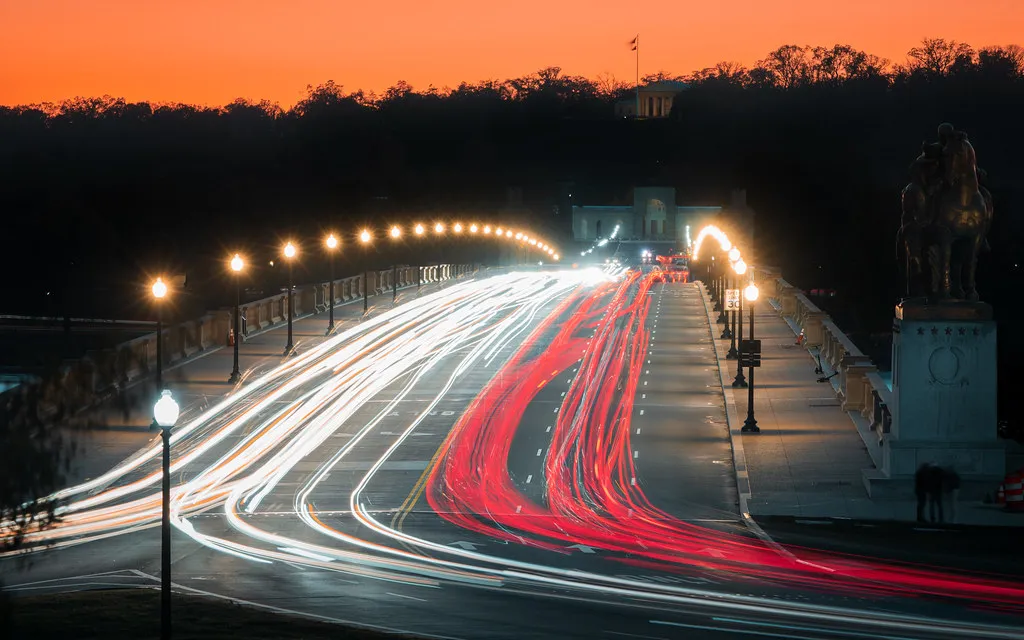
On Nov. 5, 2026, the National Capital Planning Commission (NCPC) voted 8-4 to approve final site and building plans for the arch at Memorial Circle, the traffic circle on Columbia Island at the Virginia end of Arlington Memorial Bridge.[6][7] NBC News reported that the four no votes came from commissioners not appointed by Trump.[7] Public comment ran about nine hours by NBC’s and CBS’s accounts, and the commission had received about 1,300 written comments, “the vast majority” opposed.[2][7]
The Interior Department issued its final decision approving construction the same day.[1] The Justice Department had told the court in October that construction “could commence as early as November 5.”[4] Late that night U.S. District Judge Tanya Chutkan granted the District of Columbia and Virginia a temporary restraining order barring “construction, excavation, demolition, land-disturbance, utility installation, or roadway-closure activity” for 14 days.[6][8] Her 33-page opinion found the two governments likely to succeed on their claim that the project violates the Commemorative Works Act.[1]
The design is a 166-foot stone arch topped by three gilded figures, a 60-foot winged female figure flanked by two eagles, for an overall height of 250 feet.[2] It includes an observation deck, and NPS projects two to three years of construction.[1][6]
Does it need Congress?
The administration’s case for the arch is stated plainly by its officials. Interior Secretary Doug Burgum called it “one of the Great Pieces of American Architecture,” and former press secretary Karoline Leavitt said it “should be a project that all Americans of all political persuasions can support.”[12][14] On authority, the position is Trump’s. In May, he told reporters: “We’re doing it, it’s, the land is owned … by the Interior Department, we don’t need anything from Congress.”[13] Three federal laws bear on that.
The 1912 rule and the Commemorative Works Act
A 1912 statute, now 40 U.S.C. § 8106, says in full: “A building or structure shall not be erected on any reservation, park, or public grounds of the Federal Government in the District of Columbia without express authority of Congress.” Memorial Circle is NPS parkland inside the District’s boundary.[1][2] The Commemorative Works Act of 1986 adds that a commemorative work on NPS land in the District and its environs may be built “only as specifically authorized by law,” with a sponsor authorized by Congress and consultation with the National Capital Memorial Advisory Commission.[1]
Chutkan found none of that happened: “Congress has not enacted any statute authorizing construction of the Arch,” the advisory commission was never consulted, and no sponsor was appointed.[1] The government argued the arch is not a commemorative work because it may be meant to “inspire future American greatness” or serve as a gateway, tourist site and “national security hub.” The judge pointed to the government’s own environmental assessment, which calls the arch a “major commemorative feature,” and found it likely is one.[1]
The 1925 bridge law
The administration’s main answer is a 1925 act authorizing Arlington Memorial Bridge “in accordance with” a 1924 design by the Arlington Memorial Bridge Commission. That design proposed two 166-foot columns “surmounted by statues of Victory” on Columbia Island. The columns were dropped in 1931 “in the interests of aviation safety and economy.”[1] The Justice Department argues that “Congress undeniably authorized erecting and redesigning 166-foot-tall columns surmounted by statues” and that Interior inherited the bridge commission’s power to revise the design, which “includes modifying the two 166-foot columns into a 250-foot Arch.”[3] Because the Commemorative Works Act exempts works authorized before 1985, that theory would take the arch outside it.[1]
Chutkan rejected it at this stage: “Merely to state this argument is to reveal its flaws.” The act let the commission change the design only “without increasing the total cost of the project,” of which just over $2.5 million remained in 1933. The 1924 report described columns “framing in but not interfering with the view of the Lincoln Memorial from the direction of the Lee Mansion,” while the arch “would squarely block” that view.[1] She also rejected a fallback argument under the NPS Organic Act, holding that its general authority yields to the more specific Commemorative Works Act.[1]
Why the rating is Misleading, not False
Trump’s statement presents a contested legal theory as settled. It is not frivolous on its face: a 1925 statute did authorize tall statue-topped structures at this spot, and NCPC’s majority accepted that history as an implied waiver of the 1910 Height of Buildings Act.[2] But the land being Interior’s does not answer § 8106, which applies precisely to federal land, and the one judge to examine the theory found it likely fails. The ruling is preliminary; a final judgment or appeal could differ. The strongest counter-case is that the 1925 act still governs an unfinished Columbia Island. It rests on real history, but it does not explain how a 250-foot arch that blocks the protected view fits a law authorizing 166-foot columns that frame it.
Precedent: how tall, against what
“The one that people know mostly is the Arc de Triomphe in Paris, France, and we’re going to top it by, I think, a lot,” Trump said in December 2025.[12] At the November hearing, Paoletta called the design “the grandest arch ever built by mankind.”[6][7]
Compared against: the tallest triumphal or memorial arches in Wikipedia’s entries (Mexico City’s Monumento a la Revolución, Pyongyang’s Arch of Triumph, the Arc de Triomphe) and, for “arch” in general, the Gateway Arch in St. Louis. Heights are overall heights as each source gives them. The proposed arch is measured two ways, with and without its statue group, from the NCPC and Commission of Fine Arts records.
Overall, the design does top Paris. Wikipedia’s Arc de Triomphe entry gives 49.54 meters (162.5 feet); other reports, and Wikipedia’s own article on the Trump arch, use 164 feet.[17][21] On either figure, 250 feet is 86 to 88 feet taller. The structure is the catch. NCPC describes a 166-foot arch “topped with three gilded figures which extend to an overall height of 250 feet,” leaving 84 feet for the statue group, the same height the Fine Arts Commission gave it in April.[2] Without it, the arch would be 3.5 feet taller than the Arc de Triomphe on Wikipedia’s figure, a difference of about 2%. The fine arts panel itself suggested removing the statues in April, and its vice chair asked in May, “I wonder if you need those up there.”[2][12] We rate Trump’s claim Mostly True: the overall structure is much taller, but the margin comes from sculpture, not from a bigger arch.
Paoletta’s superlative splits on the comparison set. Among triumphal arches, Mexico City’s Monumento a la Revolución, at 67 meters (220 feet), holds the title; Pyongyang’s 60-meter (197-foot) arch is second.[18][19] At 250 feet the proposed arch would pass both by 30 and 53 feet. Without its statue group it would rank third. Among arches of any kind, the Gateway Arch in St. Louis stands 630 feet, and Wikipedia calls it the world’s tallest arch.[20] “Grandest” is a judgment we cannot rate, so the measurable part earns a Mixed: true for triumphal arches if the statues count, false for arches generally. The ranking’s only source is the official whose commission approved the project.
Who pays, and how much
Marine veteran Jimi Shaughnessy told the commission that “this administration is intent on spending taxpayer dollars to site, plan, and design a monument no one asked for.”[6] The taxpayer part is documented. The National Endowment for the Humanities’ FY2026 spend plan, approved by the Office of Management and Budget in September 2025, says “$2M of Special Initiative funds are reserved for the Arch” and “$13M of matching funds are reserved for the Arch.”[10][11] The planning itself is federal work: NPS wrote the environmental assessment, and NCPC staff reviewed the submission.[2] One source conflict: a Yahoo News explainer attributes the spend plan to the National Endowment for the Arts, but the document it links is the humanities endowment’s.[12] We rate the claim True. “No one asked for” is opinion, though the public record leans that way: the Fine Arts Commission’s secretary said only one of about 1,600 comments in its review favored the project without major changes.[12]
Trump has said private money would carry much of the cost, including funds left over from his White House ballroom, and a White House official told reporters to expect “a mix of public and private money.”[11][12][16] No donor list for the arch has been published.
The total is unknown. In September, The Architect’s Newspaper wrote that “the project cost is estimated to cost approximately $400 million,” without saying who made the estimate. The sentence follows a citation to NCPC’s July staff report, but that report contains no dollar figure.[14][22] CBS News wrote on Nov. 6 that “it’s unclear how much the project will cost.” PBS NewsHour reported “no official final budget” and estimates “more than $100 million.”[6][16] The $100 million figure appeared in November 2025, when The Daily Beast cited an Axios report, before the 250-foot design was chosen.[15] The $300 million to $400 million range matches what Trump has said about the ballroom.[11] The $400 million could be right, but no public document supports it, so we rate it Unproven.
Does it block the view?
The veterans’ complaint says the arch would sit “on an axis between the Lincoln Memorial and Arlington National Cemetery, obstructing a line of sight that was designed to represent the unification of the Nation following the Civil War and that has existed for nearly a century.”[5][7] The Fine Arts Commission found the opposite in May, saying the arch “would be visually open and would not block views toward the significant landmarks.”[2]
NCPC’s staff report for the final vote, summarizing the commission’s own July findings, describes the view effects as “tradeoffs” but largely bears out the plaintiffs. It says the arch “will allow for framed views of the Lincoln Memorial and Arlington House from the lower elevations of Memorial Bridge and Memorial Avenue” but will “fully obstruct reciprocal views of the Lincoln Memorial and Arlington from the higher elevations of Arlington House and the Lincoln Memorial terrace.”[2] NPS’s revised environmental assessment found adverse effects on historic properties including Arlington National Cemetery and the Lincoln Memorial.[1] We rate the plaintiffs’ claim Mostly True: a person standing at street level on the bridge would still see through the opening, so “obstructing” fits the elevated, reciprocal view the corridor was designed around, not every angle. The Fine Arts Commission’s statement does not hold up against the planning agency’s own analysis.
What the approval implies
Coverage of Thursday’s vote called it “final approval” and “the final go-ahead,” and the government had told the court construction could start as soon as Interior acted after the vote.[4][6][8] No official we found said the arch was cleared to build, so this is a reader’s likely takeaway, not anyone’s statement. A reader could take away that the arch is now cleared. That is false. NCPC approval of site and building plans for federal projects in the District is required by 40 U.S.C. § 8722, so the vote was a necessary step.[1][2] It is not sufficient. The court order now bars all construction-related work, and the judge held two other motions for later, including the veterans’ request for a preliminary injunction.[1]
The second implied claim is that the approvals vetted the project’s legality. The government’s court brief lists them as signs of progress: the Fine Arts Commission approved the design, the FAA found no hazard, and NCPC gave preliminary approval.[1] On the central legal question, neither body ruled. NCPC’s report says Interior “has indicated that the project is not subject to the Commemorative Works Act (CWA) and NCPC relies on the applicant to determine whether the CWA applies.” It lists cost and CWA compliance among objections “outside of NCPC’s purview.”[2] The Fine Arts Commission “advised that many of these issues are not part of the Commission’s purview.”[2] NCPC did rule on one legal point, the height law, and did so in an executive session, accepting the applicant’s 1925 theory.[2]
Who sat on the panel matters for the “independent” part. NCPC has 12 seats. All three presidential appointees are current Trump officials: chair Paoletta, the OMB general counsel appointed in August; vice chair Stuart Levenbach of OMB; and Michael Blair, the White House deputy chief of staff.[7][9] Ex officio seats go to the secretaries of War and the Interior, the GSA administrator, the chairs of the House and Senate oversight committees, D.C.’s mayor and D.C.’s council chair, plus two mayoral appointees.[9] Interior is the applicant, and its listed alternates include Jessica Bowron, who leads NPS and is a named defendant in the D.C. and Virginia suit.[1][9] War Secretary Hegseth filed a declaration in the case calling the arch a potential platform for “coordinated protective operations.”[1]
The case against this verdict: the commission gives the major land-holding agencies seats by design, so an applicant agency on the panel is how NCPC was built, and the commission did extract changes, such as cutting traffic signal poles from 32 to 17 and requiring a traffic study and height justification.[2][9] That shows the review was not empty, but it does not touch the finding that neither commission ruled on the Commemorative Works Act. We rate the implied claim Misleading.
Trump’s description of a “top grade Military Complex” housing drones and sniper ammunition is absent from the NCPC submission. An Interior official said the details are under seal, and Chutkan called the security declarations “recent and unsupported,” noting they appear “nowhere in the planning documents.”[1][6][7] We did not rate that claim, since the sealed record cannot be checked.
What it changes
The ruling turns on standing, which matters beyond this arch. Earlier this year the Supreme Court found that plaintiffs challenging the White House ballroom likely lacked standing, and the Justice Department leaned on that decision here.[6] Chutkan instead grounded standing in the governments’ own costs: Memorial Circle carries more than 27,000 vehicles, 1,100 cyclists and 1,200 pedestrians a day, and construction would mean lane closures, detours and about 1,400 truckloads of excavated soil.[1] If that theory holds on appeal, it gives states and the District a route into court against federal construction that private plaintiffs may not have. That is our analysis, not a holding.
The 1925 theory also has reach. If a century-old authorization for unbuilt structures can be redesigned into a new monument without Congress, other unrealized plans in the capital could be revived the same way. The court’s answer so far is that the revision has to stay within the old law’s terms, including its bar on raising the project’s cost, a reading the Justice Department disputes. Whatever the courts decide, the planning record now holds NCPC’s finding that Congress “implicitly waived” the 130-foot Height of Buildings Act at this site. The arch’s 250 feet is 92% over that limit.[2][7] Our forecast is that the finding will be cited in future height disputes.
What to watch
- About Nov. 19, 2026. The 14-day restraining order runs out unless the court extends it or replaces it with a longer order.[1][6]
- Pending. D.C. and Virginia’s request to stay Interior’s approval under the APA, which the court deferred, and the veterans’ second motion for a preliminary injunction, held in abeyance.[1]
- Pending. Three fully briefed dispositive motions in the veterans’ case, which the Justice Department has asked the court to decide.[3]
- Forecast. An appeal of any longer injunction to the D.C. Circuit is likely, given the government’s statement in court that the arch is “absolutely a high priority project.”[1]
- Jan. 20, 2029. End of Trump’s term. He wants the arch done by then; NPS projects two to three years of construction.[1][8]
Parties affected
| Party | Effect | Why |
|---|---|---|
| The administration (Interior, NPS) | Costs | Holds every planning approval but cannot start work for at least 14 days.[6] |
| D.C. and Virginia | Gains | Won the order and a finding of likely standing based on their traffic and environmental costs.[1] |
| Veteran plaintiffs | Mixed | Their own motion was held in abeyance, but the order protects the site while they wait.[1] |
| Commuters through Memorial Circle | Unclear | No closures for now; NPS projects lasting delays if the arch is built. Analysis based on the court’s summary of the assessment.[1] |
| National Endowment for the Humanities | Unclear | $15 million stays reserved for a project that may not proceed.[10] |
Sources
- Memorandum Opinion granting temporary restraining order against arch construction at Memorial Circle (Commemorative Works Act, standing, 1925 Act), Lemmon v. Trump / District of Columbia v. NPS, No. 26-cv-544 (TSC), ECF No. 111 (Nov. 5, 2026)
- Executive Director’s Recommendation, New Monumental Arch, NCPC File No. 8778 (Commission meeting Nov. 5, 2026): height, views, Height of Buildings Act, Commemorative Works Act, public comments, with appended Commission of Fine Arts letters
- Defendants’ Opposition to D.C. and Virginia’s Motion for TRO: 1925 Authorization Act, 166-foot columns, standing, ECF No. 95 (Nov. 3, 2026)
- Notice that NCPC meets Nov. 5 and construction could commence as early as Nov. 5, ECF No. 63 (Oct. 21, 2026)
- Complaint, Lemmon v. Trump, ECF No. 1 (Feb. 19, 2026)
- Judge blocks construction on Trump’s 250-foot arch for now
- Trump’s D.C.-area arch approved by federal planning commission as court battle looms
- Judge blocks Trump’s 250-foot triumphal arch hours after final planning approval
- About the Commission: 12-member roster, presidential, mayoral and ex officio appointees and alternates
- FY2026 NEH Spend Plan ($2M special initiative and $13M matching funds reserved for the Arch)
- Taxpayers will help fund Independence Arch, or so-called “Arc de Trump,” plans indicate
- Work to begin on Trump’s 250-foot “triumphal arch,” administration says. Why is it so big, and what comes next?
- Trump arch, Commission of Fine Arts approval
- Construction on Trump’s triumphal arch to break ground soon
- Giant cost of President Donald Trump’s “Arc de Trump” revealed
- How Trump’s construction projects are changing Washington and costing taxpayers
- Arc de Triomphe
- Monumento a la Revolución
- Arch of Triumph (Pyongyang)
- Gateway Arch
- United States Triumphal Arch
- Executive Director’s Recommendation, New Monumental Arch, preliminary review (July 2026)