Crosscheck fact-check
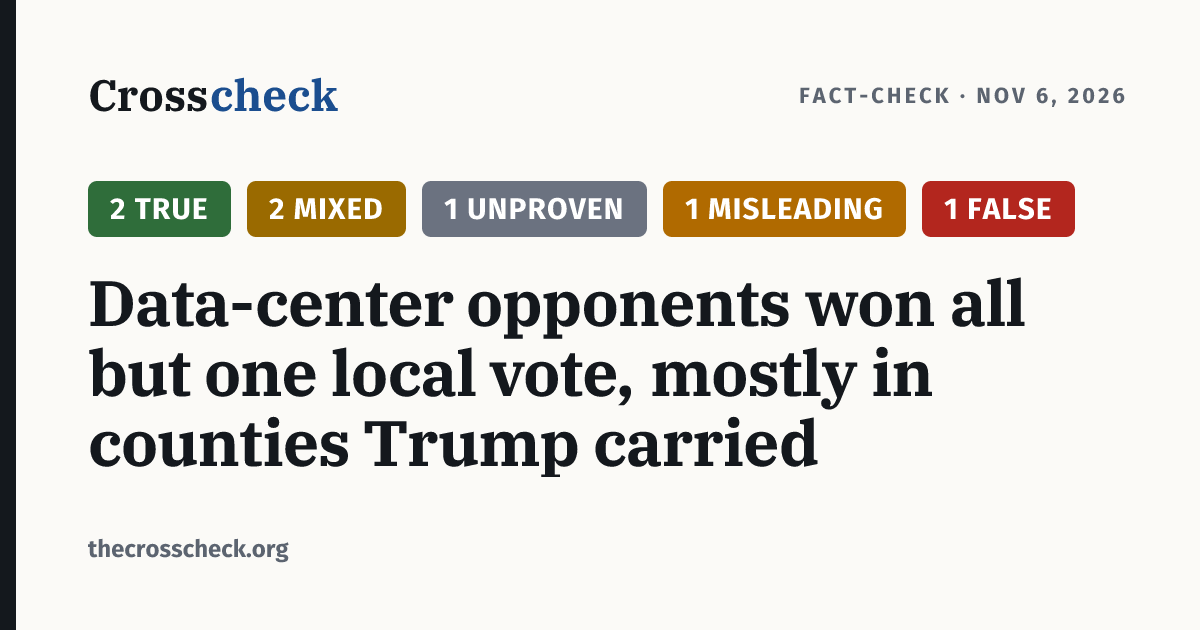
- Verdicts
- The count
- Bans, caps, pauses and advice
- Where the votes were
- Precedent: a “top issue”?
- What the coverage implies
- What it changes
- What to watch
- Parties affected
- Sources
Verdicts
- True“Voters sided against data centers in each measure except one.”CNBC, citing Ballotpedia. Both trackers we checked agree. Two counts are still open, and both favor the restrictions by wide margins.
- False“41 local ballot measures in 10 states ... that would place restrictions on the construction of data centers.”CNBC. Ballotpedia, its source, says 28 would limit data centers and 13 would facilitate them.
- True“Dozens of ballot measures placing local restrictions on data center development were passed.”Washington Post. At least 25 binding restrictions passed or lead in Ballotpedia’s set of 41.
- MixedImplied: voters banned data centers in the places that voted.Accurate for 17 of 41 measures, five of them total bans. The rest were caps on size, temporary pauses, rejected rezonings or advice to officials.
- MisleadingImplied: the anti-data-center vote was part of the Democratic “blue wave.”35 of 47 measures were in counties Trump carried, 20 of them with 60% or more. The anti-data-center side won in all of those except Harwood.
- Mixed“The revolt against data centers was one of the top issues of the 2026 election.”Rep. Greg Casar. A majority (56%) called AI and data centers a major factor, but the issue ranked last of the five that NBC’s exit poll asked about.
- UnprovenImplied: the local votes will slow the national AI data-center build-out.It is a forecast. The measures cover small towns, Harwood’s project was already approved, and one ban may be held up by a court case.
The count
Two outlets set the headline numbers: CNBC and Scientific American. CNBC reported that “there were 41 local ballot measures in 10 states up for a vote on Tuesday that would place restrictions on the construction of data centers in different ways” and that “voters sided against data centers in each measure except one in Harwood, North Dakota.”[2] The second statement holds. The first does not: Ballotpedia, which CNBC cites, counts 28 measures that would limit data centers and 13 that would facilitate them.[5] Verdict on “41 measures that would place restrictions”: False. Scientific American’s headline put it as “The data center boom was on Tuesday ballots 41 times. It won once.”[3] Both rely on Ballotpedia’s list. Ballotpedia’s Nov. 2 preview gives the breakdown: 41 measures in 10 states, of which a yes vote on 28 “would limit data center development” and a yes vote on 13 “would facilitate data center development.”[5]
Tally sources: Ballotpedia News[5] and the Redbud tracker as of Nov. 6.[6]
We checked the count against a second, independent tracker run by Redbud Consulting, which compiles Ballotpedia’s list, a MultiState roundup and county election offices. As of 5:44 a.m. ET on Nov. 6 it listed 47 Nov. 3 measures and reported that the restriction side “has won 44 of the 45 measures with complete counts, Allow one.” The two still counting were Boulder City, Nevada (70.7% for the restriction side on 7,364 votes) and Alhambra, California (82.9% on 18,369 votes).[6] A third tracker, GridSight, found that “13 of 13” questions that would have helped a project failed.[7] The trackers differ in what they include, which is why the totals run from 41 to 47, but none reports a second pro-data-center result. Route Fifty described opponents as successful in “virtually all 40 ballot measures across 10 states.”[4] Verdict: True, with the standing caveat that every figure is unofficial until certification.
The one exception is narrower than “data centers won.” Harwood voters rejected a city charter amendment requiring an independent review and public hearing before large industrial projects, data centers included. By Route Fifty’s account, 75% of 430 voters said no, and the rule “would have applied to future projects, not the controversial Applied Digital campus that has already been approved.”[4]
The Washington Post wrote that “dozens of ballot measures placing local restrictions on data center development were passed across the country Tuesday.”[1] In Ballotpedia’s set, 28 measures would restrict data centers if approved. One failed (Harwood) and two were non-binding Illinois questions, which leaves 25 binding restrictions that passed or, in Alhambra’s case, lead with most votes counted.[5][6] Redbud’s wider list has 33 restrictive measures winning, including advisory ones.[6] Either way that is more than two dozen. Verdict: True. Note that the other 13 anti-data-center results were defeats of measures that would have helped development; those create no new restriction, though they can block a specific project.
Bans, caps, pauses and advice
Much of the reaction described the night as voters banning data centers. Scientific American’s photo caption says Emporia, Kansas, “voted YES to ban construction.”[3] Breitbart wrote that in Ohio “at least 14 municipalities passed bans or restrictions.”[8] Both of those lines are accurate: Emporia did approve a ban, and Ohio towns did pass bans and restrictions. The stretch is in the totals. CNBC described all 41 measures as restrictions, and Breitbart said voters “approved moratoriums or restrictions in 40 of those.”[8] Of the measures in Ballotpedia’s set, Redbud’s results show voters approving 27 restrictive ones (25 binding, two advisory); the other 13 anti-data-center results were rejections of measures that would have helped development.[5][6] Ballotpedia’s classification of the 41 measures shows how much the word covers:[5]
| What a yes vote would do (Ballotpedia) | Measures | Outcome (Redbud) |
|---|---|---|
| Ban all data centers | 5 | Passed or leading (Alhambra still counting) |
| Ban data centers above a size threshold (often 25 MW) | 12 | Passed |
| Six-month moratorium | 3 | Passed |
| Zoning for unincorporated land, voter-approval rules, financial guarantees | 5 | Passed |
| Independent review of large projects (Harwood) | 1 | Failed |
| Non-binding disapproval of data centers (Illinois) | 2 | Passed |
| Rezone, allow or approve a specific project | 6 | Failed or failing |
| Non-binding approval of data centers | 7 | Failed |
Outcomes from the Redbud tracker’s measure list as of Nov. 6.[6] Alhambra’s ban and Boulder City’s allow-measure are still being counted. Redbud lists seven Maine moratoriums (Wells, Brownfield, Eliot, Peru, Freedom, Sabattus, Wiscasset) where Ballotpedia counts three, plus a permanent zoning ban in North Berwick. That makes Breitbart’s “Maine saw eight municipalities pass temporary moratoriums” one too many by Redbud’s list.[8]
So “banned” fits 17 of the 41, or 41.5%. Only five of those (12.2% of all measures) ban data centers of every size; the other 12 bar facilities above a threshold, which in most cases still rules out the hyperscale campuses at issue. Nine of the 41 (22%) were advisory and bind nobody. Some bans also arrive on top of rules a city already had: the Los Angeles Times reported that Alhambra “recently banned data centers as part of a zoning code update” before its ballot measure.[22] And Emporia’s ban, the one in the Scientific American caption, may not take effect yet. In August, city officials said that if voters approved it, it “may take effect only after a ruling has been issued in the declaratory judgment action regarding the legality of the petition”; the city itself had asked the court whether the ban was a proper subject for a citizen initiative.[21] We found no report of a ruling. Verdict: Mixed. Ban is the right word for 17 places and the wrong word for the majority of the votes.
Where the votes were
Market coverage tied the votes to the Democrats’ night. The Post wrote that analysts worried “the blue wave would snag America’s rapid AI build-out,” then cited the ballot measures and new governors in Texas and Ohio.[1] CNBC described Democrats as “seen as proponents of moratoriums.”[9] At the top of the ticket that fits: Scientific American notes that governors-elect Gina Hinojosa (Texas), Keisha Lance Bottoms (Georgia) and Amy Acton (Ohio), all Democrats, “made data center regulation a key part of their campaigns.”[3] The local measures are another matter.
We matched each of Redbud’s 47 measures to its county and to that county’s 2024 presidential result.[6][11][12][13][14][15][16][17][18][19][20] Thirty-five of the 47 (74.5%) were in counties Trump carried, and the restriction side won 34 of them; the lone loss was Harwood, in Cass County. Twenty measures (42.6%) were in counties Trump won with 60% or more, and the restriction side won all 20. Examples: Upper Sandusky, Ohio, in Wyandot County (Trump 74.8%), passed its ban 77% to 23%; Monroe Township, in Adams County (Trump 82.6%), adopted zoning aimed at a data center site; El Dorado, Kansas, in Butler County (Trump 69.6%), approved a ten-year ban on high-impact data centers.[6][7][11][12] The 12 measures in Harris-won counties also all went the restriction side’s way.
Limits of this check: county results are a proxy. A town can vote differently from its county, and Wilmington’s four rezoning votes are one city counted four times. Precinct-level partisan data for each town was not available to us. The pattern does not depend on Wilmington: drop three of its four votes and 32 of 44 measures remain in Trump-won counties.
Republicans also moved on the issue. Breitbart reports that Texas Gov. Greg Abbott, a Republican, “had already backed away from his earlier welcome mat for datacenters,” pushing to end their electricity subsidies, and that Florida Gov. Ron DeSantis (R) “signed a bill in May imposing strict regulations on large-scale datacenters.”[8] Route Fifty calls data centers an issue with “bipartisan opposition.”[4] NBC’s national exit poll shows the issue leans Democratic but is not confined to Democrats. 76% of voters opposed building a new data center in their own community, and they voted 64% Democratic to 34% Republican; the 24% who favored one voted 71% Republican.[10] By our calculation from those rounded figures, about 60% of Republican voters opposed a data center in their community, against about 88% of Democratic voters. Verdict on the implied claim that the local votes were part of a Democratic wave: Misleading. Democrats ran on the issue and won statewide races with it, but the ballot-measure results came mostly from Republican-voting counties, where the restrictions won by similar margins.
Precedent: a “top issue”?
Rep. Greg Casar, the Texas Democrat who chairs the Congressional Progressive Caucus, said after the results: “The revolt against data centers was one of the top issues of the 2026 election.”[2] “One of the top” ranks the issue against the others voters weighed, so we tested it against the exit poll’s issue questions.
Compared against: the five issues NBC News’ 2026 exit poll asked voters to rate as a factor in their vote for Congress (government corruption, the cost of living, the war in Iran, immigration enforcement, and AI and data centers).[10]
| Issue (NBC exit poll) | “Crucial or a major factor” |
|---|---|
| Government corruption | 90% |
| Cost of living | 89% |
| War in Iran | 74% |
| Immigration enforcement policies | 73% |
| Artificial intelligence (AI) and data centers | 56% |
A 56% majority called the issue crucial or major, and CNBC reported the same 56% from its own voter poll, “with Democrats ranking the issue higher than Republicans.”[2] But it ranked last of the five issues the exit poll measured, 34 points behind corruption.[10] The poll did not ask about every issue, so the ranking only covers those five. On the strictest measure, calling an issue “crucial,” AI and data centers also ranked last, at 23%, against 55% for government corruption. The poll’s separate question on the most important issue facing the country offered six choices and did not include AI or data centers.[10] Verdict: Mixed. Data centers mattered to a majority of voters, and in the one ranking available they placed fifth of five.
Route Fifty adds that of the 56%, “64% voted for Democrats.”[4] The NBC page as we saved it on Nov. 6 shows 65% for Democratic candidates and 33% for Republicans in that group; exit-poll weights are revised after election night, which likely explains the one-point gap.[10]
What the coverage implies
Three readings travel with the headline numbers without being stated outright. Two are rated above: that voters “banned” data centers (Mixed, see above) and that the local results were a Democratic wave (Misleading, see above). The third is that the votes will slow the national AI build-out.
CNBC wrote that “getting data center projects off the ground may have just gotten a lot harder,” and it reported analyst Dan Ives’s view that the midterms will slow the pace of data center buildouts across the U.S.[2][9] The market fear, though, centered on statewide offices. Wells Fargo estimates 27% of planned data-center gigawatts sit in Texas, and Ives called the Texas result the “biggest worry” of the night for tech investors.[9] Governor-elect Hinojosa said Thursday, “We need to stop what we are doing with data centers until we have measures to protect Texans.”[23] None of the 47 local measures was in Texas, Georgia or Pennsylvania.[6] The local votes did block named projects: Ashville rejected its EdgeConneX agreement, and Wilmington voters rejected four rezonings that would have opened land to a data-center developer.[5][6] Other projects continue. Harwood’s $3 billion Polaris Forge 2 campus is already under construction, and Ohio’s PORTS-Pike campus, which CNBC calls the largest planned AI data-center campus in the world, was not on any ballot.[2][3] Verdict: Unproven. The results raise the political cost of siting data centers in small towns; whether they change the national total depends on state action that has not happened yet.
We did not rate a fourth common reading, that power bills and water use drove the votes. The measures point that way: Emporia’s ban defines a high-impact data center by “a peak electrical load exceeding 10 megawatts or a daily water draw exceeding 100,000 gallons,” and Route Fifty lists water and power bills among residents’ concerns.[4] No source we found surveyed the voters in these towns about their reasons, so the motive remains a plausible inference, not a measured one.
What it changes
The record so far is lopsided. Counting the six measures decided earlier in 2026, which the restriction side also won, Redbud’s tally shows the restriction side winning or leading in 52 of 53 local votes this year.[6] That gives developers a reason to avoid sites where residents can force a referendum: Redbud counts 28 of the 47 Nov. 3 measures as placed on the ballot by citizens, by petition or town meeting.[6] It also hands both parties evidence that opposing data centers wins votes in red counties, which matters more for 2027 state legislative fights than for the House. In Ohio, Route Fifty reports a statewide constitutional amendment to ban new data center construction “could be on the ballot next year.”[4]
The limits matter as much. Advisory votes bind no one. Size caps leave smaller facilities legal. Moratoriums expire, most of them in six months. Bans can be tied up in court, as Emporia’s may be. And a ballot measure governs one town, while the projects that set national capacity are sited by states, utilities and the few counties that welcome them. Treat the 40-to-1 result as a measure of local sentiment, which it captures well, and not as a count of data centers stopped.
What to watch
- Final counts in Alhambra and Boulder City. Los Angeles and Clark counties add mail ballots for days or weeks after the election, per Redbud.[6]
- Dec. 1: Clarksville, Arkansas, votes on two city bond ordinances meant to support a data center project.[5]
- Dec. 15: Mandan, North Dakota, votes on banning data centers using 25 megawatts or more.[5]
- Emporia court ruling on whether the ban was a proper subject for a citizen initiative; no date has been announced.[21]
- 2027: the proposed Ohio constitutional amendment banning new data center construction.[4]
Parties affected
| Party | Effect | Basis |
|---|---|---|
| Local opponents (citizen petitioners) | Gains | Won or lead in 46 of 47 Nov. 3 measures; citizens placed 28 of them on the ballot.[6] |
| Developers named in local votes (EdgeConneX in Ashville; the Wilmington rezoning sites) | Costs | Agreement and rezonings rejected.[5][6] |
| Applied Digital (Harwood, N.D.) | Mixed | Project already approved and unaffected; the review rule for future projects failed.[4] |
| Democratic governors-elect (Texas, Georgia, Ohio) | Gains | Campaigned on data-center regulation and won.[3] |
| Republican officials | Unclear | Restrictions won in Trump-voting counties; Abbott and DeSantis had already moved toward limits.[8] Analysis, not a measured effect. |
| Large statewide projects (PORTS-Pike, Ohio; Texas pipeline) | Unclear | Not on any local ballot; exposure depends on state action.[2][9] |
Sources
- Stocks tumble, erasing post-midterm gains as markets weigh future of AI build-out
- Voters rebuff data centers in every ballot measure except one during the 2026 midterms
- The data center boom was on Tuesday ballots 41 times. It won once
- Voters reject data centers in local ballot initiatives
- The Ballotpedia News Brew, Nov. 2, 2026: “28 local ballot measures on Nov. 3 would limit data center development if approved, 13 would facilitate it”
- Data Centers on the Ballot (Nov. 3, 2026 local measure tracker)
- Data center vote results 2026: what 41 local votes decided
- The AI Election: Voters Supported Data Center Restrictions or Moratoriums in 40 of 41 Local Elections
- AI data center stocks and Musk’s SpaceX decline as Texas governor result raises risks of a slowdown
- National Exit Polls: Election 2026 Results
- 2024 United States presidential election in Ohio (results by county)
- 2024 United States presidential election in Kansas (results by county)
- 2024 United States presidential election in Illinois (results by county)
- 2024 United States presidential election in Maine (results by county)
- 2024 United States presidential election in New Jersey (results by county)
- 2024 United States presidential election in Wisconsin (results by county)
- 2024 United States presidential election in North Dakota (results by county)
- 2024 United States presidential election in Florida (results by county)
- 2024 United States presidential election in Nevada (results by county)
- 2024 United States presidential election in California (results by county)
- Emporia data center petition question to be placed on November ballot pending court ruling
- Voters Deliver a First-of-Its-Kind Rejection of Data Centers
- Stock market today: live updates