Verdicts
- Mostly TrueExecutive Order 14300 directed the NRC to eliminate the “as low as reasonably achievable” (ALARA) radiation standard to streamline reactor deployment.The order’s verb is “reconsider,” not “eliminate.” It also declares ALARA and the model under it “flawed” and ties the rewrite to faster reactor deployment. The NRC’s response, a proposed rule citing section 5(b) of the order, would remove ALARA from its regulations.
- MixedThe administration has deregulated the amount of radiation that can legally be emitted as pollution.The direction is right: the proposal would raise the effluent benchmark from 10 to 25 mrem a year. But “has” is wrong, since the rule is still a proposal, and the binding limits (NRC’s 100 mrem public dose limit and EPA’s 25 mrem fuel-cycle standard) are unchanged.
- Mostly TrueALARA is a 50-year-old radiation safety standard (Newsweek).NPR and Newsweek both date it to roughly 50 years. The NRC traces the idea to “as low as practicable” in the ICRP’s 1959 recommendations, and the current reactor effluent appendix still uses both phrases. None of the sources pins the exact year the ALARA wording entered NRC rules, so the round number is approximate.
- TrueThe first 300 MW advanced small modular reactor has been approved for construction in the U.S. (Interesting Engineering).The NRC issued TVA a construction permit for a 300-megawatt BWRX-300 at Clinch River on Sept. 29, 2026, calling it “the nation’s first commercial small modular reactor.” The outlet’s added line that this is “only the second advanced reactor construction permit ever” undercounts: Kairos Power’s two Hermes test reactors and TerraPower’s Kemmerer plant got permits first, along with a university molten-salt research reactor.
- TruePeter Thiel is backing a privately developed uranium enrichment plant in Paducah, Kentucky (WKMS).General Matter was incubated in Founders Fund, which Thiel co-founded, and Thiel is listed as a director on its Kentucky filing. The company filed its NRC license application in September 2026.
- UnprovenThe Paducah plant is America’s first U.S.-owned, privately developed uranium enrichment facility.The ranking comes from General Matter’s own announcement. It is not built, and U.S.-owned Centrus already enriches HALEU in Piketon, Ohio, at a cascade it built under a DOE contract. Whether that counts as “privately developed” is a matter of definition.
- MixedImplied: Trump’s executive orders are what greenlit miniature nuclear reactors.Partly. A companion order, EO 14301, created the DOE pilot program that approved Valar Atomics’ test reactor outside NRC licensing. But TVA filed for the Clinch River permit three days before the orders were signed, on a site permitted in 2019, and the NRC approved it under existing rules.
- FalseImplied: the looser radiation rules are already in effect.The NRC took comments until Aug. 31, 2026, and has not issued a final rule. NPR reported it “could go into effect early next year.”
The claim
“Executive Order 14300 directed the Nuclear Regulatory Commission NRC to eliminate the As Low As Reasonably Achievable radiation standard to streamline reactor deployment.” The claim adds that the administration has “deregulated the amount of radiation as pollution that can be legally emitted,” and that the order “greenlit miniature nuclear reactors.”
The links offered in support are the order itself, Newsweek’s report on the NRC proposal (“Trump Admin Moves To Scrap 50-Year US Radiation Safety Standard”), a WKMS report on the Paducah enrichment plant, an Interesting Engineering piece on the Clinch River reactor, NPR’s Sept. 30 report on Valar Atomics’ Utah project, and a Department of Energy summary of the May 2025 orders.[1][2][20] This check rates the regulatory claims first, then each linked headline.
What the order says
Trump signed four nuclear orders on May 23, 2025: EO 14299 on national-security deployment, EO 14300 on the NRC, EO 14301 on reactor testing at DOE, and EO 14302 on the industrial base.[19] EO 14300 is the one about radiation. Its section 5(b) reads:
“Adopt science-based radiation limits. In particular, the NRC shall reconsider reliance on the linear no-threshold (LNT) model for radiation exposure and the ‘as low as reasonably achievable’ standard, which is predicated on LNT. Those models are flawed, as discussed in section 1 of this order.”Executive Order 14300, sec. 5(b)[1]
Section 1 complains that NRC safety models “posit there is no safe threshold of radiation exposure” and “lack sound scientific basis.” The order also set deadlines: proposed rules within 9 months and final rules within 18 months, covering everything from licensing deadlines (18 months for a new reactor) to “high-volume licensing of microreactors and modular reactors.”[1]
So the order did not use the word “eliminate.” It ordered a reconsideration and told the agency in advance that the thing being reconsidered was flawed. It also told the NRC to “specifically consider adopting determinate radiation limits,” which is the opposite of ALARA’s case-by-case judgment.[1]
What the NRC proposed
The NRC published “Reforming and Modernizing the NRC’s Radiation Protection Framework” in the Federal Register on July 15, 2026 (91 FR 43456). Its summary says the revisions “would address section 5(b) of Executive Order 14300.”[3] The first of its nine major provisions:
“Remove ALARA requirements from the regulations in 10 CFR Chapter I, and apply a graded approach to dose management framework that involves determinate thresholds for radiation protection, methods for dose management, and acceptable dosimetry methods.”91 FR 43456, Major Provisions[3]
The agency did not take the order’s other cue. It kept the linear no-threshold model, finding that “no consensus-supported, regulation-ready alternative model to the LNT model exists at this time.”[3] NPR reported the same split: the NRC “decided not to change its scientific model of radiation risk ... but it has proposed eliminating ALARA.”[4] The Union of Concerned Scientists, which opposes the rule, said the NRC had “confirmed the fundamental science” behind LNT.[5]
Other provisions matter for the “more radiation” question:
- Worker dose extensions. A new “planned occupational dose limit extension” would let licensees give a worker up to twice the annual limit in one year, as long as multi-year averages hold.[3] NPR described it as 10 rem instead of 5 in a year, capped at 25 rem over five years.[4]
- Public dose variances. The rule would “allow for variances in public dose limits and/or accessible dose rates on a case-by-case basis, with the implementation of adequate controls.”[3]
- Effluents. It would raise the effluent constraint, covered in the next section.
NRC Chairman Ho Nieh’s defense, quoted by Newsweek: “the standard for exposure to workers and the public, those are not changing. We’re just putting in place greater clarification.”[2]
Which numbers move
The “radiation as pollution” part of the claim turns on effluents, the radioactive material a facility releases to air and water during normal operation. Two layers of numbers govern them: hard dose limits, and lower design objectives or constraints that ALARA sits on top of.
| Rule | What it governs | Today | Proposed |
|---|---|---|---|
| 10 CFR 20.1301 | Dose limit for any member of the public | 100 mrem/yr | 100 mrem/yr |
| 40 CFR 190.10 (EPA) | Public dose from uranium fuel cycle operations | 25 mrem/yr | Not part of this rule |
| 10 CFR 20.1101(d) | Air emissions constraint, non-reactor licensees | 10 mrem/yr | 25 mrem/yr |
| Part 50 Appendix I | Power reactor effluent design objectives, per reactor | 3 mrem (liquid); 5 mrem (gaseous) | New optional path: 25 mrem/yr total |
| 10 CFR 20.1201 | Adult worker annual limit | 5 rem/yr | 5 rem; up to 10 in a planned extension |
Sources for the table: the proposed rule for the 100 mrem limit, the 10 to 25 mrem change, and the worker extension;[3] the current text of Appendix I;[7] and EPA’s standard at 40 CFR 190.10.[8]
The rule states the change plainly: “the NRC is proposing to increase its radionuclide emissions standards from the current regulatory constraint in 10 CFR 20.1101(d) of 10 mrem per year to 25 mrem per year,” and “this change would also be extended to the criteria in 10 CFR part 50, Appendix I.”[3] Its reason is that the current standards are “excessively cautious and overly burdensome.”[3]
Three limits on that change:
- It is optional. Licensees could keep their current 10 mrem programs or adopt the 25 mrem constraint. A licensee that goes over 25 would have to report annually and “evaluate and consider implementing cost-justified corrective actions.” If those are not cost-justified, it could propose a higher constraint, which must stay below the public dose limit.[3]
- EPA has a say. The 10 mrem constraint was set so EPA could find an “ample margin of safety” under the Clean Air Act. The NRC acknowledges EPA “must consult with NRC prior to a new or revised ample margin determination” and argues 25 mrem would still qualify.[3]
- The NRC’s own risk estimate. Using a coefficient of 5×10⁻⁴ per rem, the agency calculates that 70 years at 10 mrem adds about 0.04 fatal cancers per 100 people, and 70 years at 25 mrem adds about 0.09, against a baseline of about 20 per 100.[3] That arithmetic rests on LNT, the model the order called flawed.
EPA studies of 412 facilities, which the rule cites, found most air emissions produce doses under 1 mrem a year, “with a small percentage of facilities approaching, but none exceeding, 10 mrem/year.”[3] Whether actual releases rise will depend on whether licensees use the extra room, which the rule cannot show in advance.
Where it stands
- Early July 2026: NRC releases the proposal. UCS reacted to the “early release” ahead of formal publication.[5]
- July 15, 2026: Published in the Federal Register, docket NRC-2025-1140.[3] That was 13 months after the order, past its 9-month deadline for proposed rules (Feb. 23, 2026).[1]
- Aug. 31, 2026: Comment period closed.[3] The American Nuclear Society “reluctantly” backed keeping LNT and warned the graded approach focuses on “staying within regulatory limits rather than optimizing doses.”[6]
- Today: No final rule. The order’s 18-month deadline for final rules falls on Nov. 23, 2026, 53 days from now.[1] NPR reported the rule “could go into effect early next year.”[4]
The reactors in the news
Clinch River, Tennessee
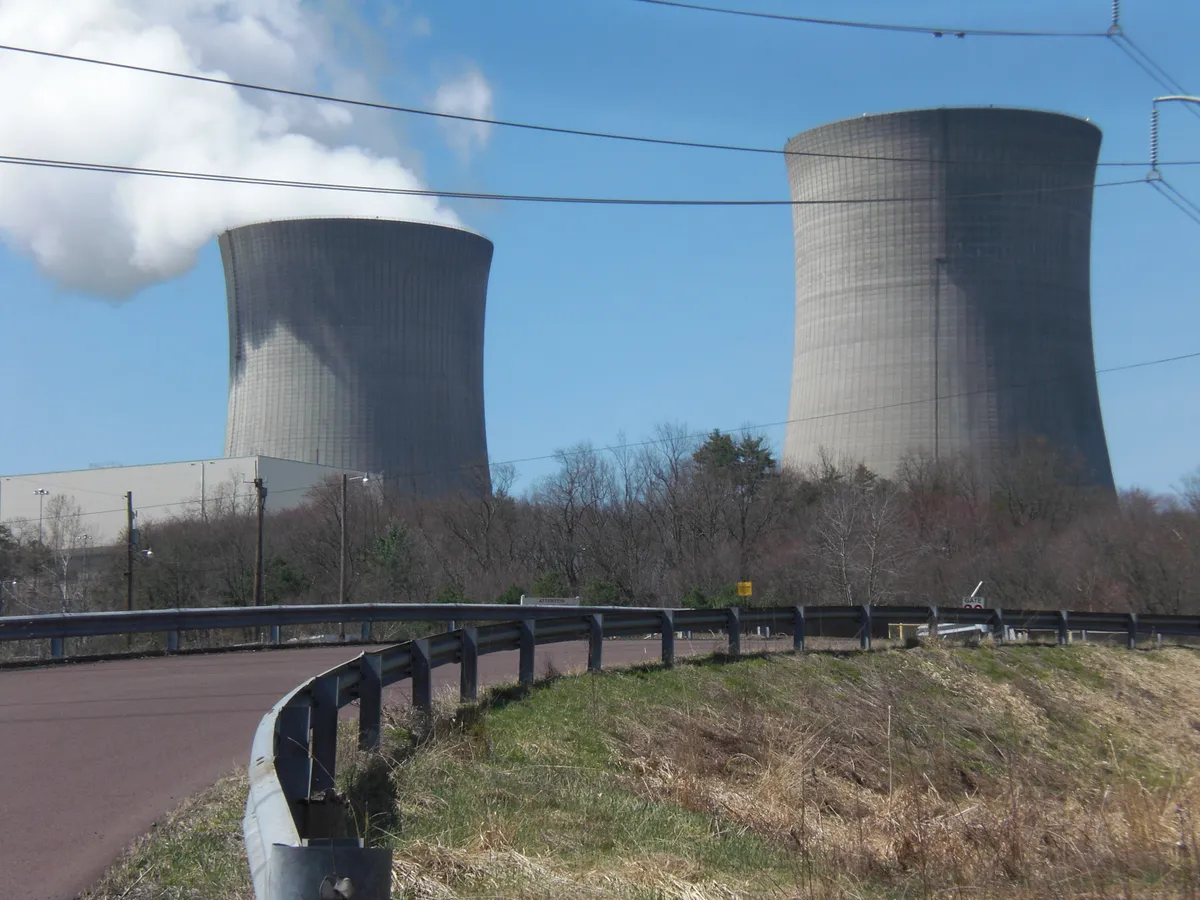
The NRC approved TVA’s construction permit on Sept. 29, 2026, for a 300-megawatt GE Vernova Hitachi BWRX-300, “clearing the way for the nation’s first commercial small modular reactor.” The review took 14 months, which the NRC said was four months ahead of schedule. TVA still needs a separate operating license before loading fuel.[9] TVA announced its application on May 20, 2025, three days before the executive orders,[12] and had held an early site permit for Clinch River since 2019.[11] Interesting Engineering’s headline is accurate.[10]
Paducah, Kentucky
WKMS reported in July 2025 that General Matter, “incubated within” Founders Fund and with Thiel on its board, planned an enrichment plant at the shuttered Paducah Gaseous Diffusion Plant.[14] It signed a DOE lease in August 2025 and filed a 1,000-page NRC license application in September 2026. It says it will produce LEU and HALEU by 2030.[15] Today the only commercial enrichment plant in the U.S. is Urenco’s in New Mexico, which uses a European centrifuge design.[15]
Project Beehive, Utah
NPR reported on Sept. 30, 2026, that Valar Atomics has applied to the Bureau of Land Management for over 9,000 acres near Price, Utah, for about 456 small reactors producing roughly 9.6 gigawatts for data centers. BLM confirmed it is “reviewing the application for completeness.” Valar’s Ward 250 test reactor reached criticality in June under DOE’s Reactor Pilot Program, after what NPR called a “quiet overhaul” of DOE’s internal safety rules.[18] That program came from a May 2025 executive order and runs through DOE, with the NRC “only consulting.”[16]
Is any of it a first
Compared against: NRC construction permits for non-light-water and small reactors since 2023 (Kairos Power’s Hermes, December 2023; Hermes 2, November 2024; Abilene Christian University’s molten-salt research reactor; TerraPower’s Kemmerer Unit 1, March 2026) and U.S. enrichment operations (Urenco USA in New Mexico; Centrus in Piketon, Ohio).
“First small modular reactor approved for construction.” Holds, with the qualifier “commercial.” Hermes is a 35-megawatt-thermal test reactor, Hermes 2 a larger demonstration unit, and the ACU permit is for a university research reactor.[13] TerraPower’s Kemmerer plant, permitted in March, is a 345-megawatt sodium fast reactor, a commercial-scale plant rather than an SMR. ANS noted the last commercial-scale approval before it was Turkey Point’s combined license in 2018.[13] Interesting Engineering’s line that Clinch River is “only the second advanced reactor construction permit ever granted” is wrong against this list. It is the second commercial reactor permit in nearly a decade, after Kemmerer.[11]
“First U.S.-owned, privately developed enrichment facility.” This ranking comes from General Matter’s own announcement, as reported by WKMS.[14] The prior case is Centrus, a U.S. company running an HALEU cascade at Piketon that it built under a DOE contract won in 2019 and is now moving to “private commercial operation.”[17] Whether Paducah counts as first depends on whether a DOE-funded cascade counts as privately developed. General Matter’s own plant also sits on a DOE lease.[15] Rated Unproven.
What the claim implies
Implied: the orders are what greenlit small reactors. For DOE test reactors, largely yes: EO 14301 set up the pilot program that let Valar’s reactor go critical without an NRC license.[16][18] For the commercial SMR, no. TVA’s application predates the orders, and the NRC approved it under the existing licensing rules, not the proposed radiation rule. The orders’ deadline pressure may have shortened the review. Nieh credited “the new NRC” for finishing four months early.[9] Rated Mixed.
Implied: the looser radiation rules are already law. The claim’s “they’ve deregulated” reads as done. It is a proposal with the comment period closed and no final text.[3][4] Rated False.
The case each side makes
Where each party stands
| Party | ALARA | LNT model | Effluent constraint |
|---|---|---|---|
| White House (EO 14300) | “Flawed”; reconsider | “Flawed”; reconsider | Not addressed; asks for “determinate” limits |
| NRC (proposed rule) | Remove | Keep; no ready alternative | Raise 10 to 25 mrem/yr, optional |
| Union of Concerned Scientists | Keep | Sound science | Opposes weakening |
| American Nuclear Society | Use as optimization tool, not a mandate | Keep, “reluctantly” | Not stated in its summary |
| EPA | No public position found; must consult before any new Clean Air Act “ample margin” finding | ||
Sources: the order,[1] the proposed rule,[3] UCS,[5] and ANS.[6]
For the change
Supporters say ALARA lacks a stopping point. Nieh compared it to a road with a 55 mph limit plus a rule to drive “as slow as reasonably achievable.”[4] Emily Caffrey, a health physicist at the University of Alabama at Birmingham, told NPR that “‘reasonable’ is too loosey-goosey” and that the industry should be held to the numbers.[4] The NRC adds that measured air emissions already sit far below both 10 and 25 mrem, so raising the constraint changes paperwork more than exposure.[3]
Against it
Edwin Lyman of UCS says ALARA is the incentive that drove exposures far below the legal limits, and that removing it “would allow nuclear facility workers and the general public to be exposed to higher levels of cancer-causing radiation just to save the nuclear industry money.”[5] He notes ALARA already allows cost trade-offs.[2] Even the industry’s professional society, ANS, worried the graded approach aims at staying under limits rather than optimizing doses.[6] Caffrey, who supports dropping ALARA, said she “would not want to get 10 rem every year for my working life.”[4]
The strongest counter to this check’s Mixed rating on deregulation: the effluent benchmark is the number that governs routine releases in practice, and it would rise to 2.5 times its current value. That point is strong but does not change the rating. The claim says “has deregulated” and “legally,” and neither the binding limits nor the rule’s status supports those words.
Implications
- The legal ceiling holds, the floor pressure goes. Most of what changes is what happens below the limits. Under ALARA, licensees had to justify not reducing doses further. Under the proposal, they mostly have to stay under thresholds. If exposures drift up, it will be within limits that already exist, and the effect will show up in licensee dose and effluent reports, not in any new limit.
- Small reactors are the stated beneficiary. Nieh said he does not expect major changes for large reactors and that the rule mainly helps companies building smaller ones.[2] A 25 mrem design objective is more room for a designer to work with than 3 to 5 mrem per pathway,[7] especially for sites like Project Beehive that plan hundreds of units.[18] How the per-reactor objective applies to multi-unit sites is a question the proposal raises and this check could not resolve.
- EPA’s role is a check that has not been tested. The NRC needs EPA to accept that 25 mrem still gives an “ample margin of safety” under the Clean Air Act.[3] EPA’s own 25 mrem fuel-cycle limit is not touched by this rule.[8]
- The order did not get everything it asked for. It called LNT flawed; the NRC kept it. A final rule that also dropped LNT would be a larger change than the one proposed. This is a forecast, not a finding.
What to watch
- Nov. 23, 2026: EO 14300’s deadline for final rules.[1] Watch whether the final text keeps the 25 mrem constraint, the public-dose variances, and the worker extension.
- EPA’s response to the NRC on the Clean Air Act “ample margin” determination.[3]
- Agreement States. The rule would require them to remove ALARA references from their own programs.[3]
- Litigation. No lawsuit was found as of Oct. 1, 2026, and none can be filed against a rule that is not final.
Sources
- Ordering the Reform of the Nuclear Regulatory Commission (Executive Order 14300)
- Trump Admin Moves To Scrap 50-Year US Radiation Safety Standard
- Reforming and Modernizing the NRC’s Radiation Protection Framework (proposed rule, 91 FR 43456)
- A new proposed rule could change standards for radiation exposure
- New NRC Radiation Rules Put Workers, Communities at Risk
- ANS comments on OMB, NRC proposed rulemakings
- 10 CFR Part 50, Appendix I: Numerical Guides for Design Objectives ... Light-Water-Cooled Nuclear Power Reactor Effluents
- 40 CFR 190.10: Standards for normal operations
- NRC Approves Construction of Nation’s First Small Modular Reactor
- First 300 MW advanced small modular nuclear reactor approved for construction in US
- TVA receives construction permit for Clinch River
- TVA files for Clinch River SMR construction permit
- NRC approves TerraPower construction permit
- Billionaire Peter Thiel backing first privately developed US uranium enrichment facility in Paducah
- General Matter submits licence application for enrichment plant
- Trump executive order on new nuclear reactors raises safety concerns
- Centrus Signs $900M DOE Contract, Pivots Sole U.S. HALEU Cascade to Commercial Operation
- A startup wants to build a massive nuclear-powered data center on public land in Utah
- Four New Executive Orders Promoting Nuclear Energy
- 9 Key Takeaways from President Trump’s Executive Orders on Nuclear Energy