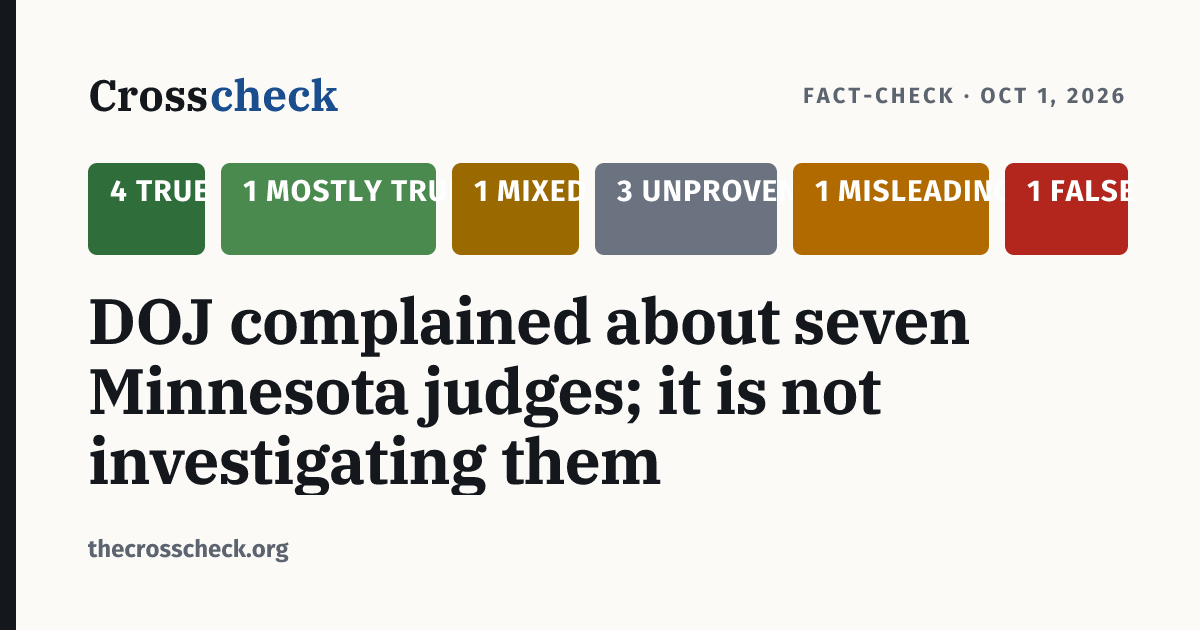
Verdicts
- FalseAttorney General Todd Blanche is launching an investigation of almost every federal judge in Minnesota.DOJ filed a complaint as a complainant under 28 U.S.C. 351(a) and asked the Eighth Circuit to investigate. Whether anyone investigates is up to that court’s chief judge. Blanche himself said DOJ had “asked the Eighth Circuit to conduct an investigation.”
- MisleadingThe complaint targets nearly every federal judge in Minnesota (headline).The headline drops even the “district” qualifier. Seven judges spoke to the Times; the court’s roster lists 6 active and 10 senior district judges plus 9 magistrate judges, 25 in all. “Nearly every” fits only the active bench of last winter.
- MixedDOJ filed the complaint against all but one of the federal district judges in Minnesota.Accurate for the active bench, which TNR does not specify: six of the seven judges active last winter spoke, and five of today’s six active judges did. Against the court’s 16 listed district judges, active and senior, it is 7. The complaint names only Schiltz and Tunheim; the rest are anonymous.
- TrueBlanche announced the complaint at a Wednesday press conference and said seven judges talked to the Times in a manner DOJ views as a clear violation of their ethical duties.The DOJ press release carries the quoted sentence, and CNBC and the Star Tribune describe it as a written statement rather than a press-conference remark. Bloomberg Law and Politico place Blanche at the Sept. 30 press conference announcing the complaint.
- TrueSchiltz, a George W. Bush appointee, gave the Times a 90-minute interview, and six other Minnesota federal judges also spoke to the paper.Stated in the complaint and the Times article. TNR misspells his name as “Schlitz.”
- TrueBlanche called the judges’ comments “blatantly false” and said DOJ asked the Eighth Circuit to investigate and wants the judges to recuse from every DHS case.Raw Story’s transcription of the press conference has both remarks; the complaint’s conclusion makes the same two requests.
- TrueIt is rare for federal judges to speak to the press, but it is not illegal.The Times called such interviews unusual. The misconduct statute is a disciplinary process run by judges. It bars the circuit council from removing an Article III judge; the most serious step open to it is referring conduct that might be grounds for impeachment to the Judicial Conference.
- UnprovenNone of the judges targeted by DOJ mentioned ongoing cases.The Times reported that Schiltz declined to discuss ongoing cases, but his January list had only “largely concluded,” and DOJ cites appeals still pending in the Eighth Circuit and the Supreme Court. Five judges spoke anonymously and their full remarks are not public, so TNR’s “none” cannot be checked.
- UnprovenThe recusal demand would essentially grind federal court proceedings in Minnesota to a halt, probably by design.The request covers matters involving DHS, not all proceedings. No DOJ document or statement expresses an aim to halt the court.
- UnprovenImplied: DOJ targeted these judges because Minnesota is a Democratic-leaning blue state.Neither the complaint nor the press release mentions the state’s politics. The stated basis is the Times interviews, and the two named judges were appointed by a Republican and a Democrat.
- Mostly TrueImplied: the complaint goes after these judges over their rulings against the administration, not only their press comments.The complaint itself spends pages faulting their habeas rulings and says the judges “repeatedly and brazenly exceed their authority.” Its formal basis is still the interviews, and motive beyond DOJ’s own text is not documented.
What TNR wrote
“Attorney General Todd Blanche is launching an investigation against almost every federal judge in Minnesota. In a press conference Wednesday, Blanche announced that the Department of Justice filed a misconduct complaint in federal court against all but one of the federal district judges in Minnesota, attacking them for speaking to The New York Times...”
The article goes on to quote Blanche, describes Judge Patrick Schiltz’s interview, and closes with its own assessment that the recusal request “would essentially grind federal court proceedings in Minnesota to a halt, which is probably by design.”[1]
What DOJ filed
On Sept. 30, 2026, DOJ hand-delivered a complaint on the judiciary’s standard form AO 310, headed “Judicial Council of the Eighth Circuit,” to the U.S. Court of Appeals for the Eighth Circuit. The form lists the complainants as Trent McCotter and Stanley Woodward and the judges as “Patrick J. Schiltz, John R. Tunheim, Anonymous Judges.”[3] An attached letter to Chief Judge Steven Colloton says DOJ submits the complaint “Pursuant to 28 U.S.C. § 351(a)” and “at the direction of the Attorney General.”[3]
The complaint is built on a Sept. 17 New York Times article, “Trump’s Minnesota Surge Threatened Democracy, Judge Warns,” whose reporter spoke with Schiltz “and six other judges who serve on Minnesota’s Federal District Court.”[9] DOJ’s press release says the complaint asks that the judges who spoke “recuse themselves from any matters involving the U.S. Department of Homeland Security” and that the Eighth Circuit “initiate an investigation into the judges’ improper and unethical conduct.”[2]
The complaint’s conclusion is narrower on recusal than the press release. It says “These judges should be ordered to recuse from any matters involving DHS” right after naming Schiltz and Tunheim, and it asks for a special committee under Rules 11(a)(4) and 11(f) “to investigate this misconduct.”[3]
Who investigates
Under the Judicial Conduct and Disability Act, “Any person” may file a complaint with the clerk of the court of appeals.[4] DOJ used that door. The statute gives the next steps to judges, not to the complainant:
- The chief judge of the circuit “shall expeditiously review” the complaint and may dismiss it if it is “directly related to the merits of a decision or procedural ruling” or “lacking sufficient evidence to raise an inference that misconduct has occurred.”[5]
- Only if the chief judge does not dismiss or close the matter does the chief judge appoint “a special committee to investigate the facts and allegations contained in the complaint.”[6]
- The circuit’s judicial council then acts on the committee’s report. Its listed sanctions include censure, reprimand and a temporary halt to case assignments, and “Under no circumstances may the judicial council order removal from office” of an Article III judge.[7]
So “launching an investigation” and “DOJ Prepares to Investigate” describe a power DOJ does not have in this process. Later in the article TNR gets it right, reporting that DOJ “asked the Eighth Circuit Court of Appeals to investigate the judges.”[1] Blanche’s own words, as transcribed by Raw Story, were “[W]e have asked the Eighth Circuit to conduct an investigation.”[13]
How many judges
The number seven comes from DOJ and the Times. The complaint says “at least seven judges” spoke, calls that “just shy of the entire bench,” and quotes the Times that those who spoke included “six of the seven judges who held active status in Minnesota last winter.”[3] AP, Bloomberg Law and CNBC also put the total at seven, with Schiltz and Tunheim named and the rest speaking anonymously; AP notes they were nominated by presidents of both parties.[20][11][12] The Star Tribune wrote that the complaint covered Schiltz, Tunheim “and six other Minnesota judges,” which would make eight; it conflicts with DOJ’s own figure, so this check uses seven.[10]
The denominator decides whether “nearly every” fits. The court’s chambers directory lists:[8]
| Category | Judges listed | Count |
|---|---|---|
| Active district judges | Chief Judge Eric C. Tostrud; Nancy E. Brasel; Kate M. Menendez; Jerry W. Blackwell; Jeffrey M. Bryan; Laura M. Provinzino | 6 |
| Senior district judges | Donald D. Alsop; Paul A. Magnuson; Michael J. Davis; John R. Tunheim; Ann D. Montgomery; Donovan W. Frank; Joan N. Ericksen; Patrick J. Schiltz; Susan Richard Nelson; Wilhelmina M. Wright | 10 |
| Magistrate judges | Brisbois, Schultz, Cowan Wright, Docherty, Foster, Micko, Elkins, Bullard, Huseby | 9 |
The Star Tribune reports that the court has seven active seats, one open since Schiltz took senior status this summer.[10] That makes last winter’s active bench seven judges, and six of them (85.7 percent) spoke to the Times. Counted against today’s 16 district judges, the seven who spoke are 43.8 percent. Counted against every federal judge the court lists, including magistrates, they are 7 of 25. Because Schiltz spoke and has since taken senior status, five of today’s six active judges (83.3 percent) spoke. Which active judge declined is not public.
CNBC put it precisely: “all but one Minnesota federal judges on active status.”[12] TNR’s body text, “all but one of the federal district judges,” drops “active,” which makes it accurate on one reading and wrong on the literal one, so it is rated Mixed. The headline’s “Nearly Every Federal Judge” overstates it. Politico used a similar phrase, “nearly all of the federal district court judges in Minnesota,” and DOJ itself said “just shy of the entire bench,” so TNR’s wording follows the way the story was framed in Washington.[14][3]
The quotes
TNR attributes to Blanche: “Seven federal judges in the District of Minnesota talked to The New York Times about cases, some of which are ongoing, in a manner that the Department of Justice views as a clear violation of their ethical duties.” The DOJ press release carries that sentence as Blanche’s statement, spelled “on-going.”[2] The “blatantly false” remark and the recusal sentence (“recuse themselves from every case involving DHS, either criminal or civil in nature, because of the obvious bias they have shown in this article with the New York Times”) match Raw Story’s account of the press conference, which TNR links.[13] Bloomberg Law separately quotes Blanche at the same event: “There’s an obvious bias against the Department of Homeland Security and immigration authorities in Minnesota.”[11]
The judges’ quotes TNR uses also check out against the complaint, which reproduces them from the Times: Tunheim’s “They weren’t arresting, in my view, people who were dangerous criminals on the street,” and Schiltz’s view that most noncompliance “was due to incompetence, . . . not due to conscious defiance of orders.”[3] Schiltz was appointed by George W. Bush; Tunheim by Bill Clinton.[10]
The judges’ response: Schiltz told the Star Tribune he acted “well within the ethical rules” and pointed to a February advisory opinion from the Committee on Codes of Conduct allowing judges to speak on “core judiciary matters such as advocacy for the rule of law and judicial independence.” “That is exactly what I did,” he said.[10] Court spokesperson Rebeccah Parks said “our judges were acting well within the ethical rules.”[12]
Did they discuss pending cases?
TNR states that none of the judges “mentioned ongoing cases.” The record splits. UPI reported that the Times noted Schiltz “declined to discuss ongoing cases in his interview,” and the Times wrote that the cases on his January list “have largely concluded.”[17][3] DOJ’s complaint seizes on “largely,” adding emphasis, and argues the habeas question at the core of the article is still pending, citing Avila v. Blanche, Supreme Court No. 26-354, an appeal from a Tunheim habeas ruling the Eighth Circuit reversed. It also lists Eighth Circuit appeals in Velasquez v. Garcia (No. 26-1185) and Anaya v. Mullin (No. 26-1226) and an ongoing criminal case, U.S. v. Levy Armstrong.[3]
Whether talking about a category of litigation that is still on appeal counts as commenting on a pending case is the legal question the Eighth Circuit would decide. TNR states its answer as a fact. And only two of the seven judges spoke on the record, so no reader can verify what the anonymous five said. TNR’s “none” is rated Unproven.
What the article implies
The blue-state frame
The headline calls Minnesota a “Blue State.” Nothing in the complaint or the press release refers to the state’s politics.[2][3] DOJ’s stated basis is the Times interviews and its view that the judges discussed immigration cases. The two named judges were appointed by presidents of different parties, and the active bench includes two Trump appointees.[10] No record links the complaint to the state’s voting, so the implied link is Unproven.
The rulings behind the complaint
TNR places the complaint in a pattern of Trump and Blanche attacking judges who rule against the administration. DOJ’s own text supports part of that. The complaint argues that Minnesota judges “have frequently entertained and granted petitions that flout the blackletter district-of-confinement rule,” that the court’s habeas rulings were “the result of these and other district judge’s own legal errors,” and that “it is judges who repeatedly and brazenly exceed their authority.”[3] Associate Attorney General Stanley Woodward said the judges were “allowing criminal illegal aliens to run free in Minnesota.”[2] The statute lets a chief judge dismiss a complaint “directly related to the merits of a decision or procedural ruling.”[5] The documented point is that DOJ ties its ethics complaint to rulings it disputes. Retaliation as the motive is an inference the documents do not state.
The halt prediction
TNR wrote that recusal “would essentially grind federal court proceedings in Minnesota to a halt, which is probably by design.” The request covers “any matters involving DHS,” not the court’s whole docket.[3] DOJ’s stated aim is “a fair and impartial forum.”[2] Pulling up to seven judges off DHS cases would strain the court at a time when, Bloomberg Law reports, immigration detention cases have “overwhelmed federal courts” across the country. Neither a halt nor a design to cause one is documented.[11]
Has DOJ done this before
TNR does not call the complaint unprecedented. Blanche said filing it “is not something that the department does typically.”[13]
Compared against: DOJ actions against sitting federal judges in Trump’s second term reported by AP and Bloomberg Law: the February 2025 misconduct complaint against Judge Ana Reyes, the 2025 complaint against Chief Judge James Boasberg, and the 2025 lawsuit against all district judges in Maryland.
| Action | Target | Outcome |
|---|---|---|
| Misconduct complaint, Feb. 2025, filed by Chad Mizelle[15] | Judge Ana Reyes, D.D.C. | Dismissed by D.C. Circuit Chief Judge Sri Srinivasan in a Sept. 29 order, which AP reports said a recusal motion was the proper route[16] |
| Misconduct complaint, 2025[18] | Chief Judge James Boasberg, D.D.C. | Dismissed Dec. 19, 2025 by Sixth Circuit Chief Judge Jeffrey Sutton for lack of corroboration[18] |
| Lawsuit, 2025 | All district judges of Maryland | Dismissed by Judge Thomas Cullen, Aug. 2025[19] |
| Misconduct complaint, Sept. 30, 2026 | Schiltz, Tunheim and anonymous D. Minn. judges | Pending before Chief Judge Colloton[3] |
Both earlier misconduct complaints were dismissed by a chief judge. The Minnesota complaint differs in reaching judges DOJ cannot name.
The case for TNR’s framing
The strongest defense of the headline: DOJ formally demanded that the judiciary investigate seven judges and asked for a special investigating committee, so in plain speech DOJ moved to have the judges investigated. Raw Story wrote that Blanche “moved to have nearly all of Minnesota’s federal district judges investigated.”[13] And Politico used nearly the same “nearly all” count.[14] Neither point rescues the literal claim. “Prepares to Investigate” and “launching an investigation” assign the investigation to DOJ, and the statute assigns it to judges who can dismiss the complaint first.[5] A reader who stopped at the headline would believe the executive branch was investigating the judiciary, which is not what happened. The count defense works for the active bench of last winter and fails for “every federal judge in Minnesota.”
Implications
The difference between a complaint and an investigation matters here. If Colloton dismisses the complaint, as two chief judges did with DOJ’s 2025 complaints, nothing is investigated, and coverage that announced an investigation will have overstated the event.[16][18] If he appoints a special committee, that body is made of circuit and district judges. The circuit council can then censure or reprimand a judge, pause case assignments, request voluntary retirement, or refer conduct that “might constitute one or more grounds for impeachment” to the Judicial Conference, but it cannot remove an Article III judge.[6][7]
The recusal request is the more consequential part. In the Reyes matter, AP reported that Srinivasan said a motion for recusal “would have been the proper means” for DOJ to contest the judge’s impartiality.[16] If that reasoning carries over, DOJ’s realistic path to removing these judges from DHS cases runs through recusal motions in individual cases. Senate Judiciary Chairman Chuck Grassley had already asked Chief Justice John Roberts to examine the Minnesota judges’ comments.[11] A forecast, not a finding: the Committee on Codes of Conduct’s February advisory opinion on judges speaking about the rule of law is likely to be the center of any ruling on this complaint.[11]
What to watch
- Chief Judge Colloton’s order: dismissal, conclusion or appointment of a special committee under 28 U.S.C. 352 and 353.[5]
- Whether DOJ files recusal motions in specific DHS cases before the Minnesota judges.
- The Supreme Court’s handling of Avila v. Blanche, No. 26-354, which DOJ cites as the pending case.[3]
Sources
- DOJ Prepares to Investigate Nearly Every Federal Judge in Blue State
- Justice Department Files Judicial Misconduct Complaint Alleging MN Judges Made Improper and Unethical Comments to the New York Times
- Complaint of Judicial Misconduct (file-stamped)
- 28 U.S. Code § 351, Complaints; judge defined
- 28 U.S. Code § 352, Review of complaint by chief judge
- 28 U.S. Code § 353, Special committees
- 28 U.S. Code § 354, Action by judicial council
- Chambers Contact Information
- Trump’s Minnesota Surge Threatened Democracy, Judge Warns
- DOJ files complaint against Minnesota’s federal judges over media comments
- DOJ Accuses Minnesota Judges of Misconduct for Media Remarks
- DOJ accuses Minnesota federal judges of misconduct for NY Times immigration interviews
- Blanche moves to investigate nearly all federal judges in one state
- Article on the DOJ ethics complaint against Minnesota judges (headline not captured)
- Justice Department files complaint against judge weighing challenge to Trump’s transgender troop ban
- Court official dismisses Justice Department’s misconduct complaint against a federal judge in DC
- Justice Department files complaint about judges who spoke to New York Times
- Misconduct complaint dismissed against judge who handled El Salvador prison deportation case
- Judge Tosses Justice Department Lawsuit Against Maryland Court
- Justice Department Files Complaint Against Judges Over Immigration Enforcement Surge Comments