The post
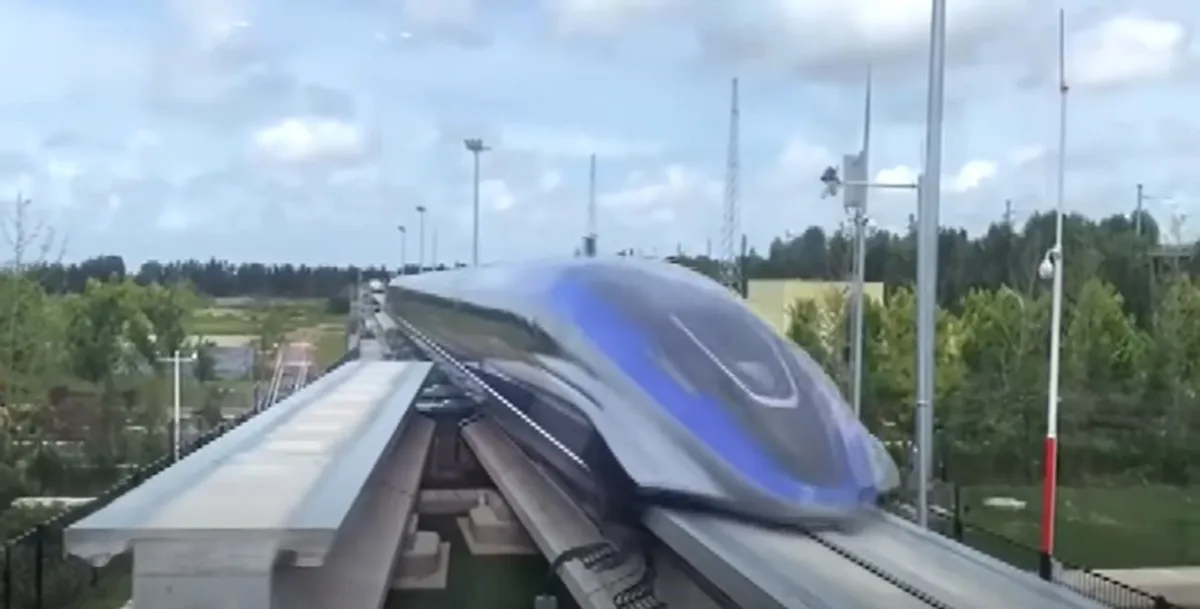
A screenshot circulating on social media shows this post from the account “Travis R. Eby” (@travis_robert), with a photo of a blue-and-silver maglev on an elevated guideway:
Travis R. Eby · @travis_robert“Do people (Americans) realize the next generation of high- speed rail coming to market could whisk you from the center of Chicago to the center of NYC in 2.5 hours with no airport hassle and we are literally buying highway expansions instead of this?”
We could not locate the original post, its platform, or its date. We read the account’s public Bluesky feed back to March 2025 and found no matching post.[1] The Threads profile under that handle lists zero threads.[2] X, which uses the same handle, requires a login we could not use for this check, so the post may live there or may have been deleted. The account belongs to a private individual who writes about transit, so this check covers the claim and names the account only as it appears in the screenshot.
Verdicts at a glance
- MisleadingNext-generation rail “coming to market” could run central Chicago to central NYC in 2.5 hours. No such train is on the market, and the trip needs a faster average than any maglev built or under construction.
- TrueThe photo shows a real next-generation maglev: China’s CRRC 600 km/h prototype, rolled out in Qingdao in July 2021.
- Mostly TrueA 2.5-hour downtown-to-downtown train would beat flying with its airport time. The comparison is fair only if the 2.5 hours were real.
- TrueThe US is paying for highway expansion while guaranteed high-speed and intercity rail money is being cut.
- FalseImplied: a Chicago–NYC high-speed line was on the table and highways were chosen instead.
- MisleadingImplied: the pictured train is in or near commercial service.
- MisleadingImplied: the money going to highway expansion could have bought this line.
The photo
We did not have the screenshot’s image file, so we could not run a reverse-image search on that exact frame. The train described matches the CRRC 600, which China’s state rolling-stock maker CRRC unveiled at its Qingdao Sifang plant on July 20, 2021.[3] The frame below, from China News Service footage of that rollout, shows the same streamlined nose, the blue side band over silver, and the elevated test guideway.[4]

What the photo does not show is a train in service. At the rollout, CRRC pitched the train as able to make the roughly 1,200 km Beijing–Shanghai trip in about three and a half hours including waiting times, but where the trains would run was “not yet clear.”[5] The speed records China has announced since came from a separate 1.1-tonne test vehicle on a 1,000-meter track at the Donghu Laboratory in Hubei: 650 km/h in June 2025 and 800 km/h in December 2025.[6][7] That is a propulsion test rig, not a passenger train. In July 2025 CRRC showed a 600 km/h superconducting lead car at a Beijing trade show and said construction of dedicated lines “could start in five years.”[8]
The 2.5-hour arithmetic
Chicago Union Station and New York Penn Station are 1,145 km (712 miles) apart in a straight line, by our great-circle calculation. The existing rail route, Amtrak’s Lake Shore Limited, covers 959 miles in 19½ to 20¼ hours.[14] A new maglev would need its own route, and the only lower bound on its length is the straight line.
| Basis | Distance | Average speed for 2.5 h |
|---|---|---|
| Straight line, no stops (impossible floor) | 1,145 km | 458 km/h (285 mph) |
| Existing rail alignment | 1,543 km | 617 km/h (384 mph) |
An average is not a top speed. Every stop, curve and acceleration pulls the average below the cruising figure. The Shanghai maglev needs about 2 minutes 15 seconds to reach 300 km/h, and about 4 minutes to reach its former top speed of 431 km/h.[11]
The fastest scheduled service anyone is building, Japan’s Chuo Shinkansen, plans to link Tokyo and Nagoya, 286 km apart, in 40 minutes, with a top speed of 505 km/h.[10] That works out to an average of 429 km/h. Held for the whole straight-line distance with no stops, that pace gives 2 hours 40 minutes, already over the post’s figure. Over a route as long as today’s rail line it gives 3.6 hours. CRRC’s own pitch for a comparable distance, Beijing to Shanghai, was three and a half hours.[5]
Two more constraints bear on “center to center.” The Congressional Research Service notes that maglev needs very straight, level track, which means extensive viaducts and tunnels, and that maglev vehicles cannot use existing rail terminals, which pushes builders either into costly city-center tunnels or to stations outside downtown.[12] The Chuo line itself will not serve Tokyo Station; it runs from Shinagawa.[9][12]
A 2.5-hour trip is not physically impossible. A train cruising at 600 km/h on a near-straight guideway with no intermediate stops would cover the straight-line distance in about 1.9 hours at constant speed. No one has built, funded or proposed such a line, and it would skip Cleveland, Pittsburgh and every other city that normally justifies a route like this.
What is on the market
Compared against: every high-speed maglev line in commercial service or under construction worldwide (Shanghai, Chuo Shinkansen), China’s CRRC 600 program, and every US maglev project that reached federal environmental review (Baltimore–Washington, Pittsburgh, Las Vegas).
| Project | Status |
|---|---|
| Shanghai maglev | The only high-speed maglev in commercial service, per CRS.[12] About 30 km to Pudong Airport. Cruise speed capped at 300 km/h since May 2021, down from 431.[11] |
| Chuo Shinkansen (Japan) | Under construction. Planned for 2027; JR Central said in October 2025 it now expects service in 2036 at the earliest, with costs up to ¥11 trillion.[9] |
| CRRC 600 (China) | Prototype trainsets. No line under construction; CRRC says line construction “could start in five years” (July 2025).[8] |
| Baltimore–Washington SCMaglev | First leg of a proposed DC–NYC line at up to 311 mph. FRA rescinded the environmental review on July 31, 2025, finding a final EIS “no longer feasible.”[13] |
| Pittsburgh and Las Vegas demos | Federally selected in the 2000s. Neither reached construction; Las Vegas’s maglev funding was redirected to a highway project.[12] |
| Chicago–New York | No federal or state study found. The closest is a June 2025 guest post for the advocacy group High Speed Rail Alliance proposing a 960-mile conventional line with a roughly 7-hour trip.[15] |
“Coming to market” overstates every row. The fastest line under construction opens in a decade at the earliest and would not make this trip in 2.5 hours at its planned pace. The 600 km/h class exists as prototypes. For Chicago–New York, advocates who want the line are proposing about 7 hours.
Against flying
The “no airport hassle” point is fair on its own terms. Chicago O’Hare to LaGuardia averages about 2 hours 10 minutes in the air.[16] Most major US airports tell domestic travelers to arrive two hours early, and some recommended more during this year’s TSA disruptions.[17] Add the trips between downtown and the airports, and a true 2.5-hour downtown-to-downtown train would beat flying. CRS puts maglev’s competitive range against airlines at up to 750 miles, which covers the straight-line distance here.[12]
The comparison flips at realistic speeds. The 7-hour conventional line advocates propose would lose to flying for end-to-end travelers. The case for that line rests on the cities in between, such as Cleveland to New York or Chicago to Buffalo.[15]
Highways versus rail money
Highway expansion is being bought
The 2021 infrastructure law (IIJA) provides about $350 billion for federal highway programs over fiscal 2022–2026[18] and $102 billion for rail, $66 billion of it guaranteed through advance appropriations.[19] Most highway money pays for repair, but a large share adds lanes. Transportation for America found states spent an average of 25 percent of transportation funds on expansion from 2018 to 2024, against 39 percent on repair,[20] and counted more than $37 billion of IIJA money going to road expansion and widening in the first portion of spending it could analyze.[21] Transportation for America advocates for repair over expansion, so treat its framing as advocacy, though the spending shares come from state data.
Rail money is being cut
- July 2025: the Transportation Department terminated about $4 billion in federal grants to California high-speed rail.[22] The same month FRA ended the Baltimore–Washington maglev review.[13]
- The House’s five-year BUILD America 250 bill authorizes $580 billion, including $376 billion for the Federal Highway Administration and $64.7 billion for FRA, and bars federal grants to California high-speed rail for two years.[23] The Urban Institute calculates it raises highways’ share of authorized surface spending from 63 to 70 percent and replaces the IIJA’s guaranteed $66 billion for intercity rail with $0 guaranteed.[24] Streetsblog puts the automatic highway set-aside at about $475 billion;[28] we use the $376 billion FHWA figure because it is the line item, while Streetsblog’s larger figure appears to cover all trust-fund-guaranteed spending.
- July 22, 2026: Transportation Secretary Sean Duffy listed building or expanding interstate highways among the administration’s priorities in a letter to senators, while proposing to eliminate the Highway Trust Fund’s mass transit account.[25]
- September 2, 2026: the president signed a stopgap funding law through December 11 that extends surface transportation programs.[29] The American Public Transportation Association estimated that the stopgap, as proposed, would cut passenger rail 83 percent from current levels, because it continues trust-fund programs without the IIJA’s advance appropriations.[26]
Is it either/or?
Partly. Highways run mostly on the Highway Trust Fund, while the IIJA’s rail money came through general-fund advance appropriations, so a dollar of fuel tax does not move straight to a rail line. The walls are thinner than they look, though. Keeping the trust fund solvent for five more years will likely take at least $150 billion from the general fund, according to the Eno Center’s Jeff Davis,[27] and federal policy gives states broad flexibility in how they spend their federal funds.[20] The House bill’s shift from guaranteed to year-by-year rail funding is a direct choice about which mode gets certainty.[24]
What the post implies
Implied: a Chicago–NYC high-speed line was on the table and highways were chosen instead. False. We found no federal, state or private proposal for a Chicago–New York maglev, and no official study of any high-speed line on that corridor. The only proposal is an advocacy blog post for a 7-hour conventional line.[15] The trade-off the post describes is real at the level of national priorities, not for this specific route.
Implied: the pictured train is in or near commercial service. Misleading. It is a 2021 prototype with no line under construction, and CRRC’s own timeline puts line construction years away.[5][8]
Implied: the money going to highway expansion could have bought this line. Misleading. The only US maglev estimate with a federal environmental review, Baltimore–Washington, came to $285 million to $370 million per mile.[12] Applied to the 712-mile straight line, that is roughly $203 billion to $263 billion. That is our illustration, not an estimate: flat Midwest terrain could cost less per mile than tunnels near Washington, and crossing the Appalachians and reaching Manhattan could cost more. Northeast Maglev put its 1-hour Washington–New York line alone at “upwards of $100 billion.”[12] Either way, the figure is several times the $37 billion of IIJA expansion spending Transportation for America identified, and equal to 58 to 75 percent of the IIJA’s entire five-year highway program.
The case against this verdict
The strongest objection to rating the travel-time claim Misleading is that the post says “could,” not “will.” A 600 km/h train on a straight nonstop guideway would make the trip in about two hours, and the technology to run at that speed has been demonstrated in test rigs.[6] We scored this a 3 of 5: it addresses the word “could” but not “coming to market” or “center to center,” and the manufacturer’s own estimate for a similar distance is 3.5 hours. We held the rating.
The strongest objection to rating the spending claim True is that highway programs are mostly repair and that the IIJA gave rail record funding. That is accurate for 2021–2026. It does not change what is happening now: expansion takes a quarter of state transportation spending, and every 2025–2026 action we found moved rail money down and highway priority up.
Implications
The post’s policy point survives the fact-check, and its headline number does not. That matters because the number is the easiest thing to rebut: a reader who checks the 2.5 hours and finds no such train may discard the spending argument with it, even though the spending argument is the part the record supports.
The real choice in front of Congress is less exotic. It is whether intercity rail keeps guaranteed multiyear funding, as under the IIJA, or goes to annual appropriations, as the House bill proposes.[24] That decision shapes whether conventional high-speed projects, such as the proposed Chicago–St. Louis line projected to carry over 2.8 million riders a year, get built at all.[28] Any Chicago–New York line would come after those. As a forecast: advocates will make a stronger case with 7-hour trains that connect a dozen cities than with 2.5-hour maglevs that connect two.
What to watch
- September 30, 2026 (6 days): the IIJA’s authorization expires; programs continue under the stopgap.[27][29]
- December 11, 2026 (78 days): the stopgap runs out. Watch whether the next funding bill restores advance appropriations for rail.[29]
- Senate surface transportation bill: none had been proposed as of the July reporting; experts expected short extensions rather than a five-year law before the election.[27]
- Chuo Shinkansen, Shizuoka tunnel: the start of this section decides whether the 2036 date holds.[9]
Sources
- Travis R. Eby (@travis-robert.bsky.social), author feed read via public API
- @travis_robert profile
- World’s speediest 600 km/h maglev rolls off assembly line in Qingdao
- CRRC 600 rollout still (China News Service, CC BY 3.0)
- China unveils new 600 km/h ultra-fast maglev train
- 650 km/h in 7 seconds: China sets new record in maglev technology
- China achieves record 800-km/h maglev test speed
- CRRC Showcases 600 km/h Maglev at Beijing Exhibition
- Maglev shinkansen costs seen ballooning further to ¥11 trillion
- Chūō Shinkansen
- Shanghai maglev train
- Magnetic Levitation (Maglev) Trains: Technical Background, Cost Estimates, and Recent Developments (IF11834)
- Baltimore-Washington Superconducting Magnetic Levitation Project
- Lake Shore Limited
- New York to Chicago – A Transformative Proposal
- Chicago to New York flight time (ORD to LGA)
- U.S. airports changing arrival time advice to travelers in wake of continued TSA chaos
- Infrastructure Investment and Jobs Act
- Infrastructure Investment and Jobs Act Information from FRA
- New release: Repair Priorities 2026
- Fueling the crisis: Overview
- Secretary Duffy pulls plug on $4B for California high-speed rail
- House committee agrees to $580B surface transportation legislation
- Congress’s Transportation Reauthorization Bill Would Drastically Underfund Transit and Rail Projects
- Mass transit, bike lanes, EV infrastructure face substantial cuts in DOT proposal
- House sends stopgap funding bill to White House with less transportation funding
- Multiyear surface transportation legislation in doubt, experts say
- Democrats Push For High-Speed Rail Investment Amid GOP Highway Feeding Frenzy
- Congressional Bill H.R. 6500 Signed into Law