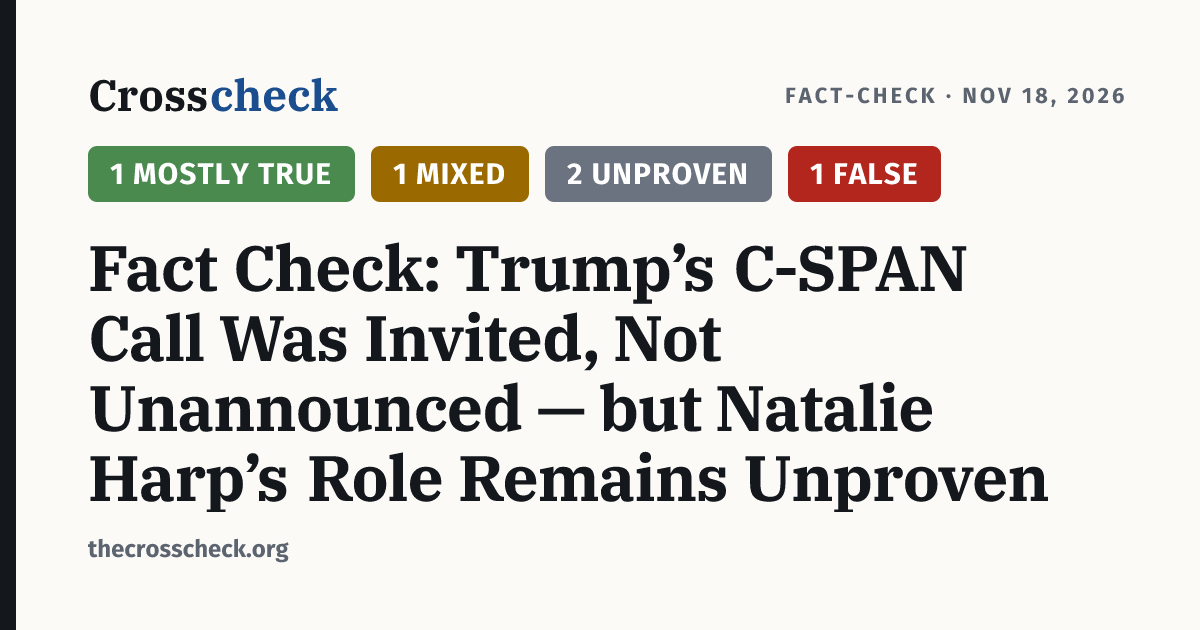
The Claims at a Glance
What Happened
On Monday evening, November 9, 2026, President Trump called into Washington Journal Primetime, the premiere episode of C-SPAN’s new nighttime program. Host Mimi Geerges announced the call to viewers with the phrase: “It looks like we’ve got a call from the White House.”[2] Trump spoke for approximately eight minutes, covering immigration enforcement, an effort by Rep. Thomas Massie and others to impeach Defense Secretary Pete Hegseth, and his stated practice of watching C-SPAN call-in programs to follow public sentiment.[9] The appearance was not listed on Trump’s public daily schedule.
As Trump began speaking, an audible laugh from an unidentified woman was heard briefly before he took over the line.[3] Multiple journalists and commentators quickly suggested the voice belonged to Natalie Harp, Trump’s longtime executive assistant, who is frequently present in his private workspace adjacent to the Oval Office.[4]
Two days later, at approximately 1:25 a.m. on Wednesday, November 11, Trump posted on Truth Social targeting New York Times coverage of the event.[1] The Times had originally described the call as made “APPARENTLY WITHOUT NOTICE.” Trump called this “WRONG,” asserting the call was “a fully scheduled call, as a favor to C-Span, set up through White House Communications. It was done at C-Span’s request, not mine.”
The Right Question
Much of the initial coverage and subsequent dispute framed the core question as: was Trump expected? But a more clarifying question is whether a sitting president’s prearranged call to a citizen call-in program should be presented as an organic viewer call-in.
Washington Journal’s format was built for ordinary viewers to phone in and ask questions or share opinions. When a network coordinates a White House call in advance and presents it on the same line, the resulting segment is functionally a presidential interview. The call-in format confers a quality of authenticity — the spontaneous citizen voice — that advance coordination undermines, whatever the scheduling details turn out to be. This distinction informs the analysis of all three claims below.
Was the Call “Unexpected”?
Multiple outlets characterized the call as a surprise. CNBC described it as “unannounced” and “unexpected.” The Daily Wire’s headline used “crashes.” The Daily Beast called it a “surprise call.”[6] None of these outlets had been told in advance that Trump would call.
The host’s on-air announcement, however, points in a different direction. Geerges said “it looks like we’ve got a call from the White House,” a phrase that implies prior knowledge, not surprise. A spontaneous caller from the public identifies themselves; a caller whose identity C-SPAN already knew could be introduced this way before the caller spoke.
The New York Times initially described the call as made “apparently without notice” to C-SPAN. Trump disputed this. Within a day, the Times had appended a correction: “Due to an editing error, an earlier version of this story misstated the circumstances of a call President Trump made to C-SPAN. Mr. Trump was invited to call in. He did not call in unannounced.”[7]
The steelman for “unexpected” is that it accurately describes the viewer’s experience: the call was not publicly pre-announced, and a journalist monitoring the schedule that night would have had no basis to expect it. Under a viewer-centered reading, the word is defensible. This version of the argument supports a narrower claim (“unexpected to the audience”) but does not counter the production-side evidence: C-SPAN’s invitation, the host’s foreknowledge, and the Times’ own correction all establish that the network was not surprised.
The verdict is Mixed: “unexpected” accurately describes the public’s experience but misrepresents C-SPAN’s. The call was entirely expected by the network that arranged it.
Was Natalie Harp the Voice in the Background?
Speculation about the giggling was rapid. Laura Rozen reported that “Natalie Harp [was] audibly giggling as Trump calls into C-SPAN.” Justin Baragona of Semafor wrote: “It has to be Natalie Harp giggling, right?” A CNN analyst posted that Trump appeared to have been “watching C-SPAN with Natalie Harp.”[10]
Harp is Trump’s executive assistant, described in reporting as a near-constant presence in the workspace adjacent to the Oval Office. She has taken on call-screening duties and reportedly received a $45,000 gift from Trump. The speculation was grounded in circumstance and her proximity to the president, not in audio identification.[4]
The White House offered a competing explanation. Through a spokesperson, the administration told Inside Edition: “The laugh is leftover audio from a previous caller who had not disconnected yet.”[5] The statement offered no identification of a person, only a technical attribution to a residual open line.
The White House’s explanation was disputed by commentators and drew public skepticism. That skepticism may be warranted — but skepticism is not identification. No authoritative source confirmed that Harp was present or that the voice was hers. The claim is Unproven.
Was the Call Fully Scheduled Through White House Communications?
Trump’s Truth Social post stated: “It was a fully scheduled call, as a favor to C-Span, set up through White House Communications. It was done at C-Span’s request, not mine.”[1]
The core claim — that the call was invited, not spontaneous — was confirmed by the outlet that originally contradicted it. The Times’ correction acknowledged that Trump “was invited to call in” and “did not call in unannounced.”[7] That correction validates Trump’s principal objection and directly addresses the contested phrase.
The specific assertion that the call was arranged “through White House Communications” and initiated “at C-Span’s request” comes solely from Trump’s account. No independent reporting or statement from C-SPAN has confirmed those organizational details. The correction establishes that the call was invited but does not describe the mechanism of invitation or which party initiated contact.
The verdict is Mostly True. Trump’s core objection stands. The specific claim about which office handled the scheduling, and whose idea it was to call, is unverified beyond Trump’s own account.
What the Post Implies
Multiple outlets’ framing of the call as a “viewer call-in” appearance implies Trump was dialing in like any member of the public. That framing is inaccurate. Trump called as a sitting president at C-SPAN’s invitation, using official White House coordination. The call-in format was the technical method; the substance was a prearranged presidential appearance.
Trump’s Truth Social post used the word “lied,” asserting the Times knew the truth and published something false regardless. The Times attributed the error to editing, not intent. There is no public evidence establishing that the original “without notice” framing was deliberate rather than a mistake. The claim that it was intentional deception cannot be rated from available evidence.
What the Findings Change
The NYT correction carries weight independent of Trump’s Truth Social post. When the newspaper that wrote “apparently without notice” publicly corrects that framing within a day, it confirms Trump had a factual grievance, not merely a political one. That correction is the most important piece of evidence in this fact-check, and it was issued by his adversary, not by his supporters.
The correction does not, however, resolve the category question. A president calling into a citizen call-in program at the network’s invitation looks different from a regular viewer dialing in with an opinion. How journalists and C-SPAN describe such appearances — whether as “interviews,” “call-ins,” or something else — has implications for how viewers understand the nature of what they are watching.
The identity of the person behind the giggle stays open. The White House explanation is implausible to many observers but has not been refuted with evidence. Without a confirmed identification from either the White House or Harp herself, the question cannot be settled from the public record.
Parties Affected
| Party | Effect | Why |
|---|---|---|
| Donald Trump | Mixed | Core scheduling objection validated by NYT’s own correction; “viewer call-in” framing he benefited from still misrepresents the nature of the appearance |
| New York Times | Costs | Had to issue a formal correction on a factual claim; “editing error” framing provided no shield against Trump’s accusation of deliberate dishonesty |
| C-SPAN | Mixed | Premiere episode attracted presidential attention and audience; its viewer call-in format was complicated by a prearranged White House call that wasn’t publicly disclosed in advance |
| Natalie Harp | Unclear | Named in widespread public speculation without confirmation or denial; an open question that the available record cannot resolve |
What to Watch
The Hegseth impeachment push. Trump used the C-SPAN call to publicly rebuke Rep. Thomas Massie and the small group of House members seeking to impeach Defense Secretary Pete Hegseth. That effort is active in the new Congress. Watch whether Massie’s coalition gains or loses members in the weeks following Trump’s on-air pushback — the call was explicitly intended as a signal to Republican holdouts.
C-SPAN’s disclosure norms for invited calls. The premiere episode raised a structural question: when C-SPAN invites a sitting president to phone in, how should that be labeled on-air and in advance? C-SPAN has not publicly stated whether it will disclose pre-coordinated presidential call-ins differently from ordinary viewer calls. A policy statement or a repeat appearance would clarify whether the November 9 format becomes a template.
Natalie Harp identification. Neither Harp nor the White House has confirmed or denied whether she was present during the call. If Harp or her representatives address the speculation publicly, or if audio-forensic reporting establishes the voice’s identity, that settles the open claim. Absent such confirmation, the Unproven verdict stands.
What Happened
On Monday night, November 9, 2026, President Trump called into a C-SPAN show. The show was called Washington Journal Primetime and it was its first episode ever. The host, Mimi Geerges, said: “It looks like we’ve got a call from the White House.” Trump talked for about eight minutes about immigration and an effort to remove Defense Secretary Pete Hegseth.
When Trump started talking, viewers briefly heard a woman laughing. No one has officially said who was laughing.
Two days later, around 1 in the morning, Trump posted on Truth Social. He said the New York Times had it wrong. The Times had said Trump called “apparently without notice.” Trump said this was false. He said the call was planned ahead of time, at C-SPAN’s request, and set up through White House Communications.
Was the Call “Unexpected”? — Mixed
Many news outlets called the call a “surprise” or “unexpected.” Trump was not on the public schedule for a C-SPAN call. So viewers watching at home were surprised.
But C-SPAN had invited Trump to call. The host said “It looks like we’ve got a call from the White House,” which suggests C-SPAN already knew the call was coming.
The New York Times first said the call was “apparently without notice.” The Times later corrected this, saying: “Mr. Trump was invited to call in. He did not call in unannounced.”
So “unexpected” is partly right (unexpected to viewers) and partly wrong (C-SPAN had invited him). That is why the verdict is Mixed. Also worth noting: Trump is the president, not a regular viewer. C-SPAN invited a sitting president to call their show. That is different from a citizen calling in with an opinion.
Was Natalie Harp the Person Giggling? — Unproven
Many journalists and social media users said the laugh belonged to Natalie Harp, Trump’s executive assistant. She is often nearby when Trump makes calls.
But no one confirmed this. The White House gave a different answer. They told Inside Edition the laugh was “leftover audio from a previous caller who had not disconnected yet.” In other words, they said it was a technical glitch, not a person in the room.
Because no one has confirmed who the giggle came from, this claim is Unproven.
Was the Call Fully Scheduled Through White House Communications? — Mostly True
Trump said the call was “a fully scheduled call, as a favor to C-Span, set up through White House Communications. It was done at C-Span’s request, not mine.”
The New York Times later corrected its own story. The correction said Trump “was invited to call in” and “did not call in unannounced.” This confirms the main part of Trump’s claim.
However, the specific detail that it went through “White House Communications” at “C-Span’s request” comes only from Trump’s own account. No outside source confirmed those details.
The main point, that the call was invited and not spontaneous, is confirmed. The specific details about how it was arranged are not independently checked. Verdict: Mostly True.
What the Post Implies
A reader might think Trump called in like a regular viewer watching TV at home. That is not accurate. The call was set up in advance, with C-SPAN inviting the president.
A reader might also think the New York Times deliberately lied. Trump used that word. But the Times said it was an editing mistake. There is no public evidence that the error was done on purpose.
What the Findings Change
The NYT’s correction matters. Even the Times admitted its “without notice” framing was wrong. This shows Trump had a valid point.
But the correction does not settle everything. A president calling a call-in show at the network’s invitation looks different from a regular viewer dialing in. How the press and C-SPAN should label such appearances is still a live question.
The identity of the person who giggled is still not known. Unless someone officially confirms or denies it, the question stays open.
What to Watch
Three things are still unresolved. First, the Hegseth impeachment push: Trump used the call to pressure House members not to impeach Defense Secretary Pete Hegseth. Watch whether that effort gains or loses support. Second, C-SPAN has not explained how it will label future invited presidential calls. If the show has Trump on again, it will matter whether viewers are told in advance. Third, the giggling voice: unless Natalie Harp or the White House confirms or denies her presence, the question stays open.
Sources
- Donald J. Trump: “The New York Times incorrectly reported…”
- Trump calls into premiere of C-SPAN’s new nighttime show
- WHO’S THAT GIRL? Internet Fixates on Mystery Giggling Woman in Trump’s C-SPAN Call-In
- Mystery Giggling Woman Crashes Trump’s Night Call
- White House Claims to Solve Mystery of Trump’s Giggler
- Trump’s C-SPAN call marks latest surprise post-midterm appearance
- Trump rages at ‘failing’ NYT in 2 AM posting spree
- Critics Mock ‘Desperate’ Trump After He Calls C-SPAN Live
- Trump dials into C-SPAN for surprise interview: ‘I like to watch the call-ins’
- CNN analyst speculates Trump was watching “C-SPAN with Natalie Harp”