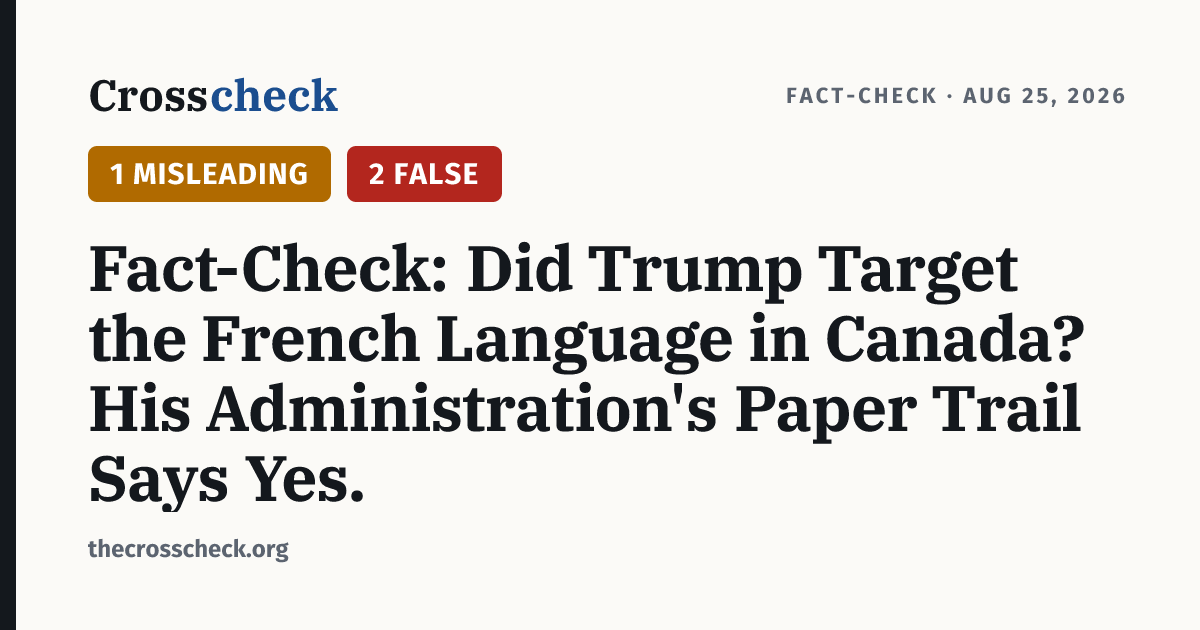
| Claim | Rating |
|---|---|
| “I would never interfere with Canadians speaking French! … I have never even thought of doing such a stupid thing.” | Misleading |
| “This lie was made up by a weak and ineffective Prime Minister” | False |
| Carney has “totally lost” support “from the people of Quebec” | False |
- The Post, Verbatim
- Context: Trade War, Language Law, and Collapsed Talks
- The Better Question (Frame-Lock Check)
- Claim 1: “Never Interfered” with French
- Claim 2: Carney’s Accusation Is a “Lie”
- Claim 3: Carney Has “Totally Lost” Quebec
- Who Is Involved and Affected
- Steelman: The Strongest Case for Trump’s Post
- What to Watch
The Post, Verbatim
“I would never interfere with Canadians speaking French! In fact, I have never even thought of doing such a stupid thing. This lie was made up by a weak and ineffective Prime Minister in an attempt to gain political support, which he has totally lost, from the people of Quebec. I love French Canadians! President DONALD J. TRUMP”
Context: Trade War, Language Law, and Collapsed Talks
At midnight on August 22, 2026, US-Canada trade negotiations collapsed after months of negotiations failed to produce agreement. The Trump administration imposed 50% tariffs on approximately $20 billion of Canadian goods. Prime Minister Mark Carney announced Canada would retaliate “dollar for dollar” with its own tariffs beginning September 8.[1]
The breakdown had been building for over a year. In April 2025, the US Office of the Trade Representative published its annual National Trade Estimate Report, which listed Quebec’s Bill 96, a 2022 provincial law strengthening French-language requirements for business and products sold in Quebec, as a foreign trade barrier. The specific grievance: provisions of Bill 96 require companies to add French translations of generic terms to product trademarks and labels when selling in Quebec.[2]
By August 2026, trade negotiations had broadened the French-language friction to include three additional policies: subsidies for Francophone media (French-language broadcasters and publishers that receive federal support), Canada’s Online Streaming Act (which requires platforms like Netflix and Spotify to invest in and promote Canadian content, including French-language programming), and Quebec’s Bill 109 (which requires streaming services operating in Quebec to prioritize French-language content in what audiences see first).[3]
On August 24, the day before Trump’s post, Carney held a press conference in which he said: “The French language and Quebec and Canadian culture might be trade irritants for the Americans, but in Canada they are fundamental rights.”[4] Trump’s Truth Social post, published at 7:36 AM on August 25, was a direct response.
The Better Question
The post’s denial, “I would never interfere with Canadians speaking French,” sidesteps the documented dispute entirely. Carney did not accuse Trump of walking up to a Quebecer and forbidding them to use French. He accused the Trump administration of pursuing trade demands that would eliminate the funding, labeling rules, and content mandates that sustain French-language culture at scale. Those are categorically different accusations, and the post answers only the one nobody made.
Claim 1: “I Would Never Interfere with Canadians Speaking French”
What is accurate
The Trump administration never proposed a policy preventing individual Canadians from speaking French. No negotiating demand, regulation, or executive action targeted individual language use. At that literal level, the denial is technically true.
What the record shows
The US did take documented actions targeting French-language institutional protections:
- April 2025: The USTR’s National Trade Estimate Report listed Quebec’s Bill 96 as a foreign trade barrier, specifically citing its French-labeling requirements for product trademarks.[2]
- August 2026 negotiations: The US negotiating position demanded elimination of Canada’s subsidies for French-language media (broadcasters, publishers, and online outlets that receive federal funding specifically to support French-language content).[3]
- Streaming laws: The US opposed the Online Streaming Act and Quebec’s Bill 109, both of which direct investment toward French-language programming on platforms operating in Canada.[3]
US Trade Representative Jamieson Greer disputed Carney’s framing. He called the French-language characterization a “funny fake story,” arguing the real objection was that Canada forces American companies like Netflix and Spotify to redirect earnings to Canadian competitors, not because the US opposes French per se.[5]
Greer’s distinction is real: the US did not write a demand saying “cut French funding.” It wrote demands targeting specific financial mechanisms (media subsidies, streaming investment mandates) whose primary purpose is sustaining French-language content. Whether to call that “targeting French language” or “targeting discriminatory taxes” is a framing contest; the underlying demands are documented.
Verdict: Misleading. Trump’s denial answers a question nobody asked. The actual US policy record directly contradicts the claim: listing Quebec’s language law as a trade barrier, demanding removal of French-media subsidies and streaming mandates. The post substitutes a literal denial of individual speech suppression for the trade policy question actually at issue.
Claim 2: “This Lie Was Made Up” by the Prime Minister
Calling Carney’s statement a “lie” requires that it be demonstrably false. The factual record does not support that.
The USTR report listing Bill 96 as a trade barrier is a public document, published by the US government in April 2025. The demands to remove French-language media subsidies and streaming investment requirements were reported by multiple independent outlets, including CBC News, CNN, and the Japan Times, all citing Canadian government officials who were present at the negotiations.[3][6]
Greer’s counter-characterization (that the real issue was discriminatory taxes, not French language) acknowledges the streaming dispute exists. He disputes the framing of that dispute, not its existence. Even in denying Carney’s framing, Greer confirmed there were US demands that Carney described as threatening French-language infrastructure.
Carney’s characterization may be contested in its framing (the US says “fair trade”; Canada says “language threat”), but it is not fabricated. The demands existed. Their documented scope overlaps substantially with policies designed to protect French-language culture. Calling Carney’s summary a “lie” requires that nothing like those demands occurred. The paper trail shows they did.
Verdict: False. The characterization of Carney’s statement as a manufactured “lie” is contradicted by the US government’s own 2025 trade barriers report and by the reported specifics of the August 2026 negotiating demands.
Claim 3: Carney Has “Totally Lost” Support from the People of Quebec
Available polling data runs in the opposite direction from this claim.
Angus Reid, Aug. 23, 2026
Liaison Strategies, Aug. 2–15, 2026
Angus Reid, Aug. 23, 2026
The Angus Reid Institute surveyed Canadians on August 23, two days before Trump’s post, and found that 76% of all Canadians said Canada was right to walk away from trade talks, versus 13% who disagreed. In Quebec specifically, that figure rose to 85%, the highest of any province.[7]
A separate Liaison Strategies poll conducted August 2–15 found Carney’s personal approval rating at 76% in Quebec, the highest of any region in the country.[8]
The Quebec provincial election is scheduled for October 5, 2026 (41 days after Trump’s post). The Parti Québécois (the separatist party) leads provincial polls with approximately 31% of decided voters, ahead of the Quebec Liberal Party at 27%. Federally, Carney’s Liberals hold their largest margin in Quebec among all surveyed regions.[9] If anything, the trade dispute has boosted Carney’s standing in Quebec, not damaged it.
Verdict: False. Two independent polls conducted within the week before the post show Carney with 76–85% support in Quebec on the specific issue Trump raises. “Totally lost” does not describe any available measure of his Quebec standing.
Who Is Involved and Affected
| Actor | Role | Position as of August 25, 2026 |
|---|---|---|
| Trump / US government | Trade demands; 50% tariffs imposed | Disputed — tariffs in effect; Greer disputes the French-language framing while confirming the streaming demands |
| PM Carney / Canada | Walked away from talks; retaliatory tariffs announced Sept. 8 | Strong domestic position — 76–85% Quebec support; highest approval in the country in that province |
| Quebec (Legault government) | Author of Bill 96; French-language advocate | Watching federal lead — province declared French protections “non-negotiable”; provincial election October 5 |
| Francophone media / broadcasters | Recipients of contested subsidies | At stake — subsidies targeted by US demands are their primary revenue source beyond advertising |
| US streaming companies (Netflix, Spotify) | Subject to Online Streaming Act and Bill 109 | US backing — Greer’s “discriminatory tax” framing represents their interests; current mandates cost them |
| Canadian consumers | Bear the cost of tariffs and retaliatory duties | Economic harm — 50% US tariffs on $20 billion of goods; retaliatory tariffs returning Sept. 8 |
Steelman: The Strongest Case for Trump’s Post
The most defensible reading of Trump’s position runs through Greer’s framing. The US did not object to the French language as such. It objected to Canada requiring US technology companies (Netflix, Spotify, Apple Music) to redirect a percentage of their Canadian revenue to fund Canadian content. That mandate happens to fund French-language content, but a hypothetical identical mandate requiring investment in, say, English-language Canadian content would draw the same US objection. The connection to French language is an effect of Canada’s content priorities, not the US’s stated target.
On this reading, “never interfere with Canadians speaking French” captures something real: the US’s objection is framed in the language of trade neutrality, not cultural hostility. Greer’s “funny fake story” comment argues that Carney repackaged a straightforward trade dispute as a cultural attack to generate domestic political support, and the polling suggests it worked.
Score: 2/5. This distinction between intent and effect is genuine, but it does not overcome two specific facts that survive Greer’s framing. First, the USTR specifically listed Quebec’s Bill 96, a law whose explicit purpose is French-language protection, as a trade barrier. That is a targeted action against a French-language law, regardless of how the US characterizes its motivation. Second, the demand to eliminate subsidies for French-language media targets a category that exists precisely because French speakers are a linguistic minority requiring structural support. Both the framing contest (intent vs. effect) and Greer’s denial have been weighed; neither reaches the threshold for reversing the verdicts above.
What to Watch
- Sep 8 Canada’s retaliatory tariffs take effect. The scope will clarify whether Ottawa targets US industries with Quebec-specific economic ties, a signal of whether Carney is playing the Quebec political angle or pursuing a symmetrical trade response.
- Oct 5 Quebec provincial election. With the Parti Québécois leading federal polls in Quebec at 31% and the federal Liberals at their national high in the province, the election result will show whether the trade war has accelerated Quebec nationalist sentiment or whether Carney’s strong approval holds. A strong PQ showing could complicate federal Carney’s positioning on future trade concessions.
- Ongoing USTR 2026 trade barriers report. The April 2025 report listed Bill 96. Watch whether the 2026 edition adds or expands the French-language entries. That would confirm the trajectory of US demands independent of any political framing by either side.
- Ongoing The Greer vs. Carney framing war. Both sides have political incentives to characterize the demands differently. A leaked negotiating text or joint statement that specifies actual US asks (rather than characterizations of them) would resolve the intent-vs.-effect dispute the steelman above identifies.
Plain-Language Summary (simpler reading level)
On August 25, 2026, Donald Trump posted on Truth Social saying he never tried to stop Canadians from speaking French. He called Canadian Prime Minister Mark Carney’s claims about this a “lie.” He also said Carney had “totally lost” the support of Quebec’s people. Here is what the facts show.
What actually happened
Three days before Trump’s post, US-Canada trade talks collapsed. The US put 50% tariffs on about $20 billion of Canadian goods. Carney said US demands would have hurt the French language in Canada. Those demands included:
- Cutting subsidies (government money) that support French-language TV, radio, and news outlets.
- Removing the rule that requires products sold in Quebec to have French labels, a rule from a Quebec law called Bill 96.
- Ending laws that make streaming services like Netflix put money toward French-language shows and films.
The US had already listed Bill 96 as a trade problem in an official report in April 2025. That is not a secret: it is in a published US government document.
Trump’s “never interfered” claim: Misleading
Trump says he never tried to stop Canadians from speaking French. That is true in the narrow sense: no law said “Canadians cannot speak French.” But Carney never claimed that. Carney said US trade demands would have eliminated the systems that help French stay strong in Canada: the funding, the labeling rules, and the streaming requirements. Trump answered a different, easier question, one nobody asked.
Calling it a “lie”: False
The US government’s own published 2025 report lists Quebec’s French-language law as a trade problem. Multiple news organizations confirmed the US demanded changes to French-media funding and labeling rules. Even the US trade representative, Jamieson Greer, admitted the streaming-funding issue was real; he just described it differently than Carney did. A dispute over framing is not a lie.
Claiming Carney lost Quebec: False
An Angus Reid Institute poll taken two days before Trump’s post found that 85% of people in Quebec supported Carney’s decision to walk away from trade talks. A separate poll found Carney’s approval in Quebec was 76%, higher than anywhere else in Canada. Trump’s claim that Carney “totally lost” Quebec support is directly contradicted by these numbers.
On August 25, 2026, Donald Trump posted on Truth Social saying he never tried to stop Canadians from speaking French. He called Canadian Prime Minister Mark Carney’s claims about this a “lie.” He also said Carney had “totally lost” the support of Quebec’s people. Here is what the facts show.
What actually happened
Three days before Trump’s post, US-Canada trade talks collapsed. The US put 50% tariffs on about $20 billion of Canadian goods. Carney said US demands would have hurt the French language in Canada. Those demands included cutting government funding for French-language TV, radio, and news outlets; removing the rule that requires products sold in Quebec to have French labels (from a Quebec law called Bill 96); and ending laws that make streaming services like Netflix put money toward French-language shows and films. The US had already listed Bill 96 as a trade problem in an official US government report in April 2025.
Trump’s “never interfered” claim: Misleading
Trump says he never tried to stop Canadians from speaking French. That is true in the narrow sense: no law said “Canadians cannot speak French.” But Carney never claimed that. Carney said US trade demands would have eliminated the systems that help French stay strong in Canada — the funding, the labeling rules, and the streaming requirements. Trump answered a different, easier question, one nobody asked.
Calling it a “lie”: False
The US government’s own published 2025 report lists Quebec’s French-language law as a trade problem. Multiple news organizations confirmed the US demanded changes to French-media funding and labeling rules. Even the US trade representative, Jamieson Greer, admitted the streaming-funding issue was real; he just described it differently than Carney did. A dispute over framing is not a lie.
Claiming Carney lost Quebec: False
An Angus Reid Institute poll taken two days before Trump’s post found that 85% of people in Quebec supported Carney’s decision to walk away from trade talks. A separate poll found Carney’s approval in Quebec was 76%, higher than anywhere else in Canada. Trump’s claim that Carney “totally lost” Quebec support is directly contradicted by these numbers.
Sources
- U.S. tariffs on Canadian goods take effect after trade talks collapse
- U.S. lists Quebec’s language law as ‘trade barrier’
- French has become a sticking point in the Canada-US trade dispute. Here’s why
- Canadian culture, French are fundamental rights — not trade irritants, Carney says
- How the French language contributed to the US-Canada trade war
- Trump says idea of him interfering with Canadians speaking French is a ‘stupid thing’
- Resolve & apprehension: 76% say Canada was right to ditch trade talks
- Federal Tracker: Liberals Lead by 11 as Carney Approval Reaches 60%
- Quebec election: Parti Québécois maintains lead in polls
- Truth Social post by Donald J. Trump, August 25, 2026, 7:36 AM