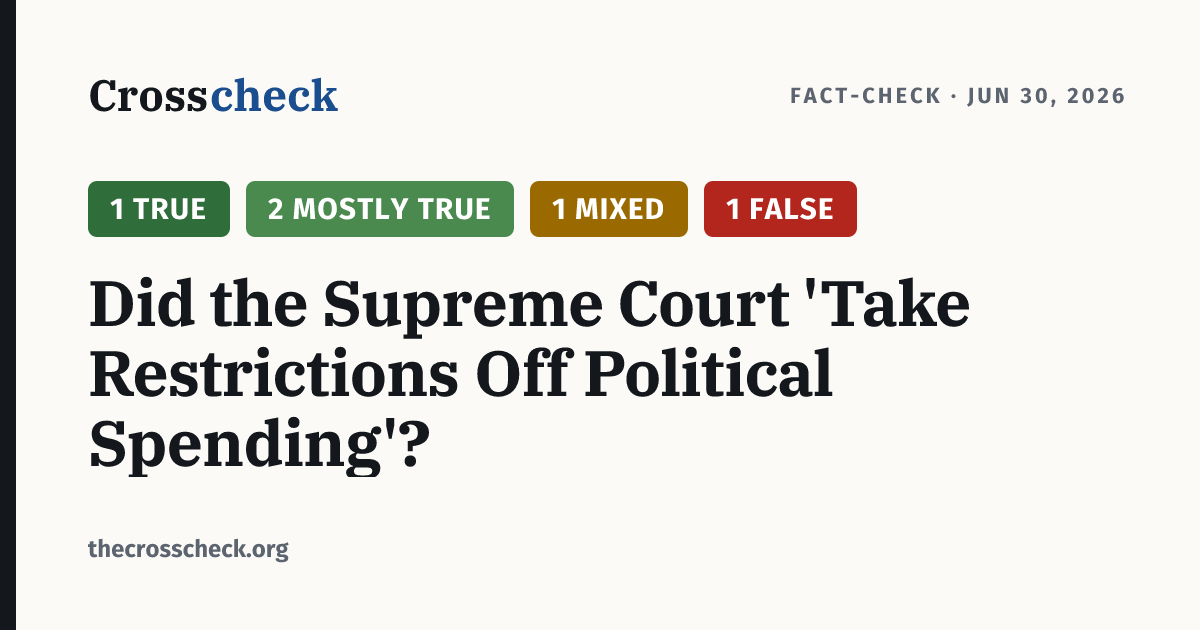
The claims, rated
The Court “took restrictions off political spending” on First Amendment grounds.
It is “a big win for Republicans.”
It lets billionaires spend an unlimited amount to win elections.
It removed all restrictions on political spending.
It overturned the 2001 precedent (Colorado II) upholding these limits.
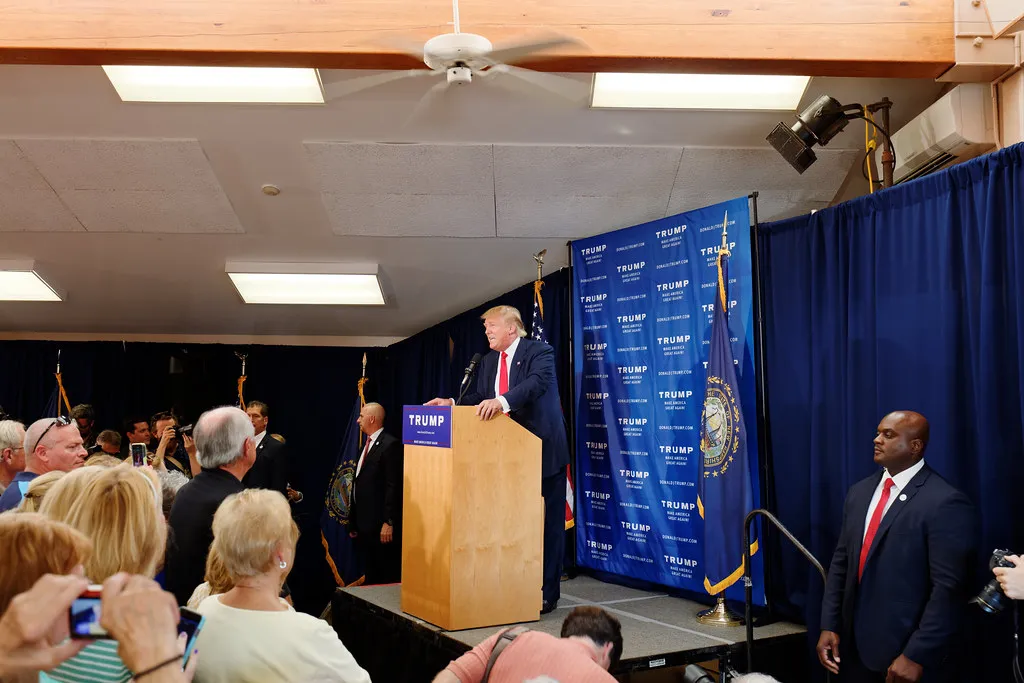
The image pairs a victory lap with a jab. Donald Trump: “The Supreme Court just took restrictions off political spending! A BIG WIN FOR REPUBLICANS and, more importantly, The First Amendment!” Beneath it, former Democratic candidate Melanie D’Arrigo: “Celebrating billionaires being able to buy elections is admitting that you need billionaires spending an unlimited amount of money… to win elections.” Both react to a real, significant ruling. Both also blur what it actually says.[1]
Mostly True01What the Court did
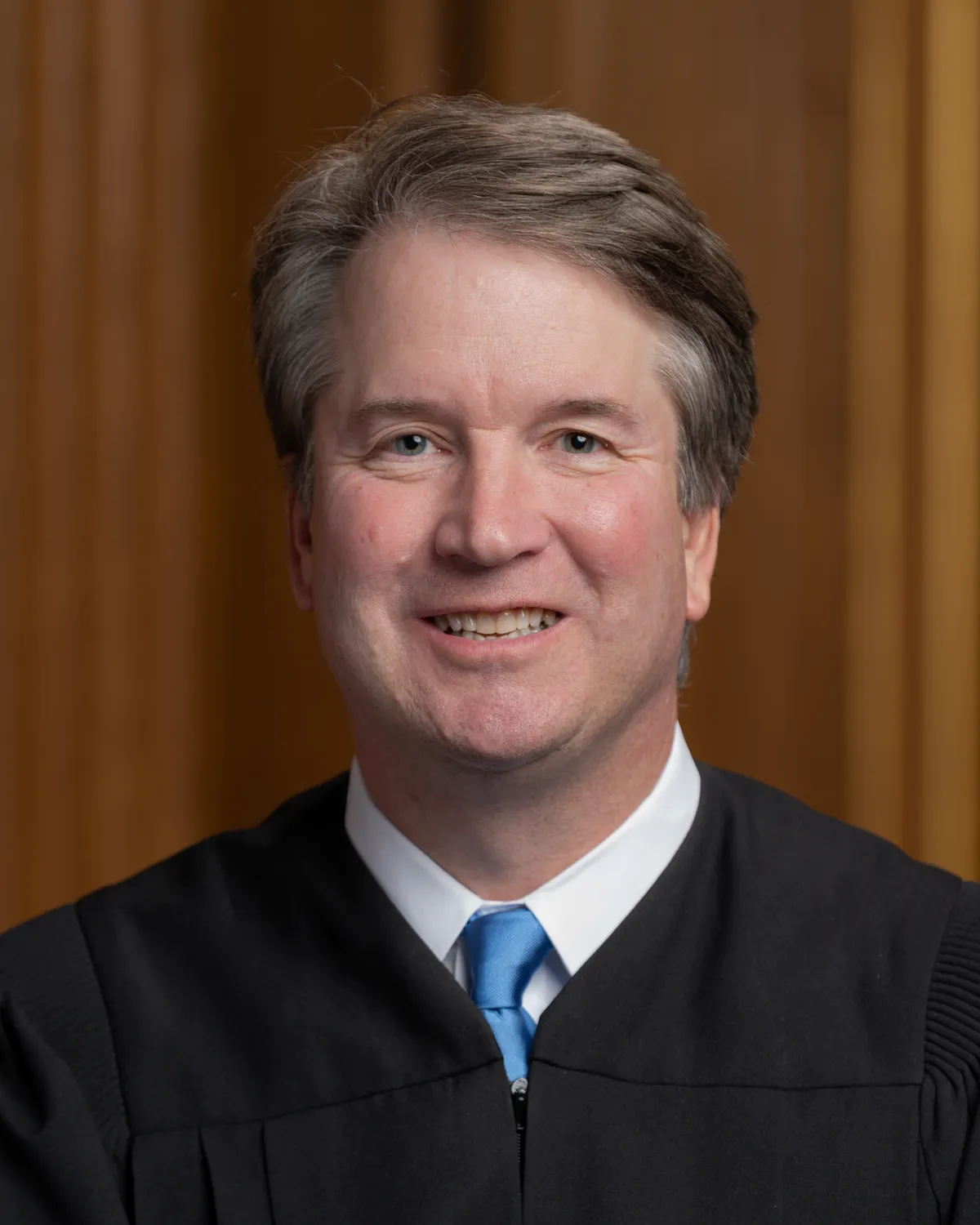
In National Republican Senatorial Committee v. FEC (decided June 30, 2026), the Court voted 6–3 along ideological lines to strike the limits on coordinated party expenditures, the cap on how much a party committee can spend in concert with a specific candidate. Justice Kavanaugh wrote for the majority; Justice Kagan dissented, joined by Sotomayor and Jackson. The case was brought by the NRSC, the NRCC, and then-candidate JD Vance, and backed by the Trump Justice Department, which declined to defend the law; the Democratic Party intervened to defend it.[1][5]
So Trump’s core claim is accurate: the Court did strike a spending restriction, on First Amendment grounds. It is Mostly True rather than flatly true because it removed one limit, not all of them, a distinction the next section draws.
“It will allow all political parties — including the DNC and RNC and the respective Senate and House campaign committees — to participate more freely and compete more fully… and to coordinate more closely with their candidates.”Justice Kavanaugh, majority[2]
02What fell, and what still stands
This is the precision Trump’s tweet skips and D’Arrigo’s overshoots.
✕ Removed
- The cap on coordinated party expenditures (§ 30116)
- Old House caps of ~$65K–$131K per race
- Old Senate caps up to ~$4 million
- The 2001 precedent (Colorado II)
✓ Still applies
- Donor-to-candidate cap (~$7,000/cycle)
- Donor-to-party cap (~$500K across accounts)
- Ban on corporate direct contributions
- Disclosure of party money
So neither “all restrictions are gone” (Trump) nor “billionaires can now spend unlimited directly” (D’Arrigo) is right. A donor still cannot hand a candidate a fortune. What changed is that the party can now pour an unlimited, coordinated total into a single race, funded by many maxed-out donors.
Mostly True03“A big win for Republicans”?
The rule is symmetric: Kavanaugh stressed it “treats all political parties equally.” But in effect, right now, it favors the GOP. Republican committees entered the midterms with about $256 million banked and no debt, versus roughly $127 million (and $18M in debt) for Democrats. The side with more cash to coordinate benefits first, so “big win for Republicans” is fair as a near-term read, even though the tool is available to both.[2]
Mixed04Does it let billionaires “buy elections”?
D’Arrigo’s line is rhetoric, but its factual premise is checkable, and it is half-right. The donor-to-party cap did not vanish; a person still cannot give a party unlimited money. What vanished is the cap on party spending. Justice Kagan’s dissent draws the mechanism precisely:
“A donor will be able to give a party as much as half a million dollars (as compared to the $7,000 he can give directly to the candidate) to cover the candidate’s bills. And the candidate can seek just such a donation.”Justice Kagan, dissenting[2]
So the straighter path from big money to a specific candidate is real, which is the substance behind D’Arrigo’s jab. But “unlimited billionaire spending” already existed as the super PAC, and this ruling is about parties, not a new uncapped donation. Directionally right, technically loose: Mixed.
05The strongest counter-case
Honesty requires the other side at full strength. A serious line of campaign finance scholarship argues that capping party spending was counterproductive, because it pushed money toward super PACs and anonymous “dark money” groups that are less transparent and less accountable than parties, which disclose donors and answer to voters. On this view, letting parties compete could pull money out of the shadows into disclosed channels. Kavanaugh’s “level playing field” framing leans on exactly that.
What the argument cannot do is make the ruling neutral in effect. Even if party money is more transparent than dark money, more coordinated money still advantages incumbents, establishments, and max-out donors. The transparency point softens the story; it does not erase it. It would be vindicated if dark-money spending actually falls as money returns to parties, and undercut if total spending simply rises with parties added on top.
06Bottom line
Trump is right that the Court removed a restriction on political spending and rested it on the First Amendment, and wrong to imply it swept them all away. “Big win for Republicans” holds in the near term because of the GOP’s cash lead, even though the rule is symmetric. D’Arrigo is right that big money got a straighter path to candidates, and loose in calling it the “unlimited billionaire” ruling, that lane was already the super PAC. The accurate version sits between the two tweets: a narrow holding with a wide effect, re-centering money on the parties and thinning the last legal defenses of campaign finance law.
Sources
- Supreme Court strikes down limits on political party spending — NPR.
- Supreme Court sides with GOP, loosens campaign spending rules — The Washington Post (GOP/Dem cash figures; Kagan’s $500K-vs-$7,000 quote).
- NRSC v. FEC, No. 24-621 — slip opinion — U.S. Supreme Court.
- Supreme Court strikes down coordinated campaign spending limits — CBS News.
- National Republican Senatorial Committee v. FEC — Wikipedia (docket, vote, holding).
- What the campaign finance ruling means for 2026 — NBC News.
- Contribution limits — Federal Election Commission (the caps that remain).
- What is NRSC v. FEC? — American Promise.
Sources
- Supreme Court strikes down limits on political party spending — NPR
- Supreme Court sides with GOP, loosens campaign spending rules — The Washington Post
- NRSC v. FEC, No. 24-621 — slip opinion — U.S. Supreme Court
- Supreme Court strikes down coordinated campaign spending limits — CBS News
- National Republican Senatorial Committee v. FEC — Wikipedia
- What the Supreme Court’s campaign finance ruling means for 2026 — NBC News
- Contribution limits — Federal Election Commission
- What is NRSC v. FEC? — American Promise