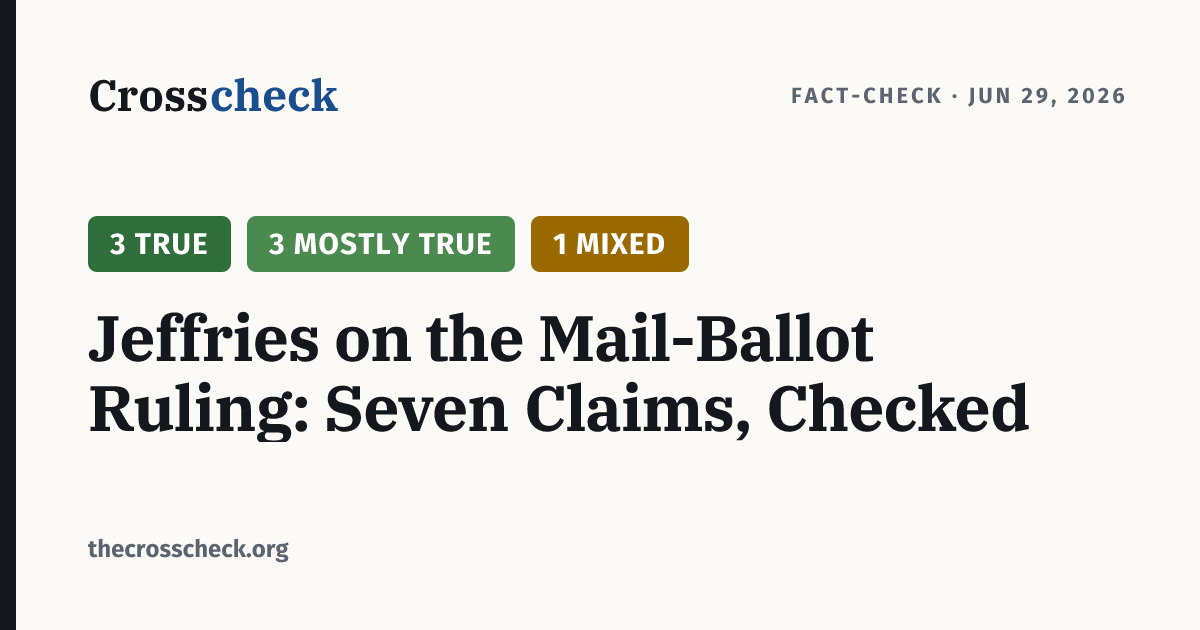
Seven claims, rated
The 5-4 ruling preserved states’ authority over mail voting, upholding grace periods for ballots postmarked by Election Day.
Mail voting was not a partisan issue until Trump attacked it after losing in 2020.
Trump promised to lower costs on day one; costs rose instead.
Tariffs cost households “thousands” per year.
The One Big Beautiful Bill enacted the largest Medicaid cut in history.
A costly Iran war Trump pledged to avoid raised gas prices.
The Court blocked a Trump “scheme to rig the midterms.”
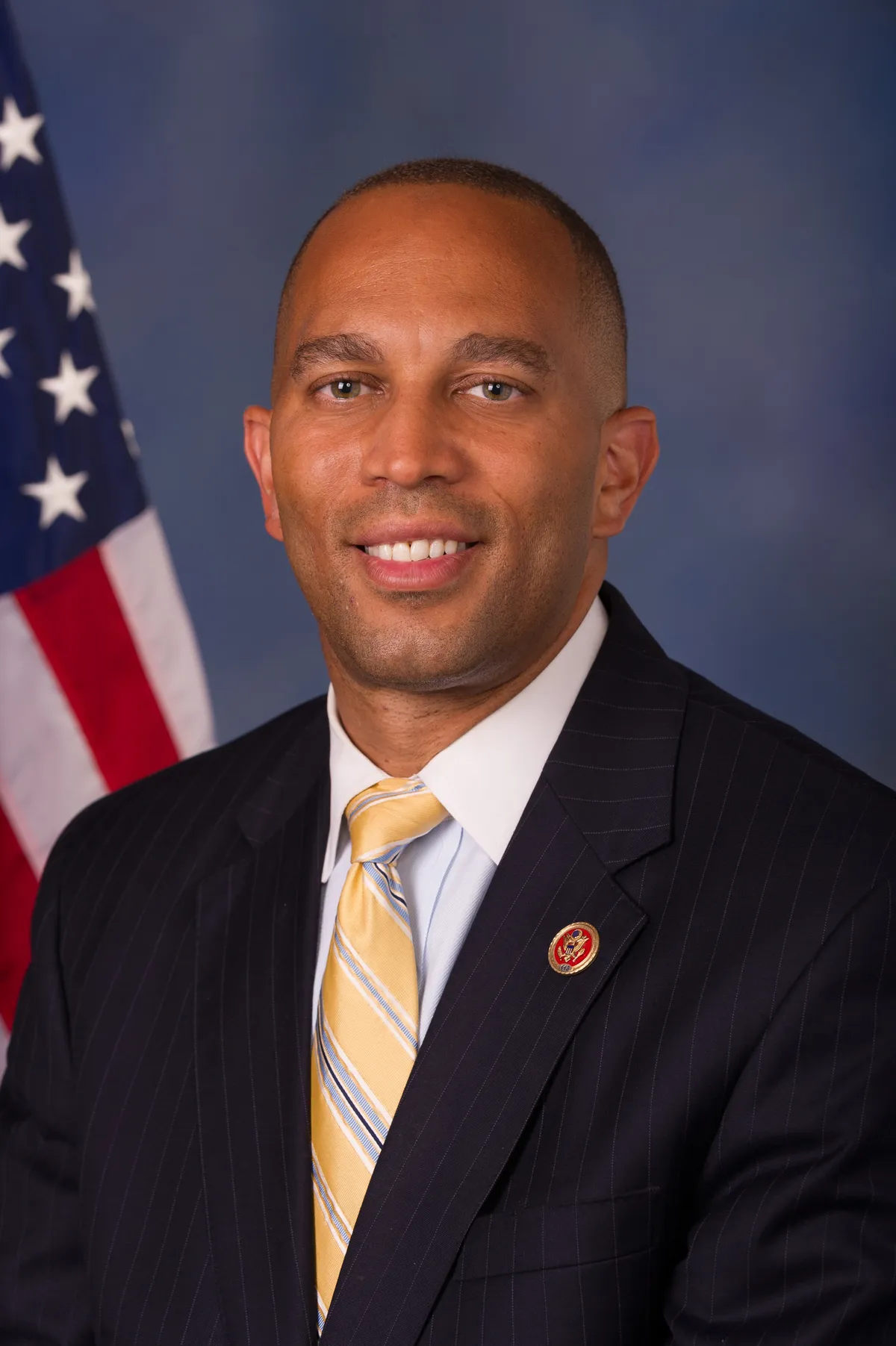
On June 29, 2026, hours after the Supreme Court ruled on mail-in ballots, House Minority Leader Hakeem Jeffries stepped to a news-conference microphone and used the win to indict Trump’s entire record, from tariffs to Medicaid to the war in Iran.[3] A leadership presser is built to persuade, so the question is whether the facts underneath the framing hold. Mostly, they do. Here is each claim against the record.
True01The ruling, and the law
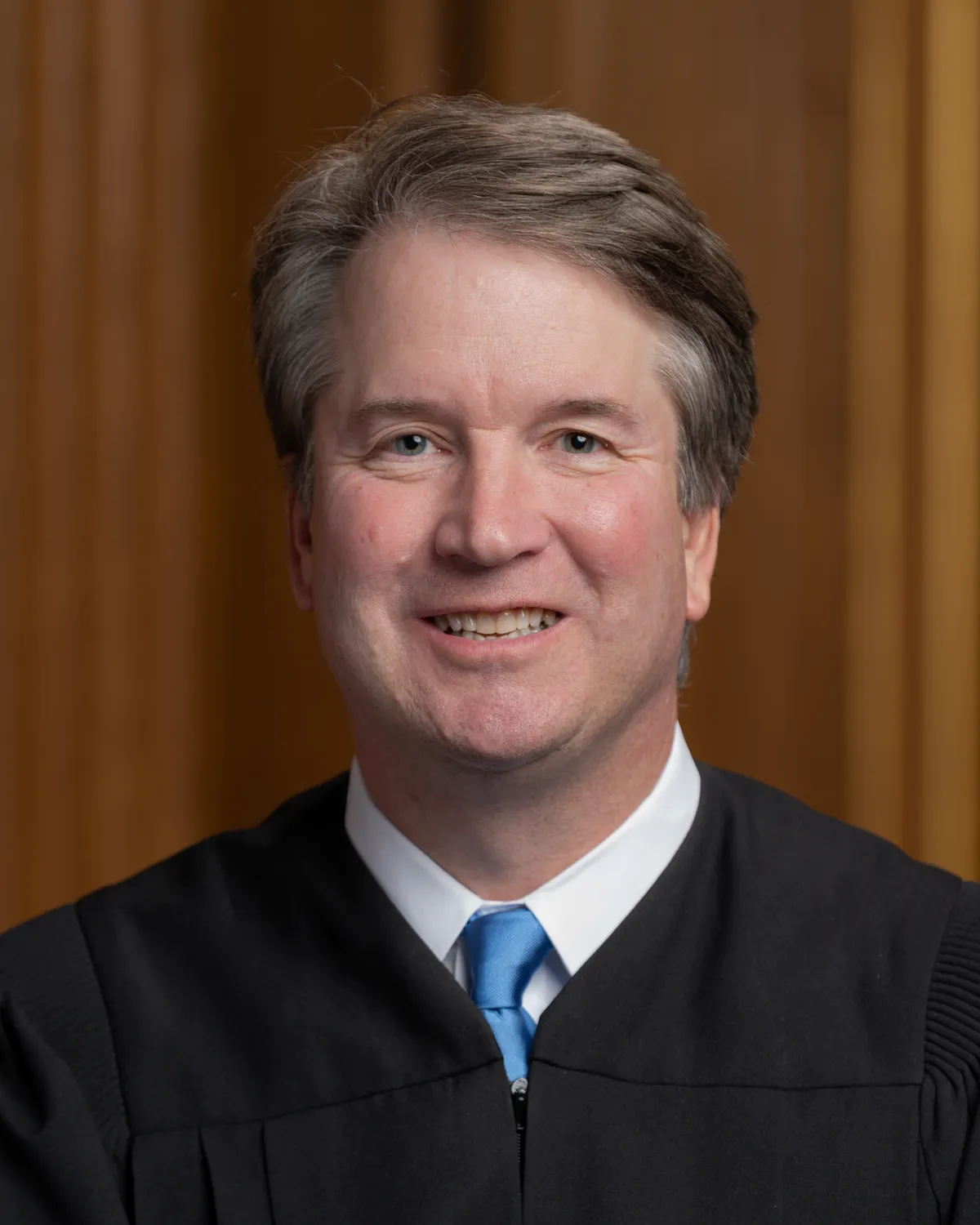
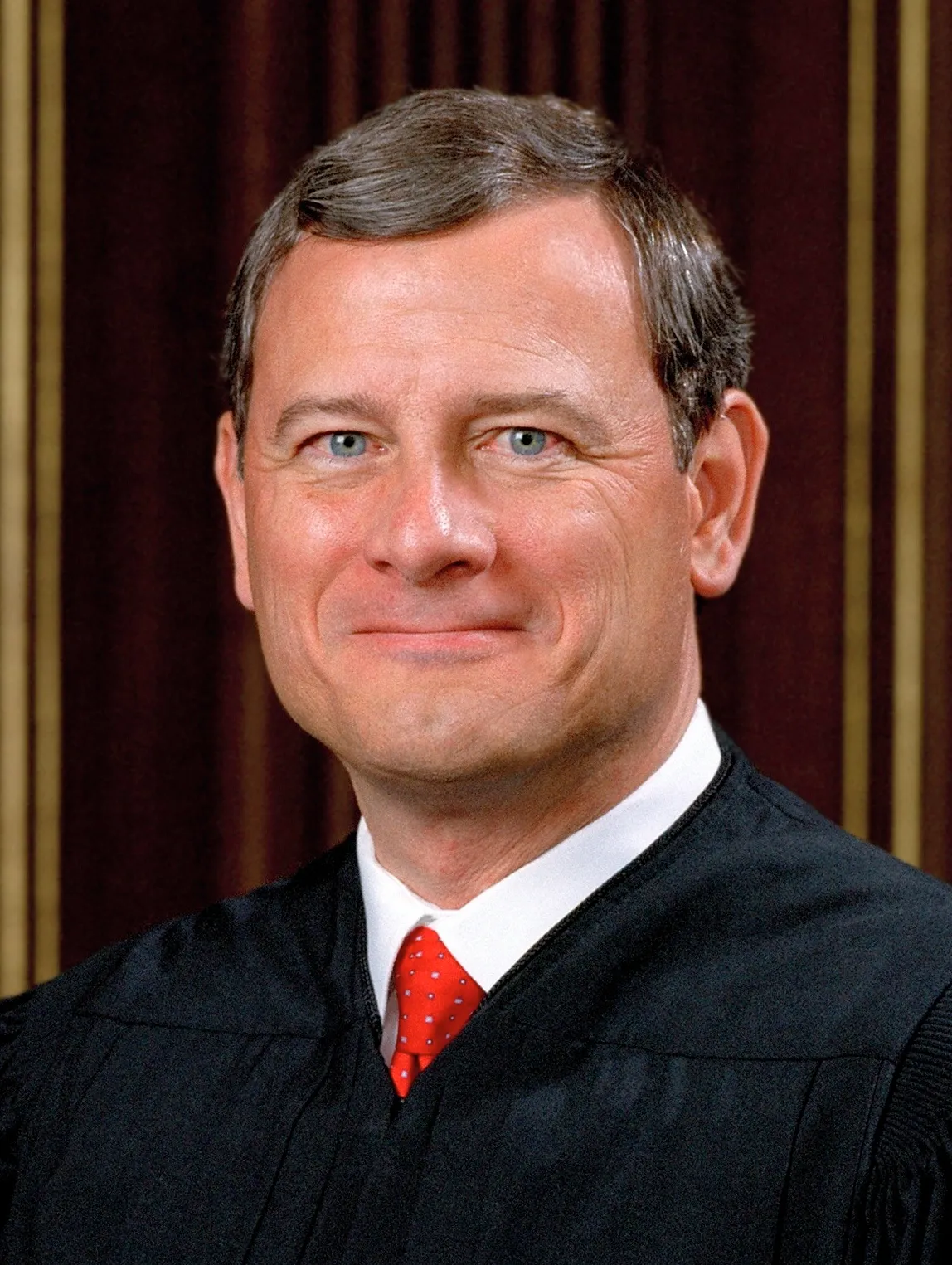
Jeffries said the Court, in a “narrowly concluded 5-4 decision,” preserved each state’s ability to manage mail voting. That is accurate. The justices upheld a Mississippi law counting mail ballots that arrive late but are postmarked by Election Day. Justice Amy Coney Barrett wrote the majority, joined by Chief Justice Roberts and the three liberal justices, an unusual cross-ideological coalition. The ruling protects grace periods in the 29 states that have them and rejected a challenge brought by the Republican National Committee and the Trump administration; Trump called it a “tremendous loss.”[1][2]
Does it stand up as law? Yes. Federal statute sets an Election Day but is silent on when ballots must be received, so states retain authority to set receipt deadlines. “Did the right thing” is Jeffries’ opinion, but his legal description, that states keep the power, matches the holding.
Mostly True02Was mail voting “never” partisan before Trump?
The strong claim mostly holds. Before 2020 there was little partisan difference in voting by mail, and Republicans for years ran vigorous absentee programs in states like Florida and Arizona. The chasm opened in 2020, when 58 percent of Democrats but only 29 percent of Republicans voted by mail, a split researchers at MIT and elsewhere attribute directly to Trump’s rhetoric calling mail ballots fraudulent.[4] The word “never” is a rhetorical absolute, and the documented irony is that Trump himself voted by mail in 2020.[5] The core history, non-partisan until Trump weaponized it after a loss, is sound.
True03“Costs have gone up”
Trump campaigned on lowering prices “starting on day one.” Prices instead rose through 2025 and into 2026, pushed by tariffs and the Iran-war fuel spike. The promise-versus-result gap is real.[12]
Mostly True04Tariffs costing “thousands” a year
This one is true at its peak and high at the margin. The Yale Budget Lab pegged the tariff burden at about $2,400 per household in 2025, then revised it down as some tariffs expired or were struck, to roughly $1,300 to $1,700 by late 2025 and about $780 to $1,338 by April 2026.[6][7] “Thousands per year” described the 2025 high-water mark accurately, but it runs ahead of the most recent estimate. The burden is also regressive, falling hardest on the lowest-income households. Defensible, but it cites the peak.
True05The largest Medicaid cut in history
Trump repeatedly promised to protect Medicaid. The One Big Beautiful Bill Act, signed July 4, 2025, then cut roughly $900 billion to more than $1 trillion from Medicaid over a decade, which health-policy analysts describe as the largest reduction in the program’s history and the most dramatic change since Medicaid began in the 1960s. The Congressional Budget Office projects on the order of 10 to nearly 12 million people losing coverage.[8][9] “Largest in history” is a superlative, but it is backed by CBO-scale numbers and stated widely.
Mostly True06A war he pledged to avoid
Trump campaigned on stopping wars, not starting them. The United States and Israel launched war on Iran in late February 2026, and Iran’s threat to the Strait of Hormuz sent energy prices up. Gas rose roughly 40 percent, about $1.08 a gallon nationally, peaking near $4 before easing.[10][11] The facts, that the war happened and gas spiked, are accurate. “Reckless war of choice” is contested characterization; the administration frames it as counter-proliferation. The factual spine is solid, the adjectives are argument.
Mixed07A “scheme to rig the midterms”?
The factual core is solid: the Court ruled against Trump and the RNC, and Trump called the result a loss. But “scheme to rig the midterm elections” is Jeffries’ inference about motive. It is true the administration has pushed to tighten federal mail-voting limits, including the SAVE Act, yet “rig” is advocacy language, not an established fact. Fact plus partisan inference.
08Bottom line
Jeffries’ numbers and his read of the law hold up. The ruling is described accurately, the Medicaid and gas-price figures check out, the mail-voting history is sound, and the tariff figure is true at its peak. What he layers on top, motive (“scheme to rig”), character (“reckless”), and absolutes (“never”), is the partisan packaging a leadership presser is built to deliver. Nothing here is false. The softest spots are the rhetorical absolute and the peak-of-the-range tariff number, and a careful listener can keep the verified facts without importing the adjectives.
Sources
- The Supreme Court upholds grace periods for mail-in ballots — NPR.
- Justices uphold state law allowing for late-arriving mail-in ballots — SCOTUSblog.
- Hakeem Jeffries news conference on the mail-in ballot decision — C-SPAN.
- How Policy Influenced the Partisan Divide over Voting by Mail — MIT Election Lab.
- Trump, while attacking mail voting, casts a mail ballot again — NPR.
- State of U.S. Tariffs: April 2, 2026 — The Budget Lab at Yale.
- Do Trump tariffs cost families $1,700? — Poynter / PolitiFact.
- Health Provisions in the 2025 Federal Budget Reconciliation Law — KFF.
- Medicaid-Related Provisions in Title IV of H.R. 1 — Congressional Budget Office.
- How much the Iran war cost — and how its effects will linger — NPR.
- Gas prices since the Iran war, tracked by state — NBC News.
- A Year in Review: How Trump’s Economic Policies Made Life Less Affordable — Center for American Progress.
Sources
- The Supreme Court upholds grace periods for mail-in ballots, siding against the GOP — NPR
- Justices uphold state law allowing for late-arriving mail-in ballots — SCOTUSblog
- Hakeem Jeffries news conference on the Supreme Court mail-in ballot decision — C-SPAN
- How Policy Influenced the Partisan Divide over Voting by Mail — MIT Election Lab
- Trump, while attacking mail voting, casts a mail ballot again — NPR
- State of U.S. Tariffs: April 2, 2026 — The Budget Lab at Yale
- Do Trump tariffs cost families $1,700? — Poynter / PolitiFact
- Health Provisions in the 2025 Federal Budget Reconciliation Law — KFF
- Information Concerning Medicaid-Related Provisions in Title IV of H.R. 1 — Congressional Budget Office
- Here’s how much the Iran war cost — and how its effects will linger — NPR
- Gas prices since the Iran war, tracked by state — NBC News
- A Year in Review: How the Trump Administration’s Economic Policies Made Life Less Affordable — Center for American Progress