
In October 2013 CNN ran an opinion piece by John Foubert, an education professor and founder of One in Four, a rape prevention nonprofit that developed the program his own research evaluates. He wrote that fraternity men are three times more likely to commit rape and that the fraternity experience makes them that way.[1] Checked against the studies he cited and the research published since, the first half holds in weaker form: fraternity membership is linked to more self-reported sexual aggression, with effect sizes that shrink as study designs improve. The second half, that fraternities cause the difference, is not established. The best longitudinal work finds that men who join already differ before college, and that a smaller link remains after accounting for it.
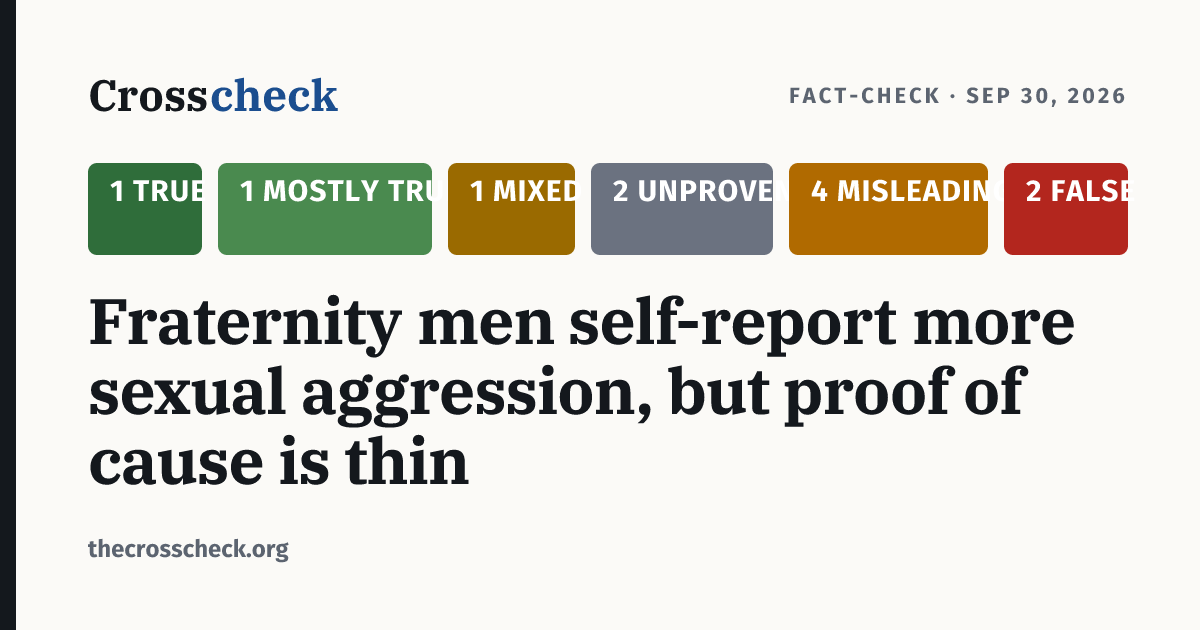
Verdicts at a glance
- Mostly True
Fraternity members are more likely than other college men to commit sexual assault
Most studies find a positive link between fraternity membership and self-reported sexual aggression. A 2007 meta-analysis called it smaller than the link to rape-supportive attitudes, and a 2022 meta-analysis of longitudinal studies pooled an odds ratio of 2.65 whose confidence interval (0.99 to 7.08) included 1.0. The size depends heavily on design and definition.
- Unproven
Fraternity membership causes the higher rate of sexual assault
Men who go on to join fraternities already differ before college in binge drinking and sexual attitudes. The largest longitudinal test found a fraternity effect that survived those controls, at an odds ratio near 1.6, down from 2.99 before those controls. Another prospective study found no fraternity effect once prior aggression was counted. No randomized or clean natural-experiment evidence on individual perpetration exists.
- Misleading
Foubert’s 2007 study found fraternity men three times more likely to commit rape than other college men
The study, at one midsized public university, measured sexually coercive acts during first-year men’s first year, a broader category than rape. Its full text is paywalled; the abstract does not report a fraternity versus non-fraternity ratio, so we could not verify the three-times figure.
- Misleading
Three studies show fraternity men are three times more likely to rape
The study the op-ed linked as support, at Ohio University, found an odds ratio of 3.27 for any sexually aggressive act, including unwanted contact and verbal coercion, over one three-month window. Fraternity status did not enter the model for the next window.
- Misleading
Before college, fraternity joiners were no different from other men, so the fraternity experience made them more likely to rape
A single-campus study cannot carry that causal conclusion, and later, larger studies find that joiners differ before they arrive: in drinking, in sexual attitudes, and in one survey of 262,634 men, in prior perpetration.
- Mixed
Undetected college rapists commit rape an average of six times each
Lisak and Miller reported that the repeat offenders in their sample averaged 5.8 rapes, not every offender. A 2015 analysis of two larger longitudinal samples found most college men who reported rape did so in only one academic year.
- Misleading
When fraternity men see the Men’s Program, 40 percent fewer sexual assault incidents occur
One in Four’s own summary gives 10 percent of untreated fraternity men versus 6 percent of treated ones, a share of men, not a count of incidents. A CDC systematic review found the program’s effects on behavior null in its most rigorous randomized test.
- True
A Georgia Tech fraternity member sent chapter brothers an email about luring rapebait
CNN and HLN reported the email and the sender’s apology in October 2013; the national fraternity temporarily suspended the chapter.
- Unproven
The rapebait email could have been sent from almost any fraternity at almost any American college
We found no study that measures how common such messages are across chapters. Group-level averages do not show that a given chapter, or most chapters, share one chapter’s conduct.
- False
Implied: fraternities are where most campus sexual assaults happen
In the 2019 AAU survey of 33 universities, women, including graduate students, placed 10.7 percent of penetration incidents in a fraternity house, compared with 26.1 percent in residence halls and 30.2 percent in other residential housing. That measures location, not who the offender was.
- False
Implied: research on fraternity men as a group is evidence about the seven men accused in the Cornell case
Population averages cannot establish what any individual did. No one in the Cornell case has been charged with a crime, and the men who have commented deny the allegations.
The 2013 op-ed, study by study
The piece ran on October 9, 2013, 155 months ago, after a Georgia Tech email came to light. CNN’s editor’s note identified Foubert as founder and national president of One in Four, which it described as a nonprofit rape prevention organization with 15 campus-based chapters.[1] That matters for one claim below, because the prevention program he promotes is his organization’s product and his own research is its main evidence.
The Georgia Tech email
The op-ed says an email from a Georgia Tech member of Phi Kappa Tau to his fraternity brothers was about “luring your rapebait.”[1] CNN’s follow-up two days later confirms the email and its title, reports that the sender apologized in the student newspaper and described it as satire that “backfired terribly,” and says the national fraternity temporarily suspended the campus chapter.[26] That part is accurate. The op-ed’s next step, that the email “could have been sent from almost any fraternity at almost any American college or university,” is an opinion no study we found can test.
“Three times more likely to commit rape”
Foubert wrote that a 2007 study with Jerry Tatum and J.T. Newberry “found that fraternity men were three times more likely to commit rape than other men on college campuses.”[1] The study is Foubert, Newberry and Tatum, “Behavior Differences Seven Months Later,” in the NASPA Journal, volume 44, issue 4 (doi:10.2202/1949-6605.1866).[2] Its abstract, on the Education Department’s ERIC database, describes first-year men at one midsized public university who either saw a rape prevention program or were in a control group, surveyed at the start and end of one academic year, with 90 percent of first-year men participating throughout. Its reported outcome is whether men who joined fraternities committed “a sexually coercive act during the year.”[2]
Three limits follow from that record alone. The outcome is sexual coercion, a broader category than rape as criminal law defines it. The sample is one campus, one entering class, one year. And the paper is closed access: OpenAlex lists no open copy, and we could not retrieve the full text through the publisher, ResearchGate or Academia.edu. The abstract does not state a fraternity versus non-fraternity ratio, so the three-times figure could not be traced to a table. We rate the claim Misleading because the study, on its own description, measured coercion rather than rape at a single school, and the op-ed presented it as a general finding about rape.
“The third study”
The op-ed adds that this “was the third study showing that fraternity men are three times more likely to rape,” with a link to a PDF titled Prospective Analysis.[1] That link is dead; the Internet Archive holds the file, which is Loh, Gidycz, Lobo and Luthra, “A Prospective Analysis of Sexual Assault Perpetration,” Journal of Interpersonal Violence, 2005 (doi:10.1177/0886260505278528).[4] It studied 325 undergraduate men in the control group of a prevention study at a large midwestern university (Ohio University, per the byline). About 24 percent said they belonged to a fraternity.[4]
The paper does report a figure near three: controlling for prior perpetration, “fraternity men were more than 3 times more likely to engage in sexually aggressive acts during the 3-month follow-up period than non-fraternity men (OR = 3.27).”[4] Two details change what that means. The outcome was any sexual aggression, grouped as the paper defines it: “moderate (contact, attempted rape, coercion), and severe (rape).” And the result held for one window. In the model predicting the 7-month follow-up, fraternity status did not enter; prior aggression and adversarial beliefs about relationships did.[4] The authors’ own discussion is more careful than the op-ed: they call fraternity membership a significant predictor for the 3-month period and consistent with earlier retrospective research. An odds ratio is also not a risk ratio; with outcome rates in the teens, an odds ratio of 3.27 overstates how many times more often the outcome occurs. We could not identify which study the op-ed counted as the first of the three.
“An average of six times each”
Foubert cites David Lisak’s research on college men who committed rape or attempted rape “an average of six times each.”[1] The source is Lisak and Miller, Violence and Victims, 2002 (PubMed 11991158). Pooling four samples totaling 1,882 men, it identified 120 whose self-reported acts met legal definitions of rape or attempted rape. The abstract says a majority were repeat rapists and that “The repeat rapists averaged 5.8 rapes each.”[5] The average describes the repeaters, not all 120 men, so the op-ed overstated it. A 2015 study in JAMA Pediatrics by Swartout and colleagues tested the serial-predator model on two longitudinal samples totaling 1,642 men and found that most men who committed a rape in college (72.8 percent) did so in only one academic year, concluding that an “Exclusive emphasis on serial predation” to guide prevention is misguided.[6] Lisak and Miller’s finding still stands for its sample; the dispute is over how typical serial offending is.
“It was the fraternity experience”
The op-ed’s central argument is causal. It says the team asked entering men about sexual violence before college, that “Before they got to college, fraternity men were no different from other male students,” and that “Guys who joined a fraternity then committed three times as many sexual assaults as those who didn’t join.” It concludes: “It is reasonable to conclude that fraternities turn men into guys more likely to rape.”[1]
We could not check the pre-college comparison against the paper’s tables. Even taken at face value, a pre-college match on one behavior does not rule out self-selection on other traits that predict later aggression, such as heavy drinking, which the literature since 2013 has measured directly (see Question B). The causal sentence goes beyond what a single-campus, one-year observational comparison can show. The op-ed’s unit also shifts within a few paragraphs, from men three times more likely to commit rape to three times as many sexual assaults, a likelihood of one act becoming a count of a broader one.
“40% fewer sexual assault incidents”
The op-ed says its Men’s Program research, “published in peer-reviewed journals, shows that when fraternity men see it, 40% fewer sexual assault incidents occur.”[1] One in Four’s own research page, the organization Foubert founded, puts the underlying numbers this way: 10 percent of fraternity men who did not see the program committed sexual assault in their first year, versus 6 percent of those who did.[3] That is a 40 percent relative drop in the share of men reporting an act, not in the number of incidents. The ERIC abstract calls the difference significant.[2]
The independent assessment is weaker. A 2014 systematic review by CDC violence prevention researchers (DeGue and colleagues), covering 140 evaluations, summarized the Men’s Program this way: “effects were consistently null in the most rigorous evaluation using random assignment and analyses by assigned condition,” with positive effects in the 2007 study only “for a subsample of fraternity men with no outcomes reported for non-fraternity men.”[19]
Question A: are fraternity men more likely to offend?
Verdict: Mostly True. The association is consistent across study types. Its size is smaller than three-to-one in the better-controlled studies, it rests almost entirely on self-report, and its definitions range from unwanted touching to rape.
Evidence ranked by strength, strongest first:
Meta-analyses
Murnen and Kohlman’s 2007 meta-analysis in Sex Roles (doi:10.1007/s11199-007-9225-1) pooled 29 studies yielding 57 effect sizes on athletes and fraternity members. Its abstract: membership in each group “was associated to a moderate extent with rape-supportive attitudes, and to a smaller extent with self-report of sexually aggressive behavior,” with much variability tied to college size, study validity and participant age.[7] The pooled effect sizes are in the paywalled body; we report only what the abstract states.
Steele and colleagues’ 2022 review in Trauma, Violence, & Abuse (PubMed Central PMC9210109) describes itself as the first systematic review to meta-analyze risk and protective factors for sexual violence by men at universities, using longitudinal studies. For fraternity membership it could pool only two studies with 570 men (Gidycz and colleagues, 2007, and Loh, 2003). The result: odds ratio 2.65, 95 percent confidence interval 0.99 to 7.08, p = .0518.[8] That is a large point estimate that narrowly misses conventional significance, from a thin base. The same review found prior perpetration was the strongest predictor (odds ratio 3.8), which, the authors wrote, complicates “the notion that HEI environments themselves foster a culture of sexual violence.”[8]
Large multi-campus samples
Hoxmeier and Zapp (2022, Violence Against Women, PubMed 34709095; PubMed lists Zapp’s affiliation as EverFi, Inc., a private company) analyzed cross-sectional data from 262,634 U.S. college men and report that fraternity status “was related to sexual assault perpetration, both prior to and while at their current institution of higher education.”[12] Foubert, Clark-Taylor and Wall (2020, Violence Against Women, PubMed 30880639) used the Core Alcohol and Other Drug Survey from 12,624 men at 49 colleges and found fraternity men and athletes “significantly more likely to commit alcohol-involved sexual assault than other men on campus.”[16] That measure is a survey item about taking sexual advantage of someone while under the influence, and the lead author is the op-ed’s author. We reached only abstracts for both; neither abstract gives an effect size.
Single-campus longitudinal studies
| Study | Sample | Outcome | Fraternity finding |
|---|---|---|---|
| Loh et al., 2005[4] | 325 men, one midwestern university | Any sexual aggression, self-report | OR 3.27 at 3 months, controlling for prior perpetration; not a predictor at 7 months |
| Gidycz, Warkentin & Orchowski, 2007[11] | 425 college men | Verbal, physical, sexual aggression over 3 months | Prior perpetration of each form was “the only predictor” |
| Kingree & Thompson, 2013[10] | 424 men, one southeastern state university | Sexual aggression, years 1 to 3 | Prospective effect, mediated by high-risk alcohol use |
| Treat et al., 2021[9] | 772 men (116 in fraternities), one southwestern university | Two items: unwanted advances or sex play; coerced sex | OR 2.99 ignoring selection; OR 1.66 and 1.56 with selection controls |
The pattern across these is a positive link in most, a null in one, and effect sizes that fall once prior behavior is controlled. Every one is self-report, and none uses the same outcome definition as another.
Question B: do fraternities cause it?
Verdict: Unproven. There is clear evidence that higher-risk men select into fraternities and some evidence of an added effect after they join. We found no study that isolates the second from the first cleanly enough to call it causal.
Evidence of selection
Treat 2021: binge drinking and sociosexual attitudes before college predicted joining.[9]
Hoxmeier 2022: fraternity status related to perpetration before college.[12]
Seabrook 2018; Palmer 2021: interest in joining tracks higher proclivity to perpetrate.[13][14]
Evidence of an added effect
Treat 2021: an association survived selection controls when both years were constrained equal.[9]
Kingree 2013: prospective effect, carried by heavy drinking.[10]
Topper 2026: campus-wide fraternity alcohol bans cut reports of alcohol offenses, and suggestively weekend sexual assault reports, while in force.[17]
The best longitudinal test
Treat, Corbin and colleagues (2021, Psychology of Addictive Behaviors, PMC8084907) followed 772 men from the summer before college through year two at a large southwestern university; 116 were fraternity members. When the model ignored who selects in, fraternity men had an odds ratio of 2.99 for sexual aggression. Descriptively, 10.6 percent of fraternity members reported aggression in year one and 12.9 percent in year two, against 3.5 percent of other men in both years.[9] When pre-college binge drinking, sociosexual attitudes and behavior, perceived peer aggression and high-school sexual aggression were in the model, the odds ratios were 1.66 for year one and 1.56 for year two. The year-one estimate was significant (p = .02), though fraternity membership and aggression were both measured in the same spring survey; the year-two estimate was not (p = .11). Constraining the two to be equal gave a significant joint estimate.[9] Their summary: “the magnitude of the relation between fraternity membership and later sexual aggression was much smaller with selection effects in the model.”[9] They also flag that they “used only two non-standard items to assess sexual aggression.” Before this study, they note, only one longitudinal study (Kingree and Thompson, 424 men with 28 fraternity members) had examined socialization while accounting for selection.[9]
Natural experiments
Two economics papers use timing that students do not choose. Topper (2026, Journal of Human Resources, doi:10.3368/jhr.0722-12422R1) studied 44 temporary, university-wide halts on fraternity activity with alcohol at 37 universities from 2014 to 2019, using campus police crime logs. He found “robust evidence that moratoriums decrease alcohol offenses by 26 percent” and “suggestive evidence that moratoriums decrease reports of sexual assault on the weekends by 29 percent,” with no lasting change after the bans lifted.[17] Lindo, Siminski and Swensen (2018, American Economic Journal: Applied Economics) found that Division I football game days increase daily reports of rape with victims aged 17 to 24 by 28 percent.[18]
These measure police reports, not self-reported perpetration, and they measure party intensity at the level of a campus. They support the idea that the alcohol-heavy social scene fraternities host raises risk while it runs. They do not show that joining a fraternity changes an individual man.
What would settle it
A multi-campus cohort, measured before recruitment with a standard instrument such as the Sexual Experiences Survey, comparing men who bid for fraternities with similar men who did not, or who were cut, would come close. So would chapter closures studied with individual-level outcomes rather than police logs. We found neither.
What changed since 2013
Where assaults happen
The 2019 AAU Campus Climate Survey, run by the research firm Westat for the Association of American Universities (an association of research universities), drew 181,752 respondents at 33 schools, a 21.9 percent response rate.[20] It found that 25.9 percent of undergraduate women reported nonconsensual sexual contact by physical force or inability to consent since enrolling. For incidents involving penetration, women named residence halls (26.1 percent), other residential housing (30.2 percent), an unspecified other place (19.3 percent) and a fraternity house (10.7 percent). For sexual touching reported by undergraduate women, fraternities accounted for 20.1 percent.[20] These are locations, not perpetrator affiliations; the survey does not tell us how many offenders were fraternity members.
Who is victimized
At Columbia and Barnard, Mellins and colleagues (2017, PLOS ONE) surveyed a random sample of undergraduates and found fraternity or sorority participation associated with sexual assault since entering college, with odds ratios of 1.46 for women and 1.82 for men. The authors say the effect was driven mainly by sexualized touching and was not significantly increased for penetrative or attempted penetrative assault.[21] Earlier, Minow and Einolf (2009) found at one public university that 29 percent of sorority women reported sexual assault in college versus 7 percent of other women, a gap that stayed large after controls for drinking and attending Greek parties.[23] Franklin (2016), with 282 women, linked sorority membership to more drinking, more risk-taking and more contact with fraternity men, each of which predicted assault.[24] A 2023 meta-analysis of 118 studies on victimization (Spencer and colleagues) lists Greek membership among significant party-culture correlates, alongside binge drinking and drug use.[22]
Who offends, and when
Salazar and colleagues (2018), surveying 1,133 incoming male freshmen at 30 Georgia colleges, found that 19.3 percent reported perpetrating sexual violence before college (weighted).[15] That, and the Steele finding that prior perpetration is the strongest predictor, shifted the field’s attention toward what men bring to campus.[8]
Precedent: the three-studies claim
The op-ed presents “three times more likely to rape” as a finding replicated across studies. That is a claim about a body of research, so we tested it against the research syntheses rather than single studies.
Compared against: Murnen & Kohlman 2007 meta-analysis (29 studies);[7] Steele et al. 2022 meta-analysis of longitudinal studies;[8] DeGue et al. 2014 CDC systematic review of 140 prevention evaluations;[19] Spencer et al. 2023 victimization meta-analysis (118 studies);[22] and the longitudinal studies in the table above.
None of the syntheses reports a three-to-one ratio for rape. Murnen and Kohlman describe the behavioral link as smaller than the attitudinal one. Steele’s pooled odds ratio of 2.65 has a lower bound of 0.99 and covers any sexual violence. Ratios near three do appear, but only for broad measures and before controls: Loh’s 3.27 covers any sexual aggression in one three-month window at one school, and Treat’s unadjusted rates (10.6 and 12.9 percent for fraternity members against 3.5 percent for others) cover two broad self-report items and shrink to an odds ratio near 1.6 once selection is modeled.[4][9][4] The consensus the literature supports is narrower: fraternity membership is a risk marker for self-reported sexual aggression, of uncertain size.
The Cornell case, as of today
This section reports allegations and official statements. No one in this case has been charged with a crime, and every person accused is presumed innocent. We do not name the accused. Nothing in the research above is evidence about what any of these individuals did.
A former Cornell student, identified in court papers as Jane Doe, filed a 101-page civil lawsuit in New York County Supreme Court in mid-September. The Cornell Daily Sun gives the filing date as Sept. 14; CNN and the Associated Press give Sept. 16.[33][27][29] The suit alleges that seven members of Cornell’s Chi Phi chapter drugged and sexually assaulted her at the fraternity house on October 19 and 20, 2024, and that one of the men invited others through a chapter group chat. It names the seven men, Cornell, Chi Phi and others, and seeks damages.[27][29] Coverage has dubbed it the Cornell 7 case, The Ithaca Voice reports, a label that groups all seven men although, as noted below, Cornell found two of them not responsible.[30]
Criminal status. No criminal charges have been filed. Tompkins County District Attorney Matthew Van Houten said his office decided in November 2024 not to charge, because the woman’s statement to Cornell police, in his words, “described her participation in drug use and sexual conduct as voluntary, conscious, and consensual.”[27] Her attorney, Thomas Giuffra, disputes the adequacy of that investigation, and CNN reports he says her report was “not materially different from what is contained in the (2026) complaint.”[28] On Monday, September 28, Van Houten said he had reopened the case and would put it before a Tompkins County grand jury, which will decide whether to indict.[31][27] New York Attorney General Letitia James’s office is reviewing Cornell’s response, a spokesperson said, according to CNN.[28]
The accused. An attorney for one man told CNN his client “never sexually assaulted or even touched the plaintiff in any way.” An attorney for another said the public allegations “differ from what was reported and investigated during that process.”[27] A third, through counsel, told ABC News he took part in the group chat but not in any sexual activity or drug use, CNN reported.[28]
University discipline. Cornell says it ran a Title IX investigation and hearing, closed the chapter, and that the Xi chapter of Chi Phi “remains barred from our campus.”[32] It denied that essay-writing was the sole consequence for any of the seven, saying “none of the individuals charged were offered the opportunity to write essays as a sole consequence of their involvement.”[27] CBS News reports that Cornell President Michael Kotlikoff told student government on September 29 that two of the accused were expelled, two were suspended for at least two semesters, one graduated before any sanction, and two were found not responsible for sexual misconduct.[34] Those are campus findings under university policy, not criminal verdicts. The Chi Phi national fraternity, in a release quoted by CNN, declined to discuss specifics and said it “unequivocally condemns sexual violence.”[28]
Campus context. The AP reports that a Cornell task force report cited a 2025 university survey in which 35 percent of undergraduate women and 8 percent of undergraduate men reported experiencing sexual assault during their time at Cornell.[29] That is victimization reported to a university survey, not a measure of fraternity involvement.
What the claim implies
Two beliefs a reader could take from the op-ed go beyond what it states, especially as it is read alongside the Cornell case.
Implied: fraternities are where most campus sexual assaults happen
False. The AAU’s 33-school survey places 10.7 percent of penetration incidents reported by women in fraternity houses, well behind residence halls and other housing.[20] The share for sexual touching reported by undergraduate women is higher, at 20.1 percent, but most reported assaults happen elsewhere.
Implied: the research is evidence about the men accused at Cornell
False. Every study here reports group averages from surveys. An odds ratio for a population says nothing about whether a particular person committed a particular act. That question belongs to the grand jury and, in the civil case, to the court.[31] The reverse inference also fails: a single case, whatever its outcome, cannot confirm or refute a causal claim about fraternities in general.
The case for the op-ed
The strongest version of Foubert’s argument does not need the three-times figure. The association points the same way in nearly every design: meta-analysis, multi-campus surveys, and most prospective studies.[7][12][16] In the best-controlled study, an association survived selection controls.[9] Topper’s moratorium estimates suggest that shutting down fraternity parties lowers reported weekend assaults while the ban lasts, which fits a story in which the setting matters.[17] And sorority members, who socialize most with fraternity men, show elevated victimization in several samples.[21][23]
Scored against the core claims: this case supports Question A. It does not overturn Question B, because the moratorium result is a campus-level party effect on police reports, flagged by its author as suggestive, and the one individual-level socialization estimate is modest, significant in year one and not on its own in year two. The counter-argument from fraternity advocates, as summarized in a 2014 review of the research by Biddix and colleagues, is that findings “represent isolated cases comparable to the same rate of incidents by nonmember students or students in other campus organizations.”[25] The multi-campus data do not support that: the elevated rate appears in large samples, not only in isolated cases.[12][16]
What to watch
Three open decisions will change the Cornell section of this piece, and none of them bears on the research findings above.
The grand jury. Van Houten told CBS News, “My hope is we’ll be able to put the case on the grand jury in the next 45 days,” and said the grand jury “can consider the charges that were set out in the civil complaint, and they can consider other charges.”[34] An indictment would be a formal accusation, not a finding of guilt; a vote not to indict would end the criminal track on the current evidence.
The civil suit. The complaint seeks a jury trial on damages.[27] Cornell says it will respond “in detail through the legal process.”[32]
Reviews of Cornell. The attorney general’s review of the university’s response is under way, and the mayor’s proposed pause on student events requires approval from the city’s council, CNN reports.[28][27]
Implications
If selection explains much of the gap, policy aimed only at fraternities will miss much of the risk. Steele’s review found prior perpetration the strongest predictor, and Salazar found almost one in five Georgia freshmen reported perpetration before arriving. Both point to prevention before and during recruitment, not only after.[8][15] If the party environment adds risk, the moratorium evidence suggests alcohol rules for fraternity events can lower reported incidents while enforced, and that the effect ends when the rules lapse.[17]
The Cornell case shows a separate gap the fraternity research does not address: how campus discipline and criminal review interact. Ithaca’s mayor has proposed pausing student events, and Governor Kathy Hochul has called for an outside review of Cornell’s response.[27][30] What happens next depends on the grand jury and the civil court, not on the literature reviewed here. A forecast, labeled as such: the evidence base on causation will stay thin until someone runs a multi-campus cohort with pre-recruitment measures and standard perpetration instruments.
Sources
- Fraternities and rape (opinion), John Foubert, Oct. 9, 2013
- Foubert, Newberry & Tatum, Behavior Differences Seven Months Later: Effects of a Rape Prevention Program, NASPA Journal 44(4):728-749, doi:10.2202/1949-6605.1866 (ERIC abstract EJ782252)
- The Men’s Program: research
- Loh, Gidycz, Lobo & Luthra, A Prospective Analysis of Sexual Assault Perpetration, J Interpers Violence 2005;20:1325, doi:10.1177/0886260505278528 (archived PDF linked by the op-ed)
- Lisak & Miller, Repeat rape and multiple offending among undetected rapists, Violence Vict 2002;17(1):73-84
- Swartout et al., Trajectory Analysis of the Campus Serial Rapist Assumption, JAMA Pediatr 2015;169(12):1148-54
- Murnen & Kohlman, Athletic Participation, Fraternity Membership, and Sexual Aggression Among College Men: A Meta-analytic Review, Sex Roles 2007;57:145-157
- Steele et al., Risk and Protective Factors for Men’s Sexual Violence Against Women at Higher Education Institutions: A Systematic and Meta-Analytic Review of the Longitudinal Evidence, Trauma Violence Abuse 2022;23(3):716-732
- Treat et al., Selection and socialization accounts of the relation between fraternity membership and sexual aggression, Psychol Addict Behav 2021;35(3):337-350, doi:10.1037/adb0000662
- Kingree & Thompson, Fraternity membership and sexual aggression: an examination of mediators of the association, J Am Coll Health 2013;61(4):213-21
- Gidycz, Warkentin & Orchowski, Predictors of perpetration of verbal, physical, and sexual violence: A prospective analysis of college men, Psychology of Men & Masculinity 2007;8(2):79-94
- Hoxmeier & Zapp, History of Sexual Assault Perpetration and Violence-Related Prosocial Tendencies Among Men by Fraternity Affiliation Status, Violence Against Women 2022;28(9):1965-1986
- Seabrook, McMahon & O’Connor, A longitudinal study of interest and membership in a fraternity, rape myth acceptance, and proclivity to perpetrate sexual assault, J Am Coll Health 2018;66(6):510-518
- Palmer, McMahon & Fissel, Correlates of Incoming Male College Students’ Proclivity to Perpetrate Sexual Assault, Violence Against Women 2021;27(3-4):507-528
- Salazar et al., Precollege Sexual Violence Perpetration and Associated Risk and Protective Factors Among Male College Freshmen in Georgia, J Adolesc Health 2018;62(3S):S51-S57
- Foubert, Clark-Taylor & Wall, Is Campus Rape Primarily a Serial or One-Time Problem? Evidence From a Multicampus Study, Violence Against Women 2020;26(3-4):296-311
- Topper, The Effect of Fraternity Moratoriums on Alcohol Offenses and Sexual Assaults, Journal of Human Resources 2026;61(1):297-334, doi:10.3368/jhr.0722-12422R1
- Lindo, Siminski & Swensen, College Party Culture and Sexual Assault, AEJ: Applied Economics 2018;10(1):236-65, doi:10.1257/app.20160031
- DeGue et al. (CDC Division of Violence Prevention), A systematic review of primary prevention strategies for sexual violence perpetration, Aggress Violent Behav 2014;19(4):346-362
- Report on the AAU Campus Climate Survey on Sexual Assault and Sexual Misconduct (2019), Westat, revised Jan. 16, 2020, incl. Table 17
- Mellins et al., Sexual assault incidents among college undergraduates: Prevalence and factors associated with risk, PLoS One 2017;12(11):e0186471
- Spencer et al., Factors Correlated With Sexual Assault Victimization Among College Students in the United States: A Meta-Analysis, Trauma Violence Abuse 2024;25(1):246-259 (online 2023)
- Minow & Einolf, Sorority participation and sexual assault risk, Violence Against Women 2009;15(7):835-51
- Franklin, Sorority Affiliation and Sexual Assault Victimization: Assessing Vulnerability Using Path Analysis, Violence Against Women 2016;22(8):895-922
- Biddix, Matney, Norman & Martin, The Influence of Fraternity and Sorority Involvement: A Critical Analysis of Research (1996-2013), ASHE Higher Education Report 39(6)
- Georgia Tech ‘rapebait’ e-mail writer apologizes
- New York prosecutors reopen investigation after student files lawsuit
- New York attorney general to review Cornell’s response to rape allegations
- Prosecutor reopens probe into Cornell gang rape allegations after accuser files lawsuit
- ‘Cornell 7’: District attorney to reopen investigation in fraternity rape allegations
- District Attorney statement regarding Jane Doe v. Cornell University et al.
- Statement on lawsuit regarding 2024 sexual violence allegations, Sept. 21, 2026
- Cornell Denies That Defendants in Alleged Chi Phi Gang Rape Only Wrote Essays, Confirms Expulsions
- Details emerge in case of former Cornell student alleging gang rape