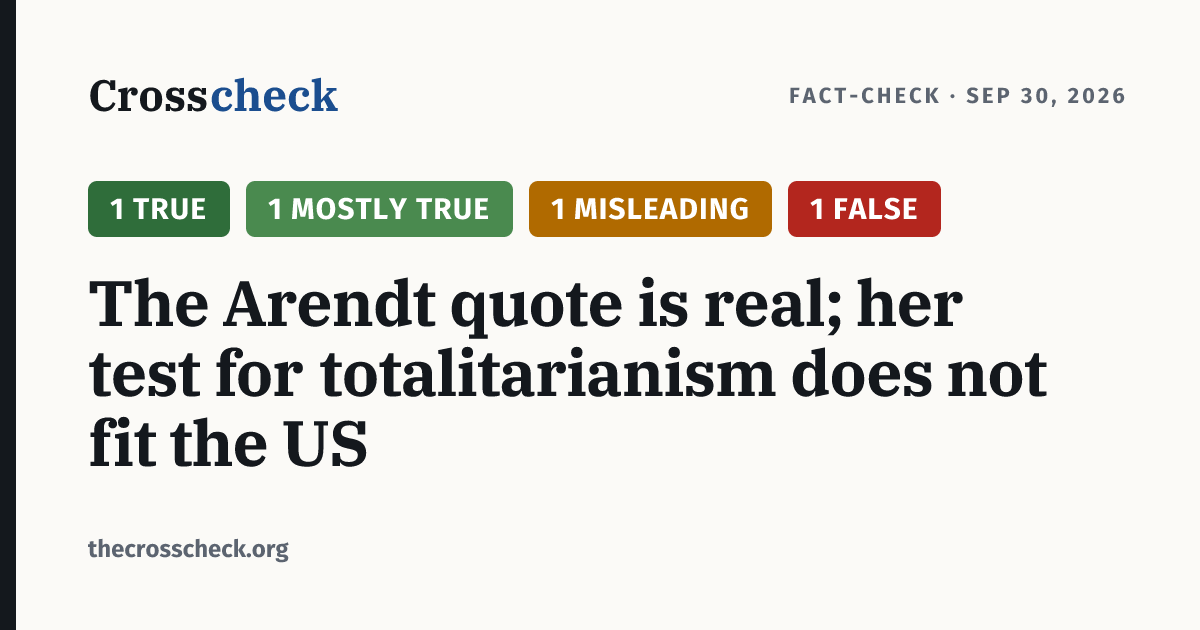
The quotation is Hannah Arendt’s, word for word, from Part Three of The Origins of Totalitarianism. The premise it is used to support has documentary backing: a federal judge stayed an Office of Personnel Management (OPM) job-application question asking applicants how they would advance the President’s executive orders, and another judge found that the prosecutor installed after the President pushed out her predecessor had no lawful authority. The leap the post invites does not hold. Arendt reserved the word totalitarian for Nazi Germany after 1938 and the Soviet Union after 1930, and she defined it by terror, camps and a mass movement that replaces all parties. The documented American record shows a sharp authoritarian slide, as independent democracy monitors measure it, but none of the features she treated as defining.
Verdicts at a glance
- True
Arendt wrote this sentence in The Origins of Totalitarianism.
It appears verbatim on page 339 of both the 1958 second enlarged edition and the 1973 Harcourt Brace Jovanovich edition, in Part Three, Chapter Ten, section 2. The 1951 first-edition page could not be checked.
- Mostly True
The Trump administration gives federal jobs for loyalty over expertise and qualifications.
Court records, OPM documents and appointment data document a political-allegiance question put to career applicants, which a court stayed, plus loyalty-linked placements and removals. The formal rules disclaim loyalty tests, the career-applicant question has been stayed, and the evidence covers specific cases and trends, not every hire.
- Misleading
Implied: Arendt’s sentence describes any government that rewards loyalty over expertise.
Her subject was regimes of total domination that purged talent even among their own supporters. She described filling all offices with party members as the goal of one-party dictatorship, a category she kept separate.
- False
Implied: the United States is now a totalitarian state in Arendt’s sense.
Her criteria include a mass movement replacing all parties, terror that no longer depends on any opposition, and camps as the regime’s central institution. Opposition parties compete, federal elections are scheduled, courts rule against the administration and it files compliance reports.
Is it Arendt’s text?
Yes. The sentence the post quotes reads, in full:
Totalitarianism in power invariably replaces all first-rate talents, regardless of their sympathies, with those crackpots and fools whose lack of intelligence and creativity is still the best guarantee of their loyalty.Hannah Arendt, The Origins of Totalitarianism, Part Three, ch. 10, sec. 2, p. 339 (1958 and 1973 editions)
We matched it against two complete scans on the Internet Archive. In the Harcourt Brace Jovanovich edition of 1973, the sentence closes a paragraph on page 339, under the running head “A Classless Society,” and carries footnote 65.[1] The same sentence, with the same footnote, sits on page 339 of the Meridian Books second enlarged edition, whose copyright page reads “First Meridian printing September 1958.”[2] That edition’s table of contents places the page inside Chapter Ten, “A Classless Society,” section 2, “The Temporary Alliance Between the Mob and the Elite,” which runs from page 326.[2]
One gap remains. The book first appeared in 1951, which is the date the post gives, but the scans of the 1951 printing on the Internet Archive are lending-only, and HathiTrust’s search returned a bot-verification page. We could not see the first-edition page. The 1958 preface says that edition added two new chapters and some enlargements first published in German in 1955,[2] so the 1951 wording and page number are unconfirmed here, not contradicted.
Which version the post uses
The post uses the full sentence, without trims. Circulating versions differ. A July 8, 2025 post on X by D.J. Grothe drops the phrase “regardless of their sympathies,” inserts the word “blind” before “loyalty,” and dates the book to 1950.[3] The economist Paul Krugman, in an October 2, 2025 Substack column, used the closing clause verbatim but introduced it as Arendt’s view of authoritarian regimes.[4] Her sentence is about totalitarianism, which she set apart from dictatorship and tyranny, as the next section shows. The dropped phrase matters, as the next section shows.
What Arendt was describing
The sentence ends a passage about intellectuals who were drawn to totalitarian movements before those movements took power. Arendt argues that their sympathy bought them nothing: once the movements took power, she writes, the sympathizers were cast aside before the worst crimes began. In her account, independent thought and art threatened totalitarian rule as much as the lawless energy of the mob did, and more than political opposition, because, in her words, “Total domination does not allow for free initiative in any field of life.”[1] The crackpots-and-fools sentence follows directly.
The phrase “regardless of their sympathies” carries the argument. Footnote 65 gives the examples. The Bolsheviks, she says, killed their first-rate talents, and Nazi policy differed only in that it did not yet do so. She points to the jurist Carl Schmitt, replaced in the mid-1930s by the party’s own legal theorists, and to the historian Walter Frank, a Nazi party member before 1933, who lost his post in the early 1940s to Alfred Rosenberg; she concludes that the regime distrusted Frank for no reason except that he was a serious scholar rather than a charlatan.[1] Her claim is that total domination eliminates talent even when the talent is loyal. In her account ideological sympathy protects no one; the loyalty the regime wants is the kind guaranteed by incapacity.
How she defined totalitarianism
Arendt drew the line sharply, and the page references below are to the 1973 edition.[1]
- She wrote that totalitarianism differs in essence from despotism, tyranny and dictatorship, and that wherever it took power it transformed classes into masses, replaced the party system with a mass movement rather than a one-party dictatorship, moved the center of power from the army to the police, and pursued a foreign policy aimed at world domination (p. 460).
- She counted only two authentic forms: National Socialism after 1938 and Bolshevism since 1930 (p. 419).
- She described the one-party system, which aims to fill all government offices with party members, as total only in that it tolerates no other party or opposition, and as something different from totalitarian rule (p. 419).
- She called terror the essence of totalitarian domination, as lawlessness is the essence of tyranny, and said terror becomes total when it no longer depends on any opposition (p. 464).
- She called the concentration and extermination camps the central institution of totalitarian power (p. 438).
- She classed Mussolini’s Italy as a conventional nationalist dictatorship, not totalitarian, until 1938 (p. 257), and argued that smaller European countries lacked the population to sustain total domination and settled into dictatorship (pp. 308-310).
By this standard, fascist Italy for most of its history did not qualify. On her terms, filling offices with loyalists does not by itself make a government even a one-party dictatorship; that requires abolishing rival parties and opposition.
What the record shows about loyalty in federal hiring
The post’s premise is that the administration hands out jobs for loyalty over expertise. The documents below measure it. Partisan and advocacy sources are labeled where they appear.
The executive-orders question for career applicants
On May 29, 2025, OPM’s acting director and the President’s domestic policy adviser issued a Merit Hiring Plan directing that every federal vacancy announcement graded GS-05 or above include four short essay questions, capped at 200 words each.[5] Question three asked: “How would you help advance the President’s Executive Orders and policy priorities in this role? Identify one or two relevant Executive Orders or policy initiatives that are significant to you, and explain how you would help implement them if hired.”[5] These are career civil service jobs, not political posts.
OPM’s own follow-up guidance of June 23, 2025, as the court later summarized it, said the responses “must not be used as a means of determining whether the candidate fulfills the qualifications of a position” or “to impose an ideological litmus test,” and told applicants that responses “are not required and will not be scored.”[6] That is the strongest evidence that the question was not meant as a loyalty screen. The court noted, however, that the limitation did not appear in the text of the question as applicants saw it.
Three unions sued. On September 11, 2026, Judge George A. O’Toole Jr. of the District of Massachusetts stayed the plan insofar as it required question three.[7] He found the unions likely to succeed in showing that the question violates the Administrative Procedure Act as contrary to the First Amendment, and wrote that the government “has not articulated why or how political allegiance is ‘an appropriate requirement for the effective performance’ of civil service jobs.”[6] He also found that the unions’ members “reasonably interpret Question Three to call for the applicant’s personal political views.”[6] The ruling is preliminary, and the court denied the unions’ request for an injunction barring agencies from relying on answers already given; the case continues.
OPM complied. A September 18, 2026 notice left the question on postings closing by September 25 but told agencies they “cannot consider candidate responses to the prior Question 3” and replaced it with a question asking for an example of implementing leadership direction that differed from the applicant’s own recommendation.[8] In its compliance report, OPM said about 6,000 job announcements were open when the order issued.[9]
Schedule Policy/Career
The rule formerly called Schedule F makes policy-influencing career jobs at-will. OPM’s final rule, published February 6, 2026 and effective March 9, estimated that about 50,000 positions, roughly 2 percent of the executive branch workforce excluding the Postal Service, would move into the schedule.[10] The rule’s text states that employees and applicants “are not required to personally or politically support the current President or the policies of the current administration,” but must faithfully implement administration policies, and that “Failure to do so is grounds for dismissal.”[10] Executive Order 14410, signed June 3, 2026, carried out the transfers through a list of positions in its appendix.[11] Federal News Network reported that close to 8,000 career employees would be moved, far below OPM’s estimate (8,000 is about 16 percent of 50,000), and, citing a senior administration official, that about 97 percent of the targeted positions were at or above GS-15.[12]
The rule creates leverage rather than a loyalty test on its face: it removes appeal rights while forbidding a loyalty requirement. Whether that prohibition holds in practice is not yet measurable from public records.
Inspectors general
On January 24, 2025, the administration fired 17 inspectors general, the internal watchdogs of federal agencies, by two-sentence emails from the Presidential Personnel Office.[13] On September 24, 2025, Judge Ana C. Reyes of the District of Columbia ruled on the claims of eight of them: “President Trump violated the IGA. That much is obvious.” The defendants had conceded that the President did not give Congress the 30 days’ notice the Inspector General Act requires. She declined to reinstate them because the President could lawfully remove them again after giving notice.[13] The firings show the removal of independent overseers; they do not by themselves show who replaced them or why.
A prosecutor chosen after the President’s demand
The clearest documented case of a post filled for loyalty concerns the Eastern District of Virginia. According to the November 24, 2025 opinion of Judge Cameron McGowan Currie, the U.S. attorney, Erik Siebert, resigned on September 19, 2025, hours after the President told reporters he wanted him out.[14] The opinion reproduces a social media post the President published the next day and later deleted, in which he wrote that he had fired Siebert, called him a “Woke RINO,” and, in a post addressed to “Pam,” praised his replacement, Lindsey Halligan, as a good lawyer who “likes you, a lot.”[14] The court described Halligan as “a former White House aide with no prior prosecutorial experience,” and held that her appointment violated 28 U.S.C. § 546 and the Appointments Clause, dismissing the indictment of former FBI director James Comey that she had obtained.[14] The government appealed;[14] a Fourth Circuit panel heard argument on September 15, 2026 and, according to a Spokesman-Review report, expressed skepticism of the government’s position.[15]
Statutory qualifications and acting officials
Some posts carry qualifications written into law. The FEMA administrator must have “a demonstrated ability in and knowledge of emergency management and homeland security” and at least five years of executive leadership experience.[16] NPR reported that the agency’s acting head Cameron Hamilton was fired a day after telling a House committee he did not think FEMA should be eliminated, and that his successor, David Richardson, had no previous emergency management experience when he took the role in May 2025. NPR also reported that the administration had used temporary leaders in a way that avoided the statutory requirement.[17] Richardson left in November 2025.[17]
At the Bureau of Labor Statistics, the President fired Commissioner Erika McEntarfer on August 1, 2025, hours after a weak jobs report, and, in CNBC’s account, accused her without evidence of manipulating the figures.[18] He nominated E.J. Antoni, chief economist at the conservative Heritage Foundation and a critic of the bureau; the Senate received the withdrawal of the nomination on September 30, 2025.[19][18] The withdrawal is itself counter-evidence: a nominee whose fitness was questioned did not get the job.
What every administration does, and what is new
Every president fills political posts with allies. The Congressional Research Service, quoting the Partnership for Public Service, notes that an incoming president makes more than 4,000 appointments, most of them political.[20] The Supreme Court has long allowed party affiliation to count where it is an appropriate requirement for the job; Judge O’Toole applied that test, from Branti v. Finkel, and found at this preliminary stage that it likely does not extend to the civil service, where federal law bars personnel decisions based on political affiliation.[6] Loyalty hiring for political posts is the American baseline, not a novelty.
What is new is scale and reach. The Partnership for Public Service, a nonpartisan group that advocates for the career civil service, reports from OPM data that 1,835 Schedule C political appointees were serving at the end of January 2026, 52 more than the previous high under George H.W. Bush in OPM data going back to the mid-1980s, while the career Senior Executive Service fell from 8,127 at the end of the Biden administration to 5,837, a drop of about 28 percent.[21] It also reports that political appointees held 11.7 percent of filled senior executive positions, above any level since at least 1998.[21] The same report says the concern is not that appointees are inherently unqualified, and that many bring expertise.[21]
The other new element is the reach into career jobs: an essay question about the President’s executive orders on applications for positions that plaintiffs say ranged from air traffic control to crane operation,[6] and an at-will schedule for about 8,000 senior career staff. The V-Dem Institute at the University of Gothenburg, which scores democracies worldwide, lists purges of perceived opponents and politicization of the civil service among the tactics behind its 2025 downgrade of the United States, and quotes the legal scholar David Driesen on appointees with no relevant qualifications.[22]
The legal ground is also shifting toward the President. On June 29, 2026, in Trump v. Slaughter, the Supreme Court held the Federal Trade Commission’s for-cause removal protection unconstitutional, and said that if anything was left of Humphrey’s Executor, it was overruled.[23] That widens the President’s lawful power to remove officials. It says nothing about qualifications.
What the courts have said
| Case | Ruling | Status |
|---|---|---|
| AFGE v. Kupor (D. Mass.) | Executive-orders essay question stayed; likely violates the APA as contrary to the First Amendment[6][7] | Preliminary; OPM complied[9] |
| Storch v. Hegseth (D.D.C.) | Inspector general firings violated the 30-day notice law; no reinstatement[13] | Ruling denied preliminary relief; plaintiffs gave notice of a summary judgment motion in August 2026[13] |
| United States v. Comey (E.D. Va.) | Halligan’s appointment unlawful; indictment dismissed without prejudice[14] | On appeal; argued Sept. 15, 2026[15] |
| Schedule Policy/Career suits (D.D.C., D. Md.) | No merits ruling found; as of March 2026 the D.C. case awaited an amended complaint[24] | Transfers took effect in June 2026[12] |
| Trump v. Slaughter (U.S. Supreme Court) | For-cause removal protection for FTC commissioners unconstitutional[23] | Decided June 29, 2026 |
We searched for rulings on Schedule Policy/Career through September 2026 and found none on the merits; that is a statement about our search, not proof that none exists.
What the post implies
Pairing the quotation with the administration invites two inferences. The first is that Arendt’s sentence is a general law about governments that prize loyalty. It is not: her sentence is about regimes that purge talent “regardless of their sympathies,” including loyal talent, because they cannot tolerate any unpredictable initiative. She explicitly put loyalist office-filling in the category of one-party dictatorship (p. 419).[1] We rate that inference Misleading.
The second inference is that the United States is now totalitarian in her sense. Her criteria allow a documented answer, measured here against the features she named.
| Arendt’s criterion (1973 ed.) | Documented US record |
|---|---|
| A mass movement supplants the party system (p. 460) | A two-party system persists. V-Dem now classifies the US as an electoral democracy, down from liberal; its election-specific indicators, last assessed for the 2024 vote, held steady, though its Electoral Democracy Index fell from .84 to .74 in 2025[22] |
| Terror becomes total, independent of any opposition (p. 464) | No source we found documents terror as a system of rule. Courts still stand in the administration’s way, and OPM filed a compliance report after losing on the hiring question[9] |
| Camps are the central institution (p. 438) | ICE held 65,765 people in immigration detention as of July 11, 2026, per TRAC, and 70.6 percent had no criminal conviction[25]. Large and contested; no source we found shows detention functioning as the central institution of the state |
| Power shifts from the army to the police (p. 460) | No source we found documents this shift as a governing structure |
| Foreign policy aimed at world domination (p. 460) | No source we found documents this |
| Only Nazi Germany after 1938 and the USSR after 1930 qualified (p. 419) | She excluded even Mussolini’s Italy before 1938 (p. 257)[1] |
On her criteria, the claim that the United States is totalitarian now is False. That does not mean nothing is wrong. V-Dem’s 2026 report says the US lost its long-held status as a liberal democracy in 2025, with legislative constraints on the executive at their lowest point in over 100 years, and calls the speed of the decline unprecedented in modern history.[22] In Arendt’s vocabulary that describes the territory of tyranny and dictatorship, which she treated as grave and as different in kind.
That the United States is becoming totalitarian. This is carried without a separate rating because it is a forecast: Arendt’s criteria describe a completed regime, and no source can settle where a trajectory ends. What can be measured is rated above: the documented trend is autocratization by V-Dem’s measures, and the features Arendt treated as defining are absent from the record.
The strongest case for the post
The best version of the post does not claim the US is Nazi Germany. It claims Arendt identified a mechanism: regimes that fear independent judgment replace competence with dependence. On that reading, the record is on the post’s side. The President’s own post, reproduced by a federal court and addressed to “Pam,” said he had fired the prosecutor news reports said had doubted the case, and praised as a good lawyer who “likes you, a lot” a replacement the court found had no prior prosecutorial experience.[14] OPM asked career applicants, including for nonpolitical jobs, which of the President’s orders they would help carry out.[5] The BLS commissioner was fired hours after a weak jobs report,[18] and FEMA’s acting chief was fired a day after telling a House committee that FEMA should not be eliminated.[17] Career senior leadership shrank by more than a quarter while Schedule C political appointees reached a record.[21]
That case is strong on the premise, which is why the premise rates Mostly True. It fails on the analogy for the reason Arendt herself gives: her mechanism punishes talent whatever its sympathies, and she located it in regimes that had destroyed a country’s legal and political traditions and replaced its party system. In the documented American record, courts, parties and elections are still operating and still checking the administration.
The strongest case against the premise
Every incoming president makes more than 4,000 appointments.[20] The Schedule Policy/Career rule forbids loyalty tests in writing and covered about 8,000 employees, not the 50,000 first estimated.[10][12] OPM told agencies the essay answers would not be scored.[6] The White House withdrew the Antoni nomination.[19] These points narrow the claim to specific cases and trends. They do not erase the court findings about the essay question and the Virginia prosecutor, which is why the rating is Mostly True rather than True or Mixed.
Implications
The quote’s misuse has a cost for the argument it serves. Calling the government totalitarian invites a rebuttal that wins on definitions, and the documented problems, a stayed political-allegiance question, an unlawful prosecutor appointment, unlawful inspector general firings and a hollowed-out senior career service, get lost in the dispute over the label. The measured claims are stronger than the borrowed one.
The legal pattern so far cuts two ways. Courts have checked specific loyalty-linked actions; OPM complied with the hiring-question stay, and the government appealed the prosecutor ruling rather than defy it. At the same time, the Supreme Court has expanded the President’s removal power in Trump v. Slaughter,[23] and the IG ruling shows that a finding of illegality may come with no remedy.[13] If the hiring-question case reaches final judgment, it could set a precedent on whether civil service applicants may be asked about support for a president’s agenda; that is a forecast, and the ruling so far is preliminary.
What to watch
- September 30, 2026: OPM’s deadline for agencies to submit a new essay question five, tying applications to each agency’s current priorities.[8]
- Fourth Circuit: a ruling on the Halligan appointment and the Comey and James dismissals, argued September 15.[15]
- November 3, 2026: the federal midterm elections, set by statute for the Tuesday after the first Monday in November of even years,[26] 34 days from publication. V-Dem calls them decisive for its assessment.[22]
- Schedule Policy/Career suits: the first merits ruling on whether the at-will conversions are lawful.[24]
Sources
- Hannah Arendt, The Origins of Totalitarianism (Harcourt Brace Jovanovich, 1973), full scan
- Hannah Arendt, The Origins of Totalitarianism, second enlarged edition (Meridian Books, 1958), full scan
- D.J. Grothe, post on X, July 8, 2025
- Paul Krugman, “An Autocracy of Dunces”
- Merit Hiring Plan memorandum, May 29, 2025
- AFGE v. Kupor, No. 25-cv-13305, Opinion and Order (D. Mass. Sept. 11, 2026), ECF 86
- AFGE v. Kupor, Order (D. Mass. Sept. 11, 2026), ECF 87
- “Merit Hiring Plan: Revised Essay Questions and Treatment of Prior Question Three Responses,” Sept. 18, 2026
- AFGE v. Kupor, Compliance Status Report (Sept. 25, 2026), ECF 88
- Improving Performance, Accountability and Responsiveness in the Civil Service, final rule, 91 FR 5580 (Feb. 6, 2026)
- Executive Order 14410, Implementing Schedule Policy/Career in the Excepted Service (June 3, 2026)
- “Trump moves about 8,000 federal positions to Schedule Policy/Career”
- Storch v. Hegseth, No. 25-cv-415, Memorandum Opinion (D.D.C. Sept. 24, 2025), ECF 54; plaintiffs’ pre-motion notice, ECF 60 (Aug. 3, 2026)
- United States v. Comey, No. 1:25-cr-272, Memorandum Opinion and Order (E.D. Va. Nov. 24, 2025), ECF 213; notice of appeal, ECF 217
- “DOJ seeks to revive cases against Comey, James a year after dismissals”
- 6 U.S.C. § 313, Federal Emergency Management Agency
- “FEMA acting chief David Richardson departs after 6 months on the job”
- “White House withdraws Antoni’s nomination to lead Bureau of Labor Statistics”
- PN499-1, Nomination of Erwin Antoni, 119th Congress
- Presidential Transitions: An Overview, IN11538 (Nov. 24, 2020)
- The Politicization of Federal Leadership
- Democracy Report 2026: Unraveling the Democratic Era?
- Trump v. Slaughter, No. 25-332 (U.S. June 29, 2026)
- Schedule Policy/Career: 2026 Final Rule, Legal Challenges, and Issues for Lawmakers, LSB11412 (Mar. 26, 2026)
- Immigration Detention Quick Facts
- 2 U.S.C. § 7, Time of election