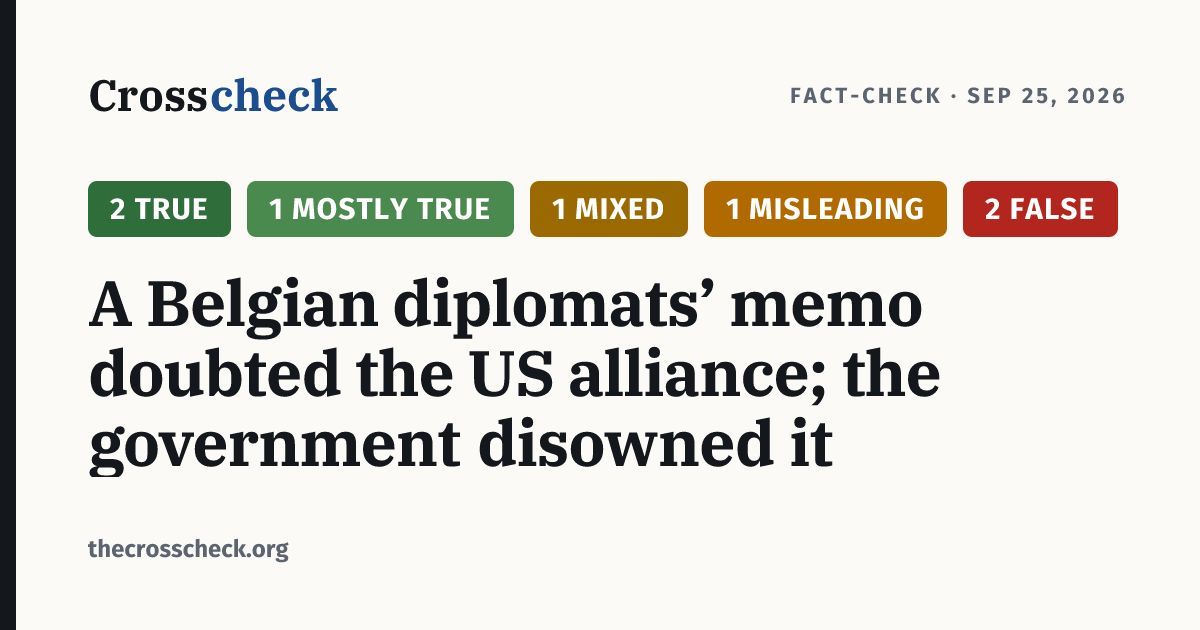
Verdicts at a glance
- True
Belgium’s foreign ministry produced an internal document saying the US is no longer the ally it was
The ministry told the FT it was an “internal working document,” and Foreign Minister Maxime Prévot’s office regretted its “unauthorised” release. Neither disputed the quoted text.
- True
Standfirst: dynamics in Washington are likely to compromise vital interests of Belgium and the EU, says a foreign ministry document
Belgian and wire reports quote the memo: “the dynamics currently at play in the United States… are likely to compromise several vital interests of Belgium and the European Union.”
- Mostly True
Headline: Donald Trump’s US no longer a reliable ally, warns Belgium in leaked document
The memo’s quoted line is “no longer the ally it has been in the past”; “reliable” is the FT’s gloss. “Warns Belgium” describes a desk-level draft the government says it never approved.
- False
Implied: the document is Belgium’s official policy toward the United States
Prévot’s office says it was drafted at administrative level, “neither validated nor approved,” and set aside. Government sources say it never cleared the inter-cabinet working group.
- False
Implied: the memo urges Belgium to distance itself from Washington
As quoted, it calls engagement with the Trump administration “indispensable” and adds contacts with states, cities, Congress and the Democratic opposition on top of it.
- Mixed
Implied: the warning is a fresh assessment by the Belgian government
The memo is dated 27 October 2025, 332 days before the story ran. Prévot’s spokesperson said on the day that the concerns it raised “remain relevant.”
- Misleading
Implied: Belgium’s diplomats broke ranks with other US allies
Leaders in Germany, Canada and the EU, and Denmark’s military intelligence service in a published report, said similar or stronger things first. De Wever himself spoke of a “breaking point” at Davos.
Does the document exist?
Yes. No outlet we found says it obtained the memo independently; Belgian, Dutch and wire coverage all cites the FT.[2][3][4] What confirms the document is the Belgian government’s own response. A foreign ministry spokesperson told the FT it was an “internal working document” whose contents “should be distinguished from an agreed policy strategy.”[5] Prévot’s office later said it regretted that “an early internal working document” had been “made public without authorisation.”[6] A government does not regret the leak of a document that does not exist.
The reports agree on its origin. The memo was written by the ministry’s Americas and Caribbean department in late 2025.[2][3] The Brussels Times and La DH give the date as 27 October 2025.[5][7] One account differs: La DH first calls it an “old preparatory note of the cabinet” of Prévot, then a working document of the ministry.[7] The minister’s own statement settles it as an administrative draft, not a text from his political staff.[6]
What it says, as quoted
The same core passages appear in VRT (from the Belga wire), RTBF, La Libre, the Brussels Times, Seeking Alpha and the Dutch ANP wire:[2][3][4][5][6][8]
“It is now clear that the American partner is no longer the ally it has been in the past.”
“The dynamics currently at play in the United States… are likely to compromise several vital interests of Belgium and the European Union.”
It calls for a “thorough re-evaluation” of relations between the EU and Belgium on one side and the US on the other.[2][8] Its recommendations, as reported:
- Keep talking to Washington. “Engagement with the current U.S. administration remains indispensable.”[8]
- Widen the contact list. Dialogue with Republican and Democratic states and big-city mayors should be “significantly reinforced,” along with the Democratic opposition, Congress, and “the new generations of bipartisan elites that could play a role in tomorrow’s America.”[2][8]
- Use the monarchy. “We should not underestimate the respect that President Trump has for royal families.”[5][4]
- Four files to manage: trade, military spending, migration, and drug trafficking and organised crime.[5] On trade it says “diversifying our partnerships is more essential than ever.”[8] On arms, per the Brussels Times, buying US weapons would please the administration, but Belgium should buy more EU-made equipment.[5]
- Legal risks in security cooperation. “There is a risk that shared information and extraditions could lead to death sentences in the US.”[5]
RTBF, summarising the FT, says the aim was to protect Belgian interests without being seen as “hostile.”[3]
The government’s response
The response came in two stages on 24 September, and the second went further than the first.
Morning, to Belga. Prévot’s office called the memo an internal reflection note, written because of the “very explicit” shift in US policy toward Europe, and said it was not part of any final political agreement on a US strategy.[3][2] A spokesperson added that the concerns it raised “remain relevant,” including in talks with American partners, and gave this line:[3]
“The United States remains an ally, but the transatlantic relationship is evolving. We must take that into account to defend our interests and prepare for the future.”
Later, a formal statement. The minister’s office said the text “was a draft preliminary analysis prepared at administrative level; it was neither validated nor approved,” and that it “was reviewed internally and set aside as a basis for Belgian policy. It therefore has no official status.” Any reading of it as Belgium’s position “would be inaccurate.”[6]
Elsewhere in government. A government source told La Libre the note never cleared the inter-cabinet stage, the first round of political negotiation among ministers’ offices, and “has no value.”[6] La DH reports that several ministers’ offices distanced themselves when asked, and quotes a member of the majority: “C’est un fameux bordel” (“It’s a real mess”).[7] It contrasts the memo with Interior Minister Bernard Quintin, who called the US “our greatest ally outside the European Union.”[7]
The prime minister. We found no statement from Prime Minister Bart De Wever on the memo as of 25 September. La DH notes that at Davos in January he had criticised Belgium’s “vassal” relationship with Washington but never said the alliance was in doubt.[7] At Davos on 20 January he said: “Being a happy vassal is one thing. Being an unhappy slave is something else entirely,” and that threats of military intervention on NATO territory left allies “approaching a breaking point.”[11] Other outlets translate “unhappy” as “miserable.”
Washington. La Libre reports that Belgian officials contacted the US embassy. It quotes Ambassador Bill White: Belgian authorities told him the document “in no way reflected Belgium’s official position,” and its release “changes nothing in the trajectory of our sacred ties.”[6] White has been summoned twice by Prévot this year, most recently in August over a post mocking Health Minister Frank Vandenbroucke.[9]
Is this unusual among US allies?
The FT headline does not call the memo a first. But a reader could take it as Belgium breaking ranks. We tested that against a named set.
Compared against: public statements by heads of government and senior officials of EU and NATO members, and published or leaked government documents, that question US reliability as an ally, from May 2017 to September 2026. We searched for other leaked ministry documents and found none, but that search was shallow; absence of a match is not proof none exist.
| Who | When | Form | What was said |
|---|---|---|---|
| Angela Merkel, German chancellor[12] | May 2017 | Public speech | The days when Europe could completely count on others were “over to a certain extent” |
| Emmanuel Macron, French president[13] | Nov 2019 | Interview | “What we are currently experiencing is the brain death of NATO” |
| Friedrich Merz, German chancellor-in-waiting[14] | Feb 2025 | Election-night TV | The priority is “independence from the USA”; the Americans are “largely indifferent to the fate of Europe” (translations vary) |
| Kaja Kallas, EU foreign policy chief[15] | Feb 2025 | Social media post | “It became clear that the free world needs a new leader” |
| Mark Carney, Canadian prime minister[16] | Mar 2025 | Press conference | “The old relationship we had with the United States … is over” |
| Dutch intelligence chiefs (AIVD, MIVD)[17] | Oct 2025 | Newspaper interview | They sometimes no longer share certain information with the US, case by case |
| Belgian foreign ministry, Americas desk[5] | 27 Oct 2025 | Internal draft, leaked | “No longer the ally it has been in the past” |
| Danish Defence Intelligence Service[18] | Dec 2025 | Published official report | “The possibility of employing military force – even against allies – is no longer ruled out” |
| Friedrich Merz, German chancellor[19] | Dec 2025 | Party congress speech | “The decades of Pax Americana are largely over for us in Europe” (our translation) |
| Bart De Wever, Belgian prime minister[11] | Jan 2026 | Davos panel | Threats against NATO territory leave allies “approaching a breaking point” |
The prior top case, by official weight, is Denmark’s intelligence outlook. It is a published agency assessment, not a leaked draft, and it names the US as a country that may use force against allies. On substance, the Belgian memo is milder than several entries: Merz called for independence from the US, and Carney declared the old relationship over, both as sitting or incoming heads of government.
What is less common is the form: a foreign ministry writing a strategy around the premise that the US is no longer the ally it was. We found no other such document in the public record. That is the part of the story that is news, and it is also the part the Belgian government has disowned.
What the headline implies
Implied: the memo is Belgium’s official policy. False. The headline says “warns Belgium,” and the phrase “leaked document” is the only signal that this was not a government position. The foreign minister’s office says the draft was never approved and was set aside; a government source says it never cleared the inter-cabinet working group.[6][7] The FT’s own ministry quote says the contents “should be distinguished from an agreed policy strategy.”[5] We have no evidence contradicting those accounts. A government disowning an embarrassing leak has an obvious motive, but the memo itself carries no sign of cabinet sign-off in any published excerpt.
Implied: the memo urges Belgium to pull away from Washington. False. Read as quoted, it recommends more channels, not fewer. It calls engagement with the administration “indispensable” and adds states, mayors, Congress and the opposition on top.[8][2] It proposes more intelligence exchange with US agencies on drugs, organised crime and terrorism, with caveats about the death penalty.[5] Its hedges are diversification of trade and more EU-made arms purchases.
Implied: this is a fresh assessment. Mixed. The headline’s present tense (“warns”) and the timing give no hint of age. The memo is dated 27 October 2025; the story ran 332 days later.[5][7] RTBF’s summary of the FT says the document dated from late 2025, so the FT body appears to disclose it.[3] Against the “stale” reading, Prévot’s spokesperson said on the day that the concerns it raised remain current.[3] La DH asks why the FT published the note almost a year on, while Prévot was in New York for the UN General Assembly.[7] We did not find an answer.
Implied: Belgium’s diplomats broke ranks with other US allies. Misleading. The comparison set above shows the view was widespread among allied leaders before this memo was written, and more forcefully stated. Belgium’s own prime minister said publicly in January that allies were “approaching a breaking point.”[11] The unusual element is a written ministry strategy built on that premise, not the premise.
The case for the FT’s framing
The strongest defence of the headline is that it reports the memo accurately and says “leaked document” in the same line. The quoted sentence is the memo’s own, and the ministry did not dispute it. “Reliable” is a paraphrase, but a close one: a partner that is “no longer the ally it has been” and whose politics “compromise vital interests” is being described as less dependable.
We weighed whether that makes the headline fully True. It does not move the rating past Mostly True, for one reason: “warns Belgium” assigns the view to the state, and the state has formally disowned it. The surviving caveat runs the other way. Prévot’s office conceded that the concerns in the memo remain live and that the relationship is “evolving.”[3] The dispute is over whether a desk’s draft speaks for Belgium, not over whether Belgian officials worry about Washington.
Public opinion is further along than the government’s line. In the University of Antwerp and ULB “De Stemming” survey, fielded in March 2026, half of Belgians called the US an adversary and 10% called it an ally.[10]
Implications
For readers of the headline. The accurate version is: “A Belgian foreign ministry desk wrote in October 2025 that the US is no longer the ally it was; the government says the draft was never approved.” That is still news. Career diplomats put in writing a judgement their government will not say publicly.
For Belgium’s coalition. The leak arrived with Prévot at the UN, weeks after he summoned the US ambassador for the second time this year.[7][9] The government’s response, a same-day call to the US embassy and a formal disavowal, shows it treats open rupture with Washington as a cost it will not pay. That is the practical answer to the headline’s question about Belgian policy, whatever its diplomats think.
For the memo’s approach. Its core recommendation, working around a hostile federal government through states, cities and Congress, is a hedge rather than a break. Whether any of it survives in practice is not visible in public sources. The one item with a public trace is the monarchy: the Brussels Times notes that King Philippe attended the World Cup in the US in July and Queen Mathilde has accompanied ministers to the UN this week.[5] That fits the memo’s advice but does not show the memo caused it.
What would change these verdicts. Publication of the full memo showing cabinet endorsement would move the “official policy” rating. Evidence that its recommendations were adopted in a later strategy would make the headline’s “warns Belgium” more accurate than it is today.
Sources
- Donald Trump’s US no longer a reliable ally, warns Belgium in leaked document
- Financial Times kon hand leggen op intern document van Buitenlandse Zaken
- Un document interne des Affaires étrangères qui exhorte à repenser les liens avec les USA fuite dans la presse
- FT: Belgisch ministerie acht VS niet langer betrouwbare partner
- Trump’s US no longer a ‘reliable ally’ for Belgium, leaked document suggests
- «Les États-Unis de Trump ne sont plus un allié fiable»: un document interne des Affaires étrangères embarrasse l’Arizona
- «L’Amérique de Trump n’est plus une alliée»: cette note interne qui embarrasse l’Arizona
- U.S. is not the ally it has been in the past, Belgium warns internally – report
- Foreign Minister Prévot summons US Ambassador Bill White following his attack on Minister Vandenbroucke
- Vertrouwensbreuk met VS: ruim de helft van de Belgen ziet Amerika als tegenstander
- ‘Unhappy slaves’: Belgian PM says Trump has gone too far with Greenland threats
- After summits with Trump, Merkel says Europe must take fate into own hands
- Macron claims NATO is suffering ‘brain death’
- Merz calls for independence from US (RFE/RL)
- ‘Free world needs a new leader,’ Kaja Kallas says after Trump-Zelenskyy exchange
- Era of close US-Canadian relations is over, warns Prime Minister Mark Carney
- Dutch intelligence services cut back on sharing information with US
- Intelligence Outlook 2025 (English translation)
- „Wenn die Ukraine fällt, hört er nicht auf“: Merz warnt vor Putin