The question
On Sept. 24, 2026, Rep. Steve Cohen, a Tennessee Democrat on the House Judiciary Committee, introduced 26 articles of impeachment against President Donald Trump. His release lists them under headings such as “abuse of power,” “violation of oath” and “emoluments violations.”[1] A reader asked us whether the charges hold up and whether Trump has broken the laws they cite.
The resolution’s full text was not yet posted on Congress.gov when we checked, so we tested each heading. For each one we asked three things: did the conduct happen, has a court or other authoritative body ruled on whether it was lawful, and is that ruling final? We rated the charge as a checkable claim: that Trump did the thing and that it was unlawful. We did not rate whether any of it is impeachable, which is a judgment the Constitution leaves to the House.
Verdicts at a glance
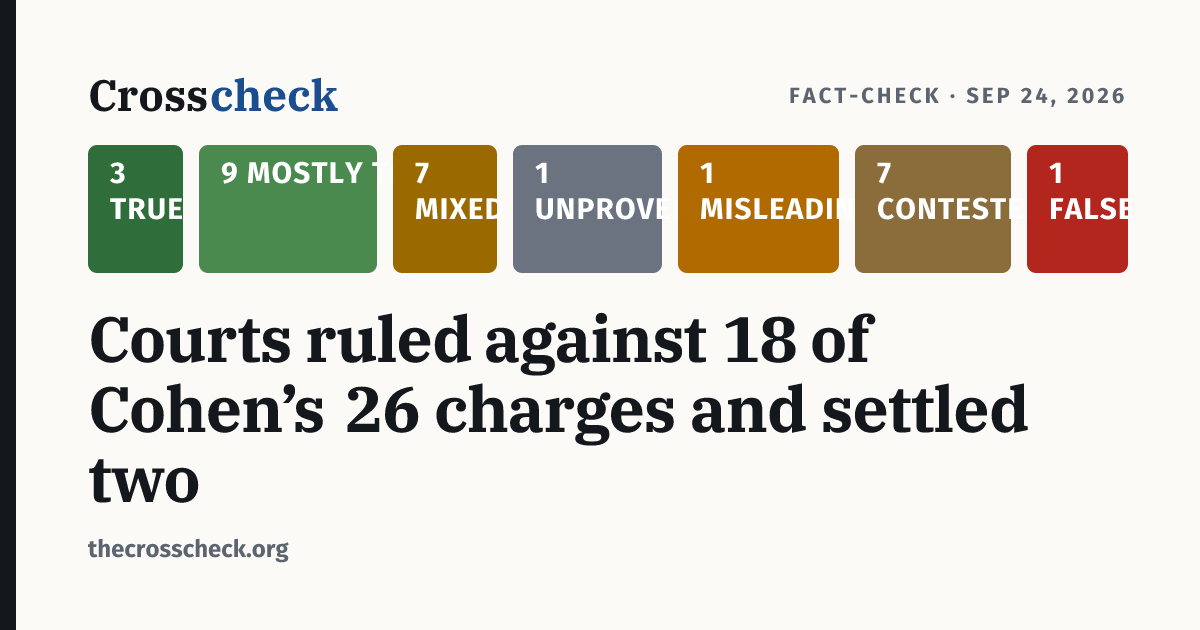
“Court ruled against” below means a court has ruled against the conduct charged at some stage, even if a higher court later stayed the ruling. By that measure courts have ruled against 18 of the 26 charges. Only two of those rulings are final Supreme Court decisions on the merits, and two others (Articles XIII and XXIII) are currently stayed by the Supreme Court.
| # | Charge | Court ruled against? | Rating |
|---|---|---|---|
| I | Sowing doubt in elections | Yes: elections orders blocked; not final | Mostly true |
| II | Iran war without Congress | No ruling | Contested |
| III | Boat-strike killings | No U.S. ruling; UN experts say unlawful | Contested |
| IV | Troops in U.S. cities | Yes: LA, Portland, Chicago; D.C. went his way | Mostly true |
| V | Birthright citizenship order | Yes: final Supreme Court ruling | True |
| VI | Grants cut over states’ votes | Yes: final district judgment, 18 grants | True |
| VII | Loyalty tests | Yes, for one hiring question only | Mixed |
| VIII | Alien Enemies Act, Abrego Garcia | Yes on notice; contempt unresolved | Contested |
| IX | Cruel punishment at CECOT | No ruling on conditions | Mixed |
| X | Dismantling programs | Yes at trial level; mostly stayed | Contested |
| XI | U.S. attorney appointments | Yes: three appeals courts | Mostly true |
| XII | Defying court orders | Yes: violations in 31+ suits | Mostly true |
| XIII | Abolishing Education Dept. | Yes, then stayed by Supreme Court | Contested |
| XIV | Firing inspectors general | Yes: “That much is obvious” | Mostly true |
| XV | Emergency tariffs | Yes: final Supreme Court ruling | True |
| XVI | Prosecuting Comey, James, Schiff | Yes, on appointment grounds | Mixed |
| XVII | IRS settlement, Judgment Fund | Fund frozen; no ruling on legality | Mixed |
| XVIII | Corrupt pardons | No ruling; pardons unreviewable | Mixed |
| XIX | Banning reporters | Yes: preliminary rulings | Mostly true |
| XX | Coercing CBS and ABC | No ruling | Mixed |
| XXI | Law-firm orders | Yes: four judges; appeal pending | Mostly true |
| XXII | Coercing universities | Yes: Harvard, UC | Mostly true |
| XXIII | East Wing demolition | Yes; Supreme Court stayed on standing | Mostly true |
| XXIV | Illegal impoundment | No court; GAO found 7 violations | Contested |
| XXV | Renaming, property, currency | Yes for Kennedy Center; coin untested | Mixed |
| XXVI | Emoluments | No ruling, ever | Contested |
Rating key. True: the conduct happened and a ruling against it stands. Mostly true: the conduct happened and courts have ruled against it, but the rulings are preliminary or on appeal. Mixed: part of the charge holds and part does not. Contested: the conduct happened, but its legality is unresolved, courts have split, or the only findings come from bodies that are not courts, such as GAO or UN experts.
Does impeachment need a crime?
No. The Constitution allows impeachment for “treason, bribery, or other high crimes and misdemeanors” and never defines the last phrase. The Library of Congress’s annotated Constitution says its meaning “is informed not by judicial decisions, but by the history of congressional impeachments.”[2] When the House impeached Trump in his first term, it “asserted that for purposes of Article II high Crimes and Misdemeanors need not be indictable criminal offenses.”[3]
So “has he broken these laws?” and “is this impeachable?” are separate questions. Few of Cohen’s charges allege a crime. Most allege that Trump exceeded his legal authority, a civil question courts decide by blocking an action, not by convicting anyone. That is the question the court record below answers.
War, force and elections
Article I: Sowing doubt in elections Mostly true
Trump still says the 2020 election was stolen, and he has said Republicans “should take over the voting in at least 15 places.” In January, federal agents seized about 700 boxes of 2020 ballots and records in Fulton County, Georgia.[12] His March 2025 elections order sought proof of citizenship to register. Judge Colleen Kollar-Kotelly blocked that part, writing that “the President lacks the authority to direct such changes.”[8] In June 2026 a Massachusetts judge permanently barred most of the order, writing that the Constitution “does not grant the President any specific powers over elections.”[9]
A second order, signed in March 2026, restricts mail ballots. The Supreme Court let it proceed on Aug. 24, but only because the challenge came too early, and said that “does not mean that any measure taken by the government to implement the order will necessarily be lawful.”[10] On Sept. 14 it refused to revive the Postal Service rule carrying out the order, finding the government “unlikely to succeed on the merits.”[11]
Why not true: every ruling can still be appealed, and no tribunal rules on speech that “sows doubt.”
Article II: War on Iran without Congress Contested
The facts are not in dispute. U.S. and Israeli strikes began the war on Feb. 28, 2026, and Trump’s report to Congress “does not address why the military carried out the attack without prior congressional authorization.”[13] Congress has never voted to authorize it. The Senate defeated another war powers resolution 49 to 50 on Sept. 24, and at least 19 service members have been killed.[15]
What is contested is the law. The administration told Congress hostilities “terminated” with an April 7 ceasefire, which would stop the War Powers Resolution’s 60-day clock. Just Security argues that the ongoing blockade is itself “hostilities.”[16] Courts have never settled the point: past suits to enforce the 60-day limit “have been dismissed on justiciability grounds without ever reaching the merits.”[14]
Article III: Killings at sea Contested
U.S. strikes on alleged drug boats have killed at least 231 people in 69 strikes since September 2025. In the first strike, a follow-up attack killed two survivors “waving overhead.”[17] The UN human rights chief said none of the people targeted “appeared to pose an imminent threat.”[18] UN experts in September called the killings “extrajudicial and unlawful” and said “No armed conflict exists.”[19]
No U.S. court has ruled. The administration’s legal theory sits in a secret Office of Legal Counsel opinion that reportedly treats the strikes as an “armed conflict” with cartels; a suit to release it is pending.[20] The heading also understates the campaign, since many strikes were in the eastern Pacific, not Venezuelan waters.[17]
Article IV: Troops in U.S. cities Mostly true
Judge Charles Breyer found the Los Angeles deployment violated the Posse Comitatus Act, which “for nearly 140 years has been in place to keep the military out of civilian law enforcement.”[21] In December the Supreme Court refused to let Trump deploy the Guard in Illinois. A Trump-appointed judge had already found he “did not have a lawful basis” to deploy it in Portland.[22] Trump then pulled troops from Chicago, Los Angeles and Portland, promising “We will come back.”[23]
Not every ruling went against him. Early in the Los Angeles case, a Ninth Circuit panel found it “likely that the President lawfully exercised his statutory authority” to federalize the Guard.[98] The Posse Comitatus ruling was reportedly stayed, and we could not confirm how its appeal ended.
Why not true: the rulings are mostly interim. An appeals court let the D.C. deployment continue while it reviews the case, and deployments in Memphis and New Orleans had governors’ consent.[23]
Courts and immigration
Article V: Birthright citizenship True
This is one of two charges the Supreme Court has settled. In Trump v. Barbara, decided June 30, 2026, the Court held that “Children born in the United States to parents unlawfully or temporarily present are ‘subject to the jurisdiction’ of the United States and are citizens at birth.” Five justices joined the opinion, Justice Kavanaugh agreed with the result, and three dissented.[7] A narrower follow-up order Trump signed in August was preliminarily blocked on Sept. 2.[25]
Article VIII: The Alien Enemies Act and Abrego Garcia Contested
Deportation flights to El Salvador continued after Chief Judge James Boasberg ordered them halted in March 2025. He found the “government’s actions on that day demonstrate a willful disregard” for his order.[31] The Supreme Court held that “notice roughly 24 hours before removal” under the act “surely does not pass muster.”[35] Kilmar Abrego Garcia was deported despite an immigration judge’s order barring his removal to El Salvador. A unanimous Supreme Court said the lower court’s order “properly requires the Government to ‘facilitate’“ his release.[95] After his return he was indicted, and in May 2026 a judge dismissed the charges as “punitive for challenging his deportation.” The Justice Department is appealing.[34]
The contempt question is unresolved. Boasberg’s finding was of probable cause, not contempt itself, and an appeals panel vacated it. A second panel shut down his inquiry, and the full D.C. Circuit will hear the case on Sept. 29.[32] Whether the act was lawfully invoked was left undecided when the Fifth Circuit dismissed its case as moot in August.[33]
Article IX: Cruel and unusual punishment at CECOT Mixed
The United States sent 252 Venezuelans to El Salvador’s CECOT prison and paid for their detention. Human Rights Watch interviewed 40 former detainees and found abuse there was “systematic,” not the work of “rogue guards.”[36] The author of the Leahy Law, which bars aid to abusive foreign security units, said the payment “would certainly appear to violate” it.[37]
Why mixed: no court has ruled on the conditions. The Supreme Court has said the Eighth Amendment’s ban on cruel and unusual punishment “was designed to protect those convicted of crimes,”[97] and these men were never convicted. Courts have ruled on how they were removed. In February Boasberg ordered help for some to return, writing that the government had “told the Court to pound sand.”[38]
Article XI: U.S. attorney appointments Mostly true
Every court that has ruled found that unconfirmed U.S. attorneys were serving unlawfully. The Third Circuit held that Alina Habba was barred from the post.[43] The Second Circuit ruled against John Sarcone in August[44], and the Ninth Circuit ruled the same month that the Justice Department cannot give an unconfirmed official the U.S. attorney’s full powers.[45] A judge found Lindsey Halligan “had no lawful authority to present the indictment” against James Comey.[46]
Why not true: the Supreme Court has not ruled, and the Halligan appeal is pending.
Article XII: Defying court orders Mostly true
An Associated Press tally found judges had ruled the administration “was violating an order in at least 31 lawsuits” across a wide range of issues, not only immigration, plus “more than 250 instances of noncompliance” in individual immigration petitions.[47] In Minnesota, Chief Judge Patrick Schiltz listed 96 violations in 74 cases and said the true extent was “almost certainly substantially understated.”[48] Another judge there held a government lawyer in contempt for “flagrant disobedience of court orders.”[49]
Why not true: formal contempt is rare, and none has been upheld on appeal. The Supreme Court undercut a judge’s enforcement order in the South Sudan deportation case.[50]
Money and agencies
Article VI: Grants canceled over states’ votes True
On the first day of the 2025 shutdown, the budget office canceled billions in Energy Department grants, nearly all in states Trump lost. In a July 2026 court filing, the department conceded the choice “was based solely on the political identity of the grant recipient’s state.”[27] Judge Amit Mehta ruled in January that the cancellations violated equal protection, noting that the awardees “(but one) were based in states whose majority of citizens casting votes did not support President Trump.”[26] In June he entered “a final, appealable judgment” restoring 11 more grants.[28]
Caveat: the judgments cover 18 of roughly 284 canceled grants. We found no report of an appeal but did not confirm that on the docket.
Article X: Dismantling programs Congress created Contested
The administration shut down USAID and gutted the Consumer Financial Protection Bureau, Voice of America, the Institute of Peace and AmeriCorps. Trial judges ruled against most of it. A court kept an injunction against mass CFPB layoffs “fully in effect.”[39] Judge Royce Lamberth declared Kari Lake’s Voice of America actions “null and void.”[40] AmeriCorps settled with a coalition of states.[42]
Why contested: appeals courts stayed the USAID, Voice of America and Institute of Peace rulings, the USAID case has “no final ruling on the merits yet,”[41] and no appeals court has ruled against the administration on the merits. The Supreme Court’s June 2026 ruling in Trump v. Slaughter, which held a for-cause limit on firing FTC commissioners “contrary to the separation of powers,” weakens the Institute of Peace’s case.[96]
Article XIII: Abolishing the Department of Education Contested
Trump’s March 2025 order told the secretary to “facilitate the closure of the Department of Education,” but only “to the maximum extent appropriate and permitted by law.”[51] The department still exists. Layoffs cut staff from about 4,133 to about 2,183[54], and programs have moved to other agencies under agreements that, the Congressional Research Service notes, rest on a law that “does not authorize the transfer of statutory functions.”[53] A judge blocked the layoffs, and the Supreme Court stayed that order in July 2025 without explanation.[52]
Why contested, when the East Wing (Article XXIII) is mostly true: here the Supreme Court stayed a ruling against the administration without saying why, which leaves the merits open in its favor. In the East Wing case it said it was ruling only on standing.
Article XIV: Firing inspectors general Mostly true
Seventeen inspectors general were fired in January 2025 with “a two-sentence email,” without the 30 days’ notice and reasons the law requires. Judge Ana Reyes wrote: “President Trump violated the IGA. That much is obvious.” She did not reinstate them.[55] Remedies are still being briefed.[56]
Why not true: the administration questions whether Congress can limit the president’s power to remove inspectors general at all, and Trump v. Slaughter expanded that power in June.[96]
Article XXIV: Illegal impoundment Contested
The Government Accountability Office, the agency Congress tasked with policing impoundments, lists five decisions finding Impoundment Control Act violations since January 2025, two finding them in part and four finding none. The violations covered EV chargers, Head Start and NIH grants.[83] In August 2025 the administration used a “pocket rescission” to let about $4 billion in foreign aid expire.[85] GAO’s published position, stated weeks earlier, is that “A pocket rescission is illegal.”[84] The White House budget office told the Transportation Department to “pay no heed whatsoever to GAO’s conclusions.”[86]
Why contested: GAO is the office Congress chose to police impoundments, but its findings do not bind the executive branch, and no court has ruled on the merits. The Supreme Court let the foreign aid lapse on the ground that the groups suing could not bring the case.[85]
Prosecutions, pardons and profit
Article VII: Loyalty tests for federal workers Mixed
A federal hiring essay question asked applicants how they would “help advance the President’s Executive Orders.” Judge George O’Toole suspended it government-wide on Sept. 11, finding it likely unconstitutional.[29] But the question went to job applicants, not the sitting workforce. The rule stripping job protections from policy-influencing career positions “explicitly prohibits political patronage, loyalty tests, or political discrimination,” and no court has ruled on it.[30]
Article XV: Emergency tariffs True
This is the other charge the Supreme Court has settled. On Feb. 20, 2026, the Court held 6 to 3 that “IEEPA does not authorize the President to impose tariffs.” It rested that holding on Congress’s taxing power: “The Framers did not vest any part of the taxing power in the Executive Branch.”[6] Customs had accepted about $134.7 billion in refund claims by Sept. 11.[57] The replacement tariffs use other laws and are a separate fight.
Article XVI: Prosecuting Comey, James and Schiff Mixed
Trump publicly urged Attorney General Pam Bondi to act against Comey, Schiff and Letitia James: “JUSTICE MUST BE SERVED, NOW!!!” He installed Lindsey Halligan, “a tough, smart, and loyal attorney,” as the prosecutor.[58] A judge dismissed both indictments she obtained because her appointment was unlawful. At the government’s appeal on Sept. 15, two judges on the panel questioned its position.[59]
Why mixed: the pressure and the unlawful appointment are documented, but no court has ruled on whether the cases were political, and Schiff was never charged. That is the same gap that makes the pardon charge mixed.
Article XVII: The IRS settlement and the Judgment Fund Mixed
Trump sued his own IRS over a leak of his tax returns, and his Justice Department settled. The settlement says Trump “will not receive any monetary payment.” It did create a $1.776 billion “Anti-Weaponization Fund” drawn from the Judgment Fund, with members “the President... can remove... without cause” and “no appeal, arbitration, or judicial review.”[60][61] A judge froze the fund.[63] It was rescinded in August before anyone was paid, but an order shielding Trump from past-year IRS audits appears to remain.[62]
Why mixed: the self-dealing structure is documented, but Trump got no money and no court has ruled on whether the Judgment Fund use was lawful.
Article XVIII: Corrupt use of the pardon power Mixed
On his first day Trump pardoned everyone convicted of offenses tied to Jan. 6 and commuted 14 other sentences.[64] A House Judiciary Democrats staff report documents donor ties: Trevor Milton and his wife gave “over $1.8 million” to pro-Trump committees before his pardon, and Paul Walczak was pardoned “twelve days” after sentencing, after his mother was invited to a $1 million-a-plate dinner at Mar-a-Lago.[65] Binance founder Changpeng Zhao was pardoned after a UAE fund used the Trump family’s stablecoin for a $2 billion Binance deal.[66]
Why mixed: the pattern is documented, but no court or prosecutor has found that a pardon was bought. The Supreme Court calls the pardon power “conclusive and preclusive.” Justice Barrett wrote that a president who takes a bribe can still be prosecuted, while Justice Sotomayor’s dissent read the majority as leaving it immune: “Takes a bribe in exchange for a pardon? Immune.”[67]
Article XXVI: Emoluments Contested
The profit is documented. A Trump-affiliated entity holds 60% of World Liberty Financial, whose stablecoin carried a $2 billion UAE-backed investment in Binance.[93] Qatar gave a $400 million jet that is to go to Trump’s presidential library after his term.[92] Congress has not consented to either.
Why contested: no court has ever ruled on the Emoluments Clauses. The first-term suits ended when the Supreme Court dismissed them “as moot since Trump was no longer in office,”[94] and we found no suit filed in this term.
Press, speech and property
Article XIX: Banning reporters Mostly true
Trump banned CNN, Politico and MS NOW on Sept. 18, saying “They purposely write negative news.”[68] On Sept. 24 Judge Timothy Kelly, a Trump appointee, restored their access. He found them “likely to succeed in showing that their hard passes were revoked without constitutionally adequate due process” and was “skeptical” that national security was “the actual motivation.”[69] The Associated Press’s 2025 suit over its ban is still before the D.C. Circuit, which stayed most of AP’s win, ruling that spaces like the Oval Office are not public forums.[70]
Why not true: the Kelly order is a 14-day temporary restraining order resting on due process, not a First Amendment ruling, and the appeals court has sided with the White House on restricted spaces.
Article XX: Coercing CBS and ABC Mixed
Paramount paid $16 million to settle Trump’s “60 Minutes” suit, which the legal scholar Noah Feldman called an “outrageous violation of First Amendment principles.”[71] The settlement and the FCC’s approval of Paramount’s merger came “within days of each other.”[72] In April the FCC ordered ABC to renew its station licenses early, a day after Trump demanded Jimmy Kimmel’s firing.[74]
Why mixed: ABC’s $15 million settlement came before Trump took office and resolved a suit over an inaccurate on-air claim.[73] No court has found coercion.
Article XXI: Orders against law firms Mostly true
Four federal judges struck down Trump’s orders against Perkins Coie, Jenner & Block, WilmerHale and Susman Godfrey.[75] Judge Beryl Howell summed up the order in her case as “Let’s kill the lawyers I don’t like.”[76] The D.C. Circuit heard the appeal in May and has not ruled.
Article XXII: Coercing universities Mostly true
A judge ruled the Harvard funding freeze “retaliation for protected speech.”[77] The administration dropped its appeal of an order blocking a $1.2 billion demand on UCLA.[78] Columbia paid $221 million in a settlement no court reviewed.[79] The Harvard ruling is on appeal.
Article XXIII: The East Wing Mostly true
No statute explicitly requires Congress to approve a demolition. The courts’ reasoning is that nothing authorizes it. Judge Richard Leon wrote that “no statute comes close to giving the President the authority he claims” and that the president “is not, however, the owner!”[80] The D.C. Circuit upheld his order.[81] The Supreme Court then let construction go ahead, 5 to 4, finding the challengers likely lacked standing. SCOTUSblog reported that the majority emphasized it was not deciding whether the project was legal, and Chief Justice John Roberts, dissenting, called construction “likely unlawful.”[82]
Article XXV: Renaming, property and currency Mixed
A judge ruled that “Congress gave the Kennedy Center its name, and only Congress can change it,” and Trump’s name came down.[87] In September the same judge blocked the board’s second attempt.[88] The State Department renamed the Institute of Peace after Trump, and the new name went up on its building.[91] The Mint put $1 coins bearing his portrait into circulation on Sept. 2. ABC News reports that the law authorizing them bars people from a coin’s back but “the restriction doesn’t apply to its face,” and no one has sued.[89]
Why mixed: the Kennedy Center renaming charge holds, though the ruling is on appeal. The Institute of Peace takeover was ruled unlawful, but that ruling is stayed, and Slaughter weakens the challenge. The currency charge is legally untested. Separately, a rumored plan to add his name to Ford’s Theatre has no public evidence behind it.[90]
Most impeachable? The comparison
Cohen calls Trump “clearly the most impeachable President our country has ever endured.”[1] That is a judgment no record can rank, so we rate it Unproven. What can be measured points in one direction: Trump is the only president the House has impeached twice.[3]
Compared against: impeachment resolutions filed against presidents in the House. The longest we found is Rep. Dennis Kucinich’s 2008 resolution against George W. Bush, with 35 articles; we did not survey every resolution ever filed.
At 26 articles, Cohen’s resolution is long but not a record; Kucinich’s resolution against Bush had 35.[4] Cohen’s own 2017 resolution against Trump had five, as his release says.[24]
The case in Trump’s defense
The administration’s strongest arguments are about who decides, not what happened. On Iran it relies on the president’s power as commander in chief and a reading of the War Powers Resolution that no court has rejected.[14] On impoundment, it argues GAO’s findings do not bind the executive.[86] On pardons, the Supreme Court’s own language supports it.[67] On agencies, the Supreme Court’s emergency stays have mostly favored the administration,[52] and Slaughter widened the president’s removal power.[96] Several lower-court losses may yet be reversed.
That defense has limits. In the two cases the Supreme Court decided on the merits, tariffs and birthright citizenship, the administration lost. Its interim orders have also gone against him: it refused the Illinois Guard deployment,[22] found the Alien Enemies Act notice inadequate,[35] ordered the government to facilitate Abrego Garcia’s release[95] and declined to revive the mail-ballot rule.[11] On the grant cancellations, its own filing conceded the political motive.[27]
What the list implies
Passed around as “articles of impeachment made against Trump,” the list suggests two things it does not say.
That Trump has been impeached again. He has not. An introduced resolution is a proposal, and Cohen’s release pins its hopes on the next Congress, the 120th.[1] The Republican House tabled the most recent resolution to reach the floor, 232 to 147, on Sept. 15.[5] False.
That courts have settled these acts as illegal. The Supreme Court has settled two. Sixteen more have rulings against Trump, most of them preliminary, on appeal or stayed; the grant-cancellation judgment is final but covers 18 grants. Eight have no court ruling against them. A reader who takes the 26 headings as 26 proven violations overstates the record. Misleading.
Implications
The resolution is unlikely to move in this Congress, where the Republican majority tabled the last impeachment resolution to reach the floor (a forecast, not a finding). Its value is as an inventory, and the inventory is mostly accurate on facts. Where it runs ahead of the record, the gap is usually the courts, not the facts: most rulings are preliminary, and appeals courts and the Supreme Court have often sided with the administration on interim relief.
Several charges will change before any future House could act on them. The D.C. Circuit hears the contempt case on Sept. 29, and appeals on U.S. attorney appointments, the law firm orders and Harvard are pending. The Supreme Court is likely to decide some of them. If the next House takes up impeachment, it will be judging a record different from this one. (That is a forecast, not a finding.)
The tariff loss rested on a separation-of-powers point: the taxing power belongs to Congress.[6] Several other charges, including impoundment, the East Wing and dismantling agencies, rest on the same kind of claim, that the president acted where only Congress can. None of those has reached a final ruling. The Court’s merits rulings so far cut both ways on presidential power: it rejected the tariffs, and in Slaughter it expanded the president’s power to fire officials.[96]
Sources
- Congressman Cohen Introduces Comprehensive Articles of Impeachment Against President Donald Trump
- Overview of Impeachable Offenses
- President Donald Trump and Impeachable Offenses
- H.Res.1258 (110th Congress), Impeaching George W. Bush
- House kills Rep. Al Green’s resolution to impeach Trump
- Learning Resources, Inc. v. Trump, No. 24-1287 (Feb. 20, 2026)
- Trump v. Barbara, No. 25-365 (June 30, 2026)
- Judge rules against Trump’s call for proof-of-citizenship requirement for voters
- Federal judge bars Trump from implementing proof of citizenship requirement to vote
- Supreme Court lifts 1 of 2 injunctions on Trump’s mail-voting executive order
- Supreme Court denies Trump administration’s request to implement parts of rule on mail-in voting
- Trump’s Voter Fraud Claims Explained as He Aims to ‘Nationalize’ Elections
- White House Submits Iran War Powers Report to Congress
- Law and the Iran War, After the First 60 Days
- Iran war powers resolution fails in the Senate
- Ongoing Iran War Reveals Necessary War Powers Reforms
- 4 killed in U.S. strike on alleged drug-smuggling boat in Caribbean, Pentagon says
- US strikes on alleged drug boats violate international law: Türk
- United States: UN experts demand end to unlawful killings at sea
- FOIA Case Seeking the Trump Administration’s Legal Justification for Deadly Boat Strikes
- Judge rules against National Guard in LA
- Supreme Court rejects Trump’s effort to deploy National Guard in Illinois
- Trump halts National Guard efforts in Chicago, LA, Portland
- H.Res.621 (115th Congress), Impeaching Donald J. Trump
- District Court Issues Preliminary Injunction Against Latest Executive Order on Birthright Citizenship
- Federal Judge Rules Trump’s Energy Project Cuts Are Unlawful
- The Energy Department Admits the OMB Canceled Grants ‘Solely’ To Punish Trump’s Political Opponents
- Judge overturns DOE’s cancellation of $82.1M in clean energy grants
- AFGE v. Kupor, Opinion and Order (D. Mass., Sept. 11, 2026)
- OPM Finalizes Schedule Policy/Career Rule
- Court rules judge can’t continue contempt investigation against feds
- Full appeals court to hear arguments over contempt inquiry into CECOT deportations
- En Banc Fifth Circuit Dismisses Alien Enemies Act Case as Moot
- Charges against Kilmar Abrego Garcia dismissed as vindictive prosecution
- A.A.R.P. v. Trump, No. 24A1007 (May 16, 2025)
- US/El Salvador: Torture of Venezuelan Deportees
- Experts: $6 million payment to Salvadoran prison likely violates US human rights law
- Judge says US must help bring back a handful of Venezuelans deported to notorious prison
- CFPB and NTEU Jointly Seek, and Obtain, Stay of Litigation
- U.S. Judge says Kari Lake broke law in overseeing Voice of America
- AFSA Lawsuit Tracker
- Settlement reached in AmeriCorps lawsuit
- United States v. Giraud, Nos. 25-2635 & 25-2636 (3d Cir. Dec. 1, 2025)
- Federal appeals court affirms Sarcone not lawfully U.S. attorney
- A 9th Circuit Ruling Could Complicate Bill Essayli’s Role in L.A.
- Judge dismisses cases against James Comey and Letitia James
- Takeaways from AP report on Trump administration’s defiance of lower court orders
- Judge says ICE violated court orders in 74 cases
- Minnesota judge holds lawyer for DOJ in contempt
- Court allows Trump administration to move forward in sending immigrants to South Sudan
- Improving Education Outcomes by Empowering Parents, States, and Communities
- McMahon v. New York, No. 24A1203 (July 14, 2025)
- Department of Education Interagency Agreements (LSB11392)
- Supreme Court green-lights Education Department layoffs
- Judge finds Trump unlawfully fired agency IGs, but won’t reinstate them
- Storch v. Hegseth, 1:25-cv-00415 (D.D.C.)
- CBP Launches CAPE for IEEPA Duty Refunds
- Trump Urges Pam Bondi to Prosecute His Political Enemies
- DOJ seeks to revive cases against Comey, James a year after dismissals
- Settlement Agreement, Trump v. IRS, No. 1:26-cv-20609 (S.D. Fla.)
- Justice Department Announces Anti-Weaponization Fund
- Blanche killed the ‘anti-weaponization’ fund, but loopholes abound
- Judge continues to block Justice Department’s $1.8 billion ‘anti-weaponization’ fund
- Granting Pardons and Commutation of Sentences (Jan. 6)
- Pardons, Inc. (staff report)
- Trump pardons Binance founder Changpeng Zhao
- Trump v. United States, 603 U.S. 593 (2024)
- CNN, MS NOW, Politico reporters denied access to White House following Trump ban
- Journalists for CNN, MS NOW and Politico return to the White House upon judge’s orders
- Associated Press v. Budowich
- Paramount, President Trump reach $16 million settlement over “60 Minutes” lawsuit
- The politics behind the $8B Paramount-Skydance merger
- ABC to give $15 million to Trump’s presidential library to settle defamation lawsuit
- Trump administration challenges ABC station licenses amid Kimmel controversy
- Judges Stand With Law Firms (and EFF) Against Trump’s Executive Orders
- Appeals court questions Trump executive orders targeting law firms
- Judge Hands Victory to Harvard in Funding Lawsuit
- Trump administration drops appeal of preliminary injunction stopping $1.2b fine to UCLA
- Tracking the Trump administration’s deals with colleges
- Judge orders halt to White House ballroom project unless Congress OKs it
- White House Ballroom Proposal
- Supreme Court allows construction on White House ballroom to continue
- Impoundment Control Act decisions
- What is a “Pocket Rescission” and is It Legal?
- Supreme Court allows Trump to withhold $4 billion in foreign aid funding
- OMB General Counsel letter to DOT regarding GAO NEVI opinion
- Judge temporarily halts Kennedy Center closure and orders removal of Trump’s name
- Trump’s handpicked Kennedy Center board votes to immediately close venue
- Trump’s face is now on money, with $1 coins going into circulation
- Is Trump adding his name to Ford’s Theatre?
- Trump added his name to the U.S. Institute of Peace building while fighting the organization in court
- What to Know About the Controversy Surrounding Trump’s Qatari-Gifted Air Force One
- Warren, Merkley Seek World Liberty Financial Records on $2 Billion Trump Stablecoin Deal
- Supreme Court Ducks an Opportunity on Trump Emoluments Cases
- Noem v. Abrego Garcia, No. 24A949 (Apr. 10, 2025)
- Trump v. Slaughter, No. 25-332 (June 29, 2026)
- Ingraham v. Wright, 430 U.S. 651 (1977)
- Donald Trump Scores Major Legal Win Over Gavin Newsom