Frame Correction: The Wrong Question
The debate over FinCEN’s final rule has settled into a familiar binary: small-business relief or shield for criminals? That framing is understandable but is not the most useful question. A single-member LLC can be a plumber’s business, a real estate holding vehicle, or a device for obscuring beneficial ownership from investigators — often simultaneously. The 32 million U.S. entities that were subject to the Corporate Transparency Act before the March 2025 interim rule spanned all three categories. The better questions are: What specifically does this rule do? What anti-money-laundering capability was traded away, and for what burden reduction? And how confident can we be about effects versus motive?
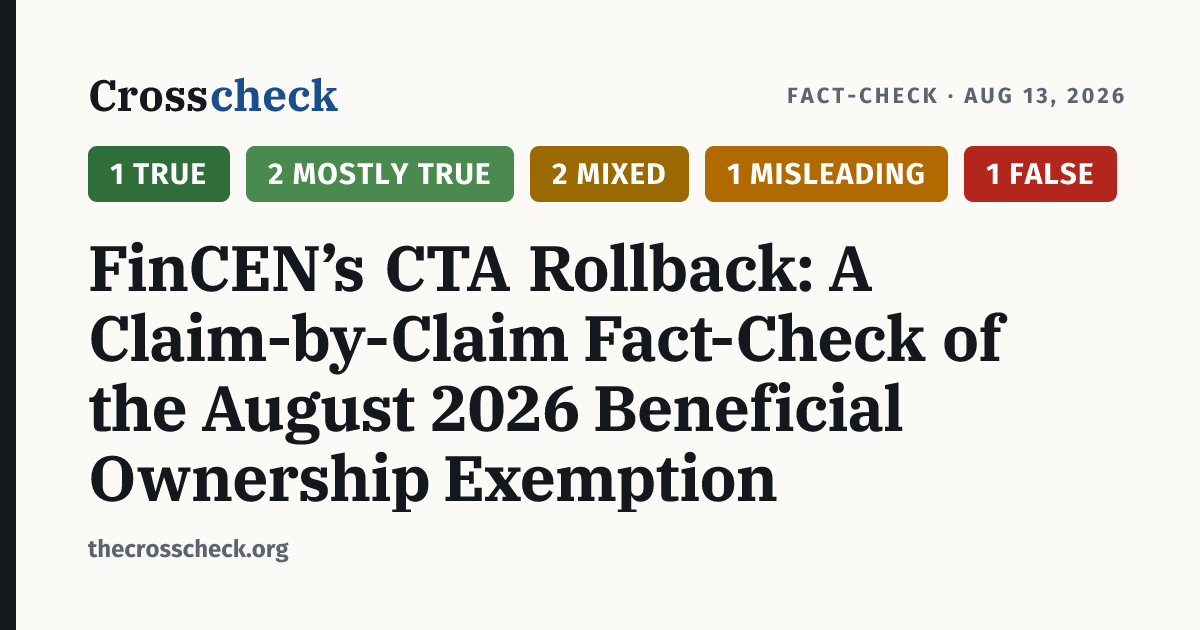
Each specific, independently verifiable claim earns its own rating below. The “primarily benefits” framing claims — small-business relief or criminal protection — are rated separately on the evidence for each, not forced into a single winner.
Claims at a Glance
| Claim | Rating |
|---|---|
| FinCEN issued a final rule on Aug. 11, 2026 permanently exempting essentially all U.S. companies and U.S. persons from BOI reporting | True |
| FinCEN committed to deleting already-collected BOI data on U.S. persons from its database | Mostly True |
| Foreign reporting companies still must disclose their U.S.-person beneficial owners | False |
| The rule constitutes genuine small-business burden relief | Mixed |
| The rule primarily benefits people seeking to hide anonymous shell company ownership | Mixed |
| Treasury’s action was largely required by or responsive to court orders | Misleading |
| The data deletion meaningfully limits law enforcement’s ability to use historical BOI records | Mostly True |
What the Rule Actually Does
On August 11, 2026, FinCEN published a final rule permanently removing the beneficial ownership information (BOI) reporting obligation for all domestic companies and all U.S. persons under the Corporate Transparency Act.[1] The rule makes permanent what had been an interim measure since March 21, 2025.[2]
The final rule does four distinct things:
- Permanently exempts all entities created under U.S. law from BOI reporting requirements.
- Eliminates the requirement that foreign reporting companies report their U.S.-person beneficial owners (they must still report beneficial owners who are foreign nationals).[3]
- Eliminates the requirement that foreign pooled investment vehicles registered in the U.S. report U.S.-person beneficial ownership.
- Commits FinCEN to deleting, from its BOI database, all information on individuals FinCEN reasonably identifies as U.S. persons, including data already submitted before the interim rule.
What remains: foreign entities that meet the CTA’s definition of a “reporting company” and do not qualify for an exemption must still file BOI for their non-U.S. beneficial owners.[3] FinCEN simultaneously stated it would work with the National Archives and Records Administration (NARA) to ensure compliance with applicable Federal records laws before completing the deletion — a procedural caveat that may affect the timeline and completeness of that deletion.[4]
Who Was Covered Under the Original CTA
The Corporate Transparency Act was enacted on January 1, 2021, as part of the National Defense Authorization Act for Fiscal Year 2021 (FY2021 NDAA).[5] Congress passed the override of then-President Trump’s veto 81-13 in the Senate and 322-87 in the House, with Trump objecting primarily to the bill’s failure to repeal Section 230 of the Communications Decency Act and to its provision renaming military installations that honored Confederate generals.[6] The CTA itself was enacted as an anti-money-laundering measure, with Congress directing FinCEN to build a beneficial ownership registry to combat money laundering, terrorist financing, and the use of anonymous shell companies.
A detail that matters directly to the “who actually benefits” question: the original FinCEN implementing rule already exempted 23 categories of entities from any reporting obligation. These included banks, credit unions, securities broker-dealers, investment companies, investment advisers, insurance companies, 501(c)(3) tax-exempt organizations, publicly traded companies, and “large operating companies” — defined as entities with more than 20 full-time U.S. employees, a physical office in the United States, and more than $5 million in gross receipts or sales on the prior year’s federal tax return.[7]
The practical consequence of those 23 exemptions: by design, the reporting population was already composed primarily of smaller, more thinly-staffed entities. Large publicly-facing businesses, heavily regulated financial institutions, and substantial operating companies were already out. The approximately 32 million companies subject to the CTA before the March 2025 interim rule skewed toward single-member LLCs, small partnerships, holding companies, and special-purpose vehicles — precisely the organizational forms most associated with both legitimate small-business activity and beneficial-ownership opacity.[8]
Litigation History: Courts vs. Rulemaking
The litigation against the CTA produced a genuinely complex picture that is often mischaracterized as courts forcing Treasury’s hand. The record shows something more specific.
Two district court challenges produced significant rulings in 2024. In the Northern District of Alabama, a March 2024 final judgment in National Small Business United v. Yellen (No. 5:22-cv-01448) found the CTA unconstitutional as exceeding Congress’s Commerce Clause, Necessary and Proper, and foreign affairs powers, producing an injunction limited to case plaintiffs.[9] In the Eastern District of Texas, a December 3, 2024 ruling in Texas Top Cop Shop, Inc. v. Garland — brought by a family firearms retailer together with the National Federation of Independent Business (NFIB) and other plaintiffs — issued a nationwide preliminary injunction.[10]
Then the situation became more complicated. On December 23, 2024, a Fifth Circuit motions panel lifted the Texas injunction, allowing enforcement to resume. Three days later, the Fifth Circuit merits panel reinstated the injunction. On January 7, 2025, a separate Texas federal judge in Smith v. U.S. Department of the Treasury issued another nationwide stay of the Reporting Rule’s effective date.[10] Then, on January 23, 2025, the Supreme Court stayed the Texas Top Cop Shop injunction pending the Fifth Circuit’s merits review — meaning the CTA was once again legally enforceable.[11] FinCEN confirmed the next day that because the Smith order remained in effect, “reporting companies are not currently required to file.”
The Fifth Circuit had oral arguments on the constitutional question scheduled for March 25, 2025. FinCEN issued its interim final rule exempting all domestic companies on March 21, 2025 — four days before those arguments, while the constitutional question was still unresolved on appeal. That rulemaking decision was Treasury’s own choice, not a response to a court order.[12]
The Small-Business Relief Claim
The administration’s framing — FinCEN’s press release is titled “FinCEN Permanently Ends Beneficial Ownership Reporting Requirements for Millions of Small Business Owners”[1] — is partially accurate.
The compliance burden argument has a real foundation. Roughly 32 million companies were subject to the CTA’s requirements; only 6.5 million had filed by November 2024, meaning that 25.5 million entities still faced a reporting obligation with no obvious infrastructure to help them comply.[8] Business groups and some legal practitioners documented genuine costs in time and professional fees for small entities navigating the beneficial ownership definitions.[13] Industry estimates put compliance costs at roughly $9 billion annually across the filing population.[14]
However, the administration’s framing is incomplete in a specific and important way: the entities being relieved are exactly the same entity types — single-member LLCs, holding companies, special-purpose vehicles — that feature prominently in money laundering schemes and asset-concealment structures. “Small business” and “anonymity-seeking holding vehicle” are not mutually exclusive legal categories. They share a form. The rule relieved the burden for both simultaneously; framing it exclusively as small-business relief is accurate as far as it goes, but incomplete about what else it does.
The Shell-Company Concern
The critics’ framing is also partially supported by the record, and also incomplete in a specific way.
The CTA’s 2021 passage was directly preceded by high-profile documentation of U.S. shell company exploitation. The FinCEN Files, published in September 2020 by BuzzFeed News and the International Consortium of Investigative Journalists, revealed 2,657 leaked suspicious activity reports covering more than $2 trillion in suspicious transactions involving major financial institutions.[15] The Panama Papers, published in April 2016, exposed the offshore structures through which thousands of individuals in over 200 countries hid assets, with U.S. entities frequently appearing in those structures.[16] In 2022, the Tax Justice Network’s Financial Secrecy Index ranked the United States first — the worst score recorded since the index began in 2009 — driven substantially by the ease of forming anonymous shell companies in Delaware, Nevada, and Wyoming, states where nominee directors, no public beneficial-ownership disclosure, and minimal verification requirements had made the U.S. a preferred destination for opacity-seeking capital.[17]
The critics are correct that the CTA was designed to directly address this specific vulnerability, and that the entities now permanently exempted — domestic LLCs and corporations of any size — include the vehicle types most exploited in documented laundering cases. The FACT Coalition’s statement that the rule “keeps the floodgates open for criminals to launder money through U.S. shell and front companies” reflects that documentary record; it is not a speculative claim.[18] Law enforcement organizations that opposed the rule made parallel arguments: the National District Attorneys Association stated that FinCEN had “significantly hindered prosecutors’ ability to identify the bad actors from legitimate businesses when investigating U.S. shell companies.”[18]
The critics’ framing becomes imprecise when it implies the affected population is primarily opacity-seekers. There is no available data on the beneficial-ownership profile of the 32 million subject entities that would let anyone assign a fraction to “genuine small businesses” versus “anonymity vehicles.” The populations overlap. The rule does benefit both. Claiming primacy for either side requires evidence that does not exist in the public record.
| Genuine small businesses | Won | Compliance burden eliminated; no 2025 or future filing obligation. |
| Opacity-seeking ownership structures | Won | Central registry database never built out to the full 32M; historical data now deleted. Status quo of anonymous ownership largely preserved. |
| Federal law enforcement | Lost | Centralized BOI database for U.S. persons deleted. Investigations involving domestic shell companies must now rely on slower, case-by-case subpoenas to banks and state records. |
| Banks / financial institutions | Mixed | Retain separate Customer Due Diligence (CDD) obligations under the Bank Secrecy Act — but lose access to a government database as a compliance shortcut. Must now build entity-resolution infrastructure privately.[4] |
| State-level AML investigators | Lost | State prosecutors had cited the CTA as a key tool; deletion of historical data forecloses use of pre-2026 filings in ongoing or future investigations. |
| Financial transparency advocates | Lost | Over a decade of legislative work toward a beneficial ownership registry — culminating in the 2021 CTA — effectively rolled back through executive rulemaking rather than congressional repeal. |
The Data Deletion: Sharpest Policy Cut
The data deletion commitment is the most concrete and consequential action in the rule, and it deserves its own rating, separate from the forward-looking exemption.
The exemption means U.S. companies do not file going forward. That removes a tool before it is fully built (only 6.5 million of 32 million expected filings had been made before the injunctions paused collection). The deletion goes further: it removes data that was already collected from the registry entirely. For law enforcement, this forecloses the use of any historical FinCEN BOI submissions as evidence in investigations of conduct during the 2024 filing window.
The practical effect is not that law enforcement loses all access to beneficial ownership information about domestic companies. Banks retain independent obligations under the Bank Secrecy Act’s Customer Due Diligence rules — they must still identify and verify the beneficial owners of their business customers. What changes is access to a centralized, searchable government repository. Instead of checking a federal database, investigators now rely on financial institution records (reachable through subpoena), state corporate filings (which rarely require beneficial ownership disclosure), and international information-exchange channels. Those paths exist but are slower and require more case-specific predication.
The NARA caveat in FinCEN’s press release is notable: FinCEN stated it would work with the National Archives to ensure it is “abiding by all applicable Federal records laws” before completing the deletion.[4] Federal records retention law may constrain how completely historical filings can be deleted. Whether the deletion will be total or partial, and on what timeline, remains a verifiable open question that FinCEN has not yet answered with specificity. Rating: Mostly True — the commitment is real and documented, but the NARA process introduces procedural uncertainty about completeness and timing.
Two Comparisons: EU and UK
Two international precedents frequently appear in coverage of this rule, and both require careful framing.
The EU precedent. On November 22, 2022, the Court of Justice of the European Union ruled in the joined cases WM and Sovim SA v. Luxembourg Business Registers (C-37/20 and C-601/20) that requiring general public access to beneficial ownership registers constituted a serious interference with the fundamental rights to privacy and personal data under Articles 7 and 8 of the EU Charter of Fundamental Rights.[19] Several EU member states subsequently restricted public access to their registers.
This ruling is relevant to a specific design question — whether beneficial ownership data should be publicly searchable — but it does not directly address the U.S. situation. The FinCEN BOI database was never public. It was restricted to law enforcement, national security agencies, and financial institutions with customer consent. The EU ruling supports a genuine privacy concern about open public disclosure; it does not speak to whether a restricted, non-public law-enforcement database is appropriate. Using the CJEU ruling as support for eliminating the FinCEN database conflates two substantially different transparency designs.
The UK precedent. The United Kingdom introduced a beneficial ownership register (the People with Significant Control, or PSC, register) through Companies House beginning in 2016. The register had a significant and well-documented weakness: it accepted self-reported, unverified information. Analysis found fraudulent and fabricated entries, with fraudsters exploiting the register’s lack of real-time verification to create misleading records.[20] The UK addressed this through the Economic Crime and Corporate Transparency Act 2023, which gave Companies House stronger powers to query, verify, amend, and share information with law enforcement partners, with implementation beginning in March 2024.
The UK experience is a genuine data point, but it supports a different lesson than the rule’s proponents suggest. The failure was weak enforcement of a transparency requirement, not the transparency requirement itself. The corrective was stronger verification, not elimination. It is more relevant as a warning about what happens when a BOI registry is real but weakly administered — a design failure the CTA’s restricted, agency-managed model was intended to avoid.
Effects Are Documented; Intent Is Not
The effects of this rule are checkable claims, and they are rated above with high confidence. What the rule does, who it exempts, what courts had actually ordered, who bears the costs and who receives the benefits — these can be assessed against documentary evidence.
The intent behind the rule is a different and more speculative claim. Treasury Secretary Scott Bessent stated that domestic BOI collection would not “serve the public interest or provide useful information for national security, intelligence, or law enforcement efforts” — a policy judgment, not a factual claim, and one that law enforcement organizations directly dispute.[4] Moving from “this rule has the documented effect of eliminating a beneficial-ownership disclosure tool that covers entities including genuine small businesses” (well-supported) to “this rule’s primary intent was to protect wealthy individuals’ hidden assets” (a claim about motive) requires evidence the public record does not provide.
What the record does support: the rule was issued by an administration whose senior officials had expressed skepticism of beneficial ownership transparency requirements; the rulemaking went substantially further than any court had mandated; and the beneficiaries include both legitimate small businesses and opacity-seeking structures. Whether the primary driver was ideological opposition to AML regulation, genuine concern for small-business compliance costs, responsiveness to political constituencies (NFIB had been a plaintiff), or some combination is not established by any document available in the public record. That question is real, but it is in a different evidentiary category from the policy effects.
What to Watch
- NARA / Records process: FinCEN’s deletion commitment is contingent on completing a National Archives review. Watch for Federal Register notices or FinCEN announcements on the scope and timeline of the actual deletion — particularly whether any categories of already-collected data are retained under records preservation requirements.
- State beneficial ownership laws: Several states have enacted or are considering their own BOI disclosure requirements. New York’s LLC Transparency Act (2023) imposes beneficial ownership disclosure at the state level for LLCs formed or registered in New York. State-level registries are not affected by the federal rollback and may partially fill the gap for intrastate enforcement.
- Congressional action: The CTA was passed by Congress over a presidential veto. Bipartisan support existed for it in 2021; whether that coalition can be reassembled to legislatively restore the requirement, or modify the rule through appropriations riders, is an open question.
- Financial Secrecy Index: The Tax Justice Network’s biennial index (next edition due in 2026 or 2027) will be the first to assess the U.S. under the full rollback. Whether the U.S. retains or worsens its 2022 first-place ranking will provide a quantitative measure of the rule’s transparency impact.
- Bank CDD enforcement: The rule shifts the de facto beneficial ownership verification burden to financial institutions’ private CDD programs. Whether regulators — FinCEN, OCC, FDIC, Federal Reserve — actively enforce those existing BSA obligations for shell-company customers, or scale back enforcement in parallel with the BOI rollback, will determine how much of the AML function actually survives in practice.
Sources
- FinCEN Permanently Ends Beneficial Ownership Reporting Requirements for Millions of Small Business Owners
- Beneficial Ownership Information Reporting Requirement Revision and Deadline Extension (Interim Final Rule, RIN 1506-AB67)
- Final rule will eliminate BOI reporting for US entities
- FinCEN Killed the Beneficial Ownership Database but Banks Still Need the Data
- Congress Passes the Corporate Transparency Act — Overriding Presidential Veto
- Tax History: The Trump Veto That (Almost) Saved Anonymous Shell Companies
- Corporate Transparency Act: Understanding the “Large Operating Company” Exemption
- BOI update: 6.5 million of 32 million reports filed so far
- Latest Corporate Transparency Act Guidance: Eleventh Circuit Decision Affirms CTA Constitutionality
- U.S. Supreme Court Lifts Corporate Transparency Act Injunction, but Another Takes its Place
- Garland v. Texas Top Cop Shop (24A653)
- UPDATE: What’s Happening With the Corporate Transparency Act
- FinCEN Beneficial Ownership Information Reporting Rule
- FinCEN drops US ownership filings, cutting $9bn a year in compliance costs
- FinCEN Files
- The Panama Papers: What a Story!
- US lands top spot as world’s biggest enabler of financial secrecy in new index
- Criminals Get Free Pass in Treasury’s Rule Rolling Back Protections to Fight Dirty Money
- Public Access to Information on Company Beneficial Ownership is a Violation of Privacy According to the CJEU
- Economic Crime and Corporate Transparency Act: beneficial ownership