Fact-check
Infrastructure and Ideology: Parsing the Tech-Elite Surveillance Claim
Palantir's ICE contracts, Thiel's 'freedom and democracy are incompatible,' and Yarvin's autocracy blueprint are all real. The claim they form a coordinated plan is not proven.
By The Crosscheck Desk · 2026-08-12

Palantir holds major ICE contracts for immigration surveillance, including the $29.9 million ImmigrationOS task order.
The Ring-Flock Safety partnership would have routed Ring doorbell footage into law-enforcement camera networks — and is an example of unstoppable surveillance expansion.
Peter Thiel wrote in 2009 that he 'no longer believes that freedom and democracy are compatible.'
Curtis Yarvin's 2022 'Butterfly Revolution' essay advocates exercising absolute sovereignty after an electoral win to dismantle and rebuild government under a single unified executive.
JD Vance has a documented relationship with Yarvin's ideas and Yarvin has a documented relationship with Peter Thiel.
DOGE was operationally inspired by or directly influenced by Yarvin's RAGE concept.
Elon Musk addressed a far-right AfD party rally in Germany on January 25, 2025.
The surveillance infrastructure is the material means by which a documented anti-democratic tech-elite ideology is being deliberately operationalized as a coordinated plan.
The Right Question to Ask
Viral commentary on this subject tends to ask: Is surveillance infrastructure being built to replace democracy? That question has an unsatisfying answer because it fuses two distinct claims at different evidentiary levels.
The more productive frame is: What exactly connects documented surveillance expansion to documented anti-democratic ideology, and how strong is each link? The pieces are not equally documented. Each deserves its own rating.
What follows rates seven factual components independently — surveillance infrastructure, primary-source statements, documented relationships, causal claims — before turning to the connecting thesis.
The Surveillance Infrastructure
Palantir's ICE Contracts
ImmigrationOS is built on top of ICE's Investigative Case Management platform, which Palantir has maintained since at least 2014. ICE tasked Palantir with enabling "complete target analysis of known populations" — agency language from contracting documents.[1] Both the $30 million ImmigrationOS task order and a separate notice of intent to sole-source a next-generation ICM system to Palantir (posted to SAM.gov in 2025) were awarded without competitive bidding, with ICE citing Palantir as the only qualified vendor.[3]
A congressional oversight letter signed by Reps. John Garamendi, Dan Goldman, Nydia Velázquez, and Sen. Ron Wyden in April 2026 demanded answers from ICE and DHS about Palantir-linked tools that allow personnel to connect individual profiles to addresses, phone numbers, devices, and identifiers across multiple datasets.[4]
Facial Recognition on US Citizens in Minneapolis
The Ring-Flock Partnership: A Necessary Correction
The Ring-Flock story is worth holding onto precisely because it complicates the determinism that often runs through viral commentary on this topic. The surveillance state is not monolithic and it is not frictionless. Companies respond to market pressure when that pressure is concentrated enough.
Peter Thiel's Own Words
Thiel published "The Education of a Libertarian" in Cato Unbound on April 13, 2009.[7] The relevant passages, quoted precisely:
"I remain committed to the faith of my teenage years: to authentic human freedom as a precondition for the highest good... But I must confess that over the last two decades, I have changed radically on the question of how to achieve these goals. Most importantly, I no longer believe that freedom and democracy are compatible." — Peter Thiel, "The Education of a Libertarian," Cato Unbound, April 13, 2009
"In our time, the great task for libertarians is to find an escape from politics in all its forms — from the totalitarian and fundamentalist catastrophes to the unthinking demos that guides so-called 'social democracy.' The critical question then becomes one of means, of how to escape not via politics but beyond it... for this reason I have focused my efforts on new technologies that may create a new space for freedom." — Peter Thiel, "The Education of a Libertarian," Cato Unbound, April 13, 2009
Thiel goes on to discuss three "frontiers" for escaping democratic politics: cyberspace, outer space, and seasteading (floating ocean communities). His point is libertarian escape, not authoritarian consolidation — he was writing against what he saw as inescapable democratic redistributionism, not sketching a surveillance state. The essay does not endorse authoritarianism; it expresses pessimism about mass democracy and a desire to find exit from it. Both the pessimism and the escape thesis are relevant context for what followed.
The same essay contains a sentence that has aged into infamy: "Since 1920, the vast increase in welfare beneficiaries and the extension of the franchise to women — two constituencies that are notoriously tough for libertarians — have rendered the notion of 'capitalist democracy' into an oxymoron." It is in the same document, not added later.
Curtis Yarvin's Blueprint
Yarvin published "The Butterfly Revolution" on his Substack Gray Mirror on April 7, 2022.[8] The essay's core argument in Yarvin's own language:
"By winning a Presidential election, he will then install it in office. Metamorphosing into a beautiful butterfly, this larva will perform the feat that eluded Trump's first regime — turning office into power." — Curtis Yarvin, "The Butterfly Revolution," Gray Mirror, April 7, 2022
"giving absolute sovereignty to a single organization — with roughly the powers that the Allied occupation authorities held in Japan and Germany in the fall of 1945." — Curtis Yarvin, "The Butterfly Revolution," Gray Mirror, April 7, 2022
The essay's central metaphor is metamorphosis: an opposition movement builds itself in "internal exile," appearing harmless until an electoral win unlocks what Yarvin calls a complete seizure of executive authority. The explicit model is the post-WWII Allied occupation — unilateral, uncontested, total. Yarvin analyzes Trump's first term as a failure because Trump "captured only office, not power," constrained by Humphrey's Executor (1935) and the Administrative Procedure Act.
His earlier RAGE concept — "Retire All Government Employees," coined in a 2012 speech at the BIL Conference[9] — proposes mass firing of the federal civil service as the mechanism for breaking what he calls "the cathedral," his term for entrenched liberal institutional consensus. RAGE and the Butterfly Revolution are companion concepts: RAGE describes what to do once power is held; the Butterfly Revolution describes how to get there.
The Documented Relationships
Thiel-Yarvin: In 2013, Thiel invested in Tlön, a software startup co-founded by Yarvin.[10] Yarvin has been described by multiple journalists covering Thiel's network as a "house political philosopher" for the Thielverse — the ecosystem of founders, investors, and operatives in Thiel's orbit. This description reflects reporting, not Yarvin's own characterization.
Vance-Yarvin: In a 2021 podcast, Vance cited Yarvin by name and referenced his ideas about replacing civil servants with loyalists — language that directly echoes RAGE.[10] Vance's rise was substantially funded by Thiel, who backed his 2022 Senate campaign. These documented connections make the claim of "exposure and engagement" accurate.
What is not well-documented: a sustained, operative relationship. Yarvin himself has said "our relationship is definitely overstated." More recently — after Vance became vice president — Yarvin recounted bumping into Vance at a party, where Vance said, "Yarvin, you reactionary fascist."[11] Whether this is Vance's actual current view or a distancing maneuver is not knowable from the outside. What it does establish: by 2025, Vance was publicly treating Yarvin as a figure to keep at arm's length, not an active advisor.
DOGE and RAGE: How Strong Is That Link?
The Washington Post's May 2025 investigation, headlined "Curtis Yarvin helped inspire DOGE. Now he scorns it.," is the most authoritative piece on this connection.[12] Its key findings:
- Two DOGE advisers (both anonymous) said Yarvin was "a powerful influence among those carrying out DOGE's radical cost-cutting agenda."
- One adviser described Yarvin as having provided "the most crisp articulation" of what DOGE is trying to achieve.
- A separate adviser said: "It's an open secret that everyone in policymaking roles has read Yarvin" and "They were able to take the Curtis theory and use it to empower people on the ground to actually do stuff — even if they can't admit it publicly."
- Yarvin himself says he has never met Musk.
The "even if they can't admit it publicly" formulation is significant precisely because of what it admits: no one inside DOGE has cited Yarvin on the record as an operational influence. The connection relies entirely on anonymous characterization.
What is on the record: both Vance and Blake Masters explicitly cited the RAGE concept by name during their 2022 campaigns, advocating for mass firing of federal employees and replacement with loyalists.[10] Vance is now vice president. That is a traceable, documented person-to-idea-to-office pathway, even if the line from "Vance endorsed RAGE in 2022" to "DOGE executes RAGE in 2025" runs through a gap in the documentary record.
The conceptual resemblance between RAGE and DOGE's operation is not in dispute — mass reductions in force, civil service replacement, administrative dismantling. Whether that resemblance reflects deliberate adoption, convergent thinking, or simple coincidence among people who share overlapping networks is the unresolved question.
Musk and the AfD
Musk's actual quoted statements from January 25, 2025:[13][14]
"I'm very excited for the AfD, I think you're really the best hope for the future of Germany." — Elon Musk, AfD rally, Halle, Germany, January 25, 2025
"The future of civilization could hang in this election... I think there is frankly too much of a focus on past guilt, and we need to move beyond that. Children should not be guilty of the sins of their parents or even their great grandparents." — Elon Musk, AfD rally, Halle, Germany, January 25, 2025
"It's good to be proud of German culture, German values, and not to lose that in some sort of multiculturalism that dilutes everything." — Elon Musk, AfD rally, Halle, Germany, January 25, 2025
Context: The appearance came days after Musk drew controversy at a Washington, DC, celebration for his raised-arm gesture, which critics described as a Nazi salute and which Musk denied. The AfD is classified by German domestic intelligence (the BfV) as a "proven right-wing extremist" organization. AfD's Alice Weidel, whom Musk also interviewed separately, ran on a platform that included mass deportations and calls to restrict German citizenship. The AfD came second in the February 23, 2025 German federal election with 20.8% of the vote; a CDU-led coalition formed without them.
The Central Connecting Thesis
The connecting thesis works at two different strengths, and the stronger version is the honest one.
The defensible claim (strong evidence): Several people who now hold significant government power or influence government contractors — Vance, Musk via DOGE, Thiel via his funding network — have documented records of exposure to, endorsement of, or funding of anti-democratic thinking. Simultaneously, those same years have seen rapid expansion of federal surveillance infrastructure, awarded to contractors with ties to that same network, without meaningful democratic debate. That is a real and concerning documented pattern.
The weaker claim embedded in the viral version (thin evidence): That these facts represent a coordinated, unified plan whose purpose is to use surveillance as a tool of democratic replacement. To establish that, you would need: (a) documented communication between these actors coordinating on that specific goal, (b) a stated policy linking surveillance expansion to political control, or (c) evidence that the surveillance tools are being used against political opponents in a systematic way beyond what existing law permits. None of these is currently in the documentary record.
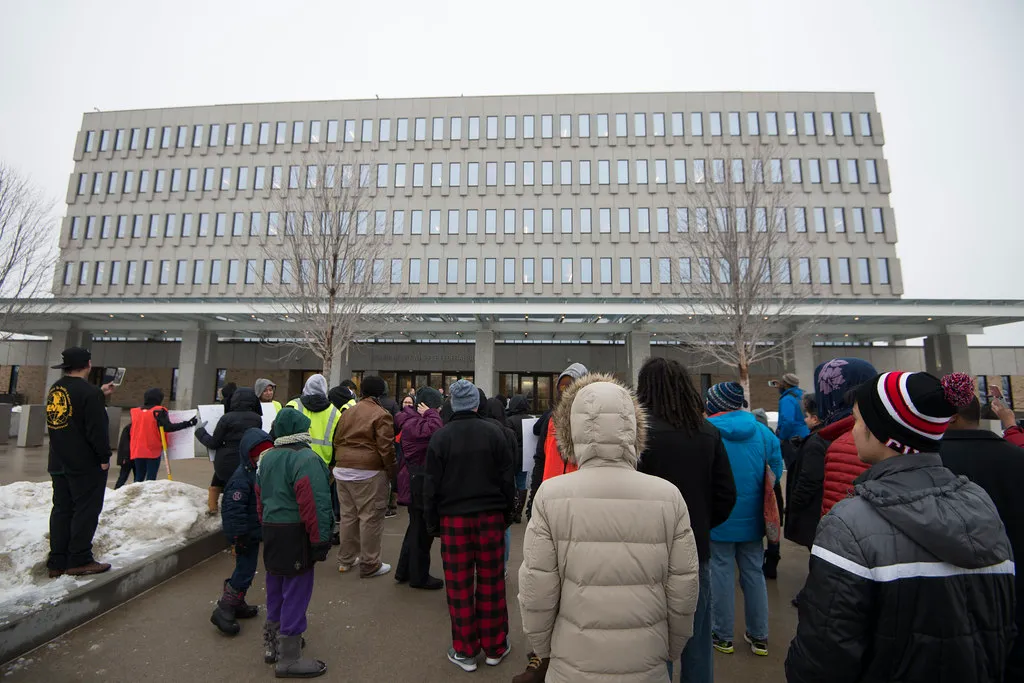
What would move the claim from "documented pattern of concerning statements and actions" to "proven coordinated plan"? A document — memo, contract rider, communications record — linking surveillance capability expansion to a specific goal of suppressing political opposition or bypassing democratic process. Alternatively, systematic documented use of Palantir data against political dissidents, analogous to documented historical cases like COINTELPRO. The Minneapolis facial recognition data includes citizens who were protesting ICE, which is suggestive — but a pattern of a few documented cases is not the same as a systematic program of political suppression.
The gap between "concerning" and "proven" is not a gap to be closed by inference alone.
The Strongest Counterargument
Steelman: The Coincidence / Ordinary-Politics Case
The federal government has been expanding surveillance infrastructure since at least 2001, under administrations of both parties. ICE's Palantir contracts began under Obama and grew under Trump 1.0, Biden, and Trump 2.0 — the growth trajectory does not break cleanly on ideological lines. Elon Musk's AfD endorsement is consistent with his publicly stated libertarian skepticism of European regulation and his support for populist-nationalist movements globally, not obviously connected to Yarvin's post-democratic theory. DOGE's mass firings are consistent with standard conservative small-government ideology without requiring Yarvin as a source. Peter Thiel's 2009 essay expressed frustration with democratic redistributionism, not a blueprint for authoritarian consolidation. The people in this network disagree with each other substantially — Yarvin himself called the Trump administration a "tragedy" that has "already lost" by his own criteria,[12] and called Vance a "reactionary fascist" back. A group this internally argumentative is not obviously a coherent conspiracy. The pattern may be genuine, and the individuals' statements are their own, but "multiple wealthy tech figures have separately said or done concerning things" is a weak basis for inferring a unified operational plan.
This counterargument scores a 3 on the adversarial rubric — it is plausible and worth taking seriously, but it does not directly refute the core concern, which is not that a conspiracy is proven but that the infrastructure exists, the ideology is documented, and the people who hold both are in power. The counterargument is a reason to hold the verdict at "Unproven as Stated" rather than "True" — not a reason to dismiss the underlying concern.
Actor Scorecard
What is documented, who did it, and what it means — held separately per actor:
| Actor | Documented Fact | Strength | Gap |
|---|---|---|---|
| Peter Thiel | 2009: wrote "I no longer believe that freedom and democracy are compatible"; invested in Yarvin's startup; funded Vance's Senate campaign | Strong — primary source | No direct documented role in surveillance contracts or DOGE |
| Curtis Yarvin | RAGE (2012) and Butterfly Revolution (2022): both publicly documented; explicitly advocates post-democratic executive consolidation | Strong — primary source | No government role; says he has never met Musk; called Trump era a "tragedy" by his own criteria |
| JD Vance | 2021: cited Yarvin by name on a podcast, endorsed RAGE concept; funded by Thiel; now VP with executive influence | Moderate — on-record statement, documented funding | More recently publicly distanced from Yarvin; no documented order directing surveillance expansion toward political opponents |
| Elon Musk / DOGE | Led DOGE mass federal workforce reductions; addressed AfD rally Jan 25, 2025; DOGE advisers (anonymous) cited Yarvin as inspiration | Moderate for DOGE-RAGE (anonymous sources only); Strong for AfD appearance (on-record) | Yarvin says he has never met Musk; no on-record DOGE official has cited Yarvin |
| Palantir / ICE | $29.9M ImmigrationOS task order (Sept 2025); $139.3M ICM contract (2022); facial recognition deployed on US citizens (Jan 2026) | Strong — contracting records, congressional record, AP/NBC reporting | No documented link to Thiel/Yarvin ideology as a driver; Palantir operates across administrations |
What to Watch
- OngoingCongressional response to the Garamendi-Goldman-Velázquez-Wyden oversight letter (April 2026): DHS and ICE were given until April 24, 2026 to respond. Whether that response has been produced, and what it contains, will bear on the documented scope of Palantir's access to personal data.
- OngoingThe sole-source notice for Palantir's next-generation ICM system is moving toward a contract award. The new system includes biometric identification integration. Any congressional debate or court challenge before that contract is finalized is a live decision point.
- OngoingA House Judiciary Committee hearing on "The Tech Behind ICE: Oligarchs, Immigration Enforcement, and the Threat to Democracy" has been scheduled. What testimony emerges about the operational relationship between surveillance platforms and enforcement targeting will clarify whether the Minneapolis-style facial recognition scans of US citizens are isolated incidents or policy.
- WatchYarvin published a follow-up declaring the Trump 2.0 administration had "already lost" by his own criteria — that office had again failed to become power. If Vance or others in DOGE respond to this publicly, that exchange would be the first on-the-record acknowledgment of ideological dialogue, and would significantly upgrade the strength of the DOGE-RAGE connection claim.
- WatchACLU and EPIC have active litigation challenging Palantir's ICE data practices. Court filings in those cases may produce internal documents describing data use policies that are not visible through contracting records alone.
Sources
- ICE Paid Palantir $30 Million to Build a Deportation Operating System
- Palantir Technologies — ICE Surveillance & Case Management Platform
- Notice of Intent to Sole Source — Investigative Case Management
- Goldman, Wyden, Velázquez Demand Answers on ICE Use of Palantir-developed Technologies
- How ICE agents are using facial recognition technology to bring surveillance to the streets
- Amazon's Ring cancels Flock partnership amid Super Bowl ad backlash
- The Education of a Libertarian
- The Butterfly Revolution
- Curtis Yarvin
- Where J.D. Vance Gets His Weird, Terrifying Techno-Authoritarian Ideas
- J.D. Vance calls Curtis Yarvin a 'reactionary fascist'
- Curtis Yarvin helped inspire DOGE. Now he scorns it.
- Elon Musk speaks at Germany's AfD campaign launch as thousands protest the far-right party
- Elon Musk faces criticism for encouraging Germans to move beyond 'past guilt'
- All the Ways Palantir is Assisting Trump's Abusive Removal Campaign
- Ring Cancels Flock Safety Partnership Amid Backlash Over 'Creepy' Super Bowl Ad
- Ramirez, Johnson Host Oversight Hearing on the Threat to Democracy Posed by ICE's Use of Technology for Mass Surveillance
- Lawmakers press DHS, ICE over Palantir surveillance tools