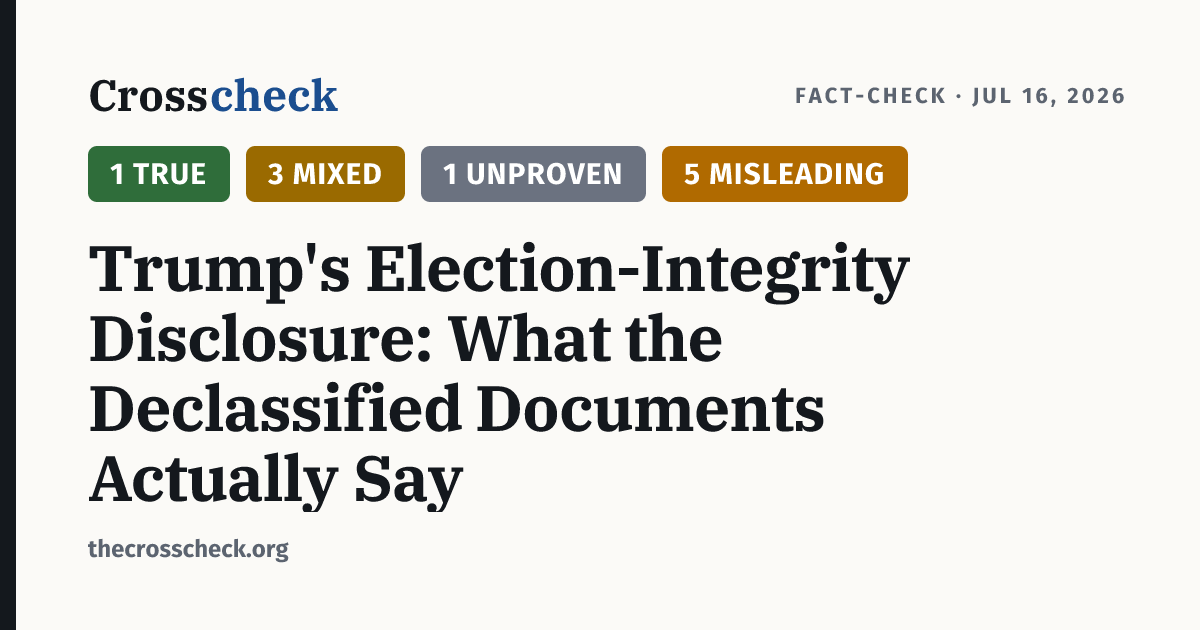
The Claims
On the night of July 16, 2026, President Trump delivered a primetime address announcing the declassification and release of intelligence records that, he said, revealed foreign compromise of U.S. elections and a domestic cover-up. The White House posted four document archives — roughly 58 files — to whitehouse.gov, organized under four headings: vulnerabilities in voting machines, China’s acquisition of voter data, a Michigan registration investigation, and noncitizens on the voter rolls.[1]
The documents are real. Many are genuine Intelligence Community products — National Intelligence Council memos, a CIA World Intelligence Review article, FBI interview reports — bearing declassification stamps from July 2026.[2][3] This fact-check sets each major claim in the address against the specific document it draws on, quoting the passage relied upon and the surrounding text. Where a document supports the President, we say so; where its own caveats, confidence levels or adjacent sentences cut against the claim, we note that too.
How We Checked This
Every document in the four archives was reviewed directly from the files the White House published. The declassified pages are image scans, so they were processed with optical character recognition and read in full where they bear on a claim. Quotations below are transcribed from those documents; occasional bracketed notes flag redactions. Throughout, we keep four distinctions the address tends to blur: the difference between capability and intent; between espionage (spying and data theft) and interference (altering the casting or counting of votes); between voter-registration fraud and fraudulent votes actually cast; and between a formally labeled dissent and suppressed intelligence.
China and the “220 Million Voter Files”
The address said China carried out “the largest compromise of election data in history,” acquiring “220 million U.S. voter files.”[6] The figure traces to one document in the China archive, which catalogs data a PRC entity was assessed to possess as of 2019. Its single largest voter-related line item reads: “Unspecified U.S. voter data — 204,822,241 records (45 GB) — 2016.”[3]
Three points of context matter. First, the number in the record is about 204.8 million; the administration’s own task-force statement rounds it to “more than 200 million,” and the address’s “220 million” is higher than both.[3] Second, the same document describes a catalog in which “most of the entries were targets in other countries,” with only a minority of U.S. entries, and much of the listed material consists of data breached and leaked publicly elsewhere. Third, U.S. voter-registration files are, in many states, public records or commercially available; a 2016 dataset of “unspecified” origin roughly the size of the entire U.S. registered-voter population is consistent with an aggregated commercial file rather than a covert penetration of election systems. A separate memo documents PRC analysis of voter data from 18 states for “U.S. person matching and public opinion analysis” — a data-exploitation and targeting concern, distinct from altering votes.[3] The underlying datapoint is genuine; the “220 million” figure and the “largest compromise in history” framing overstate what the record establishes.
The “Deep State” Cover-Up
The address said intelligence officials “worked to actively suppress and downplay” China’s activity and hid it from the President and public, including by keeping reports out of the President’s Daily Brief and “massaging” a briefing.[6] Two released records are the basis for this.
The first is an email chain in which an NSA analyst writes, on November 20, 2020: “We have deliberately massaged our one pending PDB to avoid any direct links to the election.”[3] In the released chain, that line is circulated by other analysts raising it as a concern — one calls it a potential “analytic objectivity mistake”; another writes, “I would be concerned as to why they are ‘deliberately massaging’ analysis away from elections.” The dispute is whether NSA’s China reporting should be tied to the election at all; the officer who thought it should be concedes, “NIO Cyber and I think the new info is highly relevant, though I realize we’re in the minority there.” The address’s added phrase — that the massaging was done “to withhold information regarding Chinese activities related to the election” — does not appear in the document, which says “to avoid any direct links to the election.”[3]
The second is the “shadow government” line. In an internal FBI chat, an official (Nikki Floris, Counterintelligence Division) responds to a note that all election-related intelligence reports must route through Foreign Influence Task Force headquarters with: “i’m basically running a shadow government across the FBI at this point.”[3] The context is centralizing paperwork; the purpose the address attaches — keeping China intelligence secret and “away from the honorable press” — is not in the document.
Against the cover-up framing, the records most often cited as suppressed were, in fact, formally produced and circulated. The October 16, 2020 memo the address treats as hidden truth is stamped “Alternative Analysis,” was provided to the Intelligence Community for comment, and is a labeled minority view held at “low-to-medium confidence.” A December 30, 2020 FBI email shows the Bureau was “fine with the inclusion of the minority view” while insisting it “comport to the same analytic standards” — the objection was to the dissent’s rigor, not its existence.[2] The coordinated August 2020 assessment stated China “did not intend to try to affect the election.”[3]
The CIA Quotes on China’s Intent and Journalists
The address quoted CIA reporting that China’s 2018 policy was to “leverage all domestic and foreign elements that were opposed to the U.S. President” to prevent his reelection, and that China “sought to identify U.S. journalists who had reported negatively on the U.S. President and pay them” to write more.[6] Both quotations appear, closely, in a released CIA Note.[3] Two caveats: the document’s own header states it “contains portions of sensitive reporting” and “is not a comprehensive synopsis or summary” — it is a compilation of raw single-source reporting, not a finished, coordinated CIA judgment; and the address’s phrase “pay them large sums of money” adds an amount the document does not state (it says only “pay them to write more negative articles”). The quotes are real; their provenance and one embellishment are not as the address presents them.
“Manufacture Illegal Ballots for Biden”
The address said FBI “raw intelligence obtained in 2020, yet buried,” showed China attempted “to manufacture illegal ballots for Joe Biden.”[6] The source is an FBI Intelligence Information Report whose subject line references Chinese production of “Fraudulent US Drivers Licenses… in Order to Create Tens of Thousands of Fraudulent Mail-in Votes for… Joe Biden.”[3] The report concerns counterfeit driver’s licenses, not manufactured ballots, and carries several qualifications: it is stamped “INFORMATION REPORT, NOT FINALLY EVALUATED INTELLIGENCE”; its sourcing is third-hand (a source with “indirect access,” relaying a sub-source, relaying “unidentified PRC government officials”); and the FBI’s own comment undercuts the premise, noting that address data “was not a field when creating a TikTok account,” so the described mechanism for obtaining Americans’ addresses does not hold. The report was not sequestered: its header shows routine distribution to all FBI field offices, the CIA, DNI, NSA, DHS and the White House Situation Room. Follow-up in the same archive records that such counterfeit licenses are, per CBP, “mostly used by teens… to circumvent alcohol laws,” and that the reporting “contradicts… the wider” Intelligence Community.[3]
The “Burn Bags” From Obama
The address described the recent discovery of “burn bags” of information “given by President Barack Hussein Obama” that were meant to be incinerated.[6] No document in any of the four released archives references burn bags, incineration, or such a discovery; the terms do not appear. The address itself hedges the account (“we believe this was not done on purpose”). With no supporting material in the release, the claim cannot be verified from what was disclosed.
“Adversaries Have the Capability”
The address quoted an assessment that U.S. adversaries “including at a minimum Russia, China, Iran, North Korea, as well as non-state groups, have the capability to compromise U.S. election infrastructure.”[6] That language is verbatim from the January 2020 NICM.[2] This claim is accurate as far as it goes. The context the address omits is in the next sentence of the same memo: “but we do not know whether any of them have specific plans to manipulate election-related systems.” The memo’s scope note adds that it “does not assess adversary intentions.” It is a statement about capability, not intent or action.
Voting Machines and the Venezuela Comparison
The address said machines and counting systems are “easily compromised” and that vote totals can be secretly altered — pointing to CIA reporting on a Venezuelan plot to “digitally alter vote totals in ways that could not be detected, even with an audit,” and adding, “that’s exactly what happened.”[6] The security concerns are partly documented: a 2026 CISA report found that assessors “gained full network control within hours or days” of many state and local election networks with weak cyber hygiene.[2] But CISA frames this as fixable software and network hygiene “not attributable to any single entity,” and its top recommendations are “human-readable paper ballots” and “post-election manual audits” — neither of which is in the SAVE America Act the address urges. The January 2020 NICM separately assessed that tabulation systems “would be difficult to manipulate on a wide enough scale to alter the election outcome” and that audits and paper trails, “now required in 38 states,” would likely uncover an attempt.[2]
On Venezuela, the released CIA Note is more guarded than the address. It states the reporting “did not definitively confirm that large-scale electronic fraud was successfully executed,” that the 2013 fraud scenario “was explicitly an alternative analysis exercise rather than a definitive finding,” that a 2006 assessment found neither Smartmatic nor Venezuela had the capability to manipulate an election “outside of Venezuela,” and that the 2020 plot was assessed as unnecessary because “virtually the entire opposition boycotted.” The Note also says it “reflects a CIA perspective and was not coordinated within the Intelligence Community.”[2]
“278,000 Noncitizens” on the Rolls
The address said more than a quarter-million noncitizens are illegally registered.[6] The DHS summary in the release combines two different figures: “OVER 250,000 NON-CITIZENS… IN JUST THE FOUR STATES FOR WHICH PUBLIC DATA FILES HAVE BEEN REVIEWED” (California, Pennsylvania, New Jersey and Nevada), plus “over 28,000 non-citizens” identified through the federal SAVE citizenship-status system across 25 states.[5] The two are not equivalent. The 28,000 SAVE figure derives from matches against an actual immigration-status database. The larger 250,000 figure is attributed only to a “review of the first set of public voter files,” with no matching methodology described — the same kind of name-and-date matching that produced large noncitizen-voter estimates in Texas in 2019 and Florida in 2012 that were later substantially retracted. The composite “278,000” appears in no single document; it is a sum of a well-sourced number and an unmethodologized one.
The Michigan Investigation
The address and pillar text said Michigan canvassers admitted to the FBI that they signed forms in other people’s names and were paid per application, and that the Biden Justice Department “slow-walked” the case.[1] The registration-fraud element is supported by the FBI interview memos: one canvasser stated she was told that if workers “couldn’t get enough applications, they should just fill them in,” that she could “make up names or use anyone else’s name,” and that she “submitted 100 fake voter registration applications.”[4] Database checks of 107 applications found 91 matched no real person. The payment detail is looser than described — the files record hourly pay plus a roughly $50 bonus for meeting a form quota, loaded onto reloadable debit cards, with one memo noting it “doesn’t appear as paying on a per-registration basis.”[4]
Two distinctions bear on the claim. This is registration fraud: the DOJ manual quoted in the FBI’s own file notes that such bounty-hunting schemes “usually [do] not result in fraudulent votes actually being cast,” and no document in the archive shows a fraudulent vote counted. On timing, the released timeline does show a four-year case in which the Public Integrity Section repeatedly limited the investigation’s scope and declined a full field investigation until 2023, and FBI agents recorded frustration.[4] Whether that reflects improper “slow-walking” or standard DOJ election-sensitivity practice — the files repeatedly instruct “no federal public statement should be made” — is not resolved by the documents, which establish the delay but not a motive.
Noncitizens and Dead People “Active” on the Rolls
The address said hundreds of thousands of noncitizens and dead people are “listed and active” on the rolls.[6] The DHS product reports that the SAVE system helped states identify “over 400,000 deceased registrants” and “over 28,000 non-citizens.”[5] Those are records flagged for removal; describing them as “active” inverts the document’s point, which is that participating states are using the system to clean their rolls.
The Bottom Line
The declassified files are authentic and, in places, substantive: election IT networks did show real security weaknesses; China did conduct election-related espionage and collect voter data; the January 2020 capability language is quoted accurately; and the Michigan registration fraud is documented, with admissions. On the load-bearing claims, however, the documents’ own text — scope notes, confidence levels, and the sentences immediately adjacent to the quoted lines — repeatedly narrows or contradicts the address’s framing. The through-line the speech draws (that foreign actors compromised the counting of American votes and that this was hidden) is not what the released records establish; several of them explicitly distinguish data theft and influence messaging from interference with voting systems, and one 2020 memo warns specifically against linking “an exaggerated claim… to actual operations, such as… intrusions into voter registration databases… even if the actual cyber operations were unrelated to the casting, tabulating, and reporting of votes.”[2]
The Strongest Case for the Administration’s Reading
Even discounted, the records are not nothing. China did run cyber-espionage against a U.S. presidential campaign and did collect large volumes of U.S. voter data; a foreign government building detailed files on American voters is a legitimate national-security concern regardless of whether it altered a vote. CISA’s own testing shows many local election networks are genuinely soft targets. There was a real, documented internal dispute in 2020 about whether the Intelligence Community was underplaying China’s election-related activity, and reasonable analysts were on the “China is doing more than we admit” side. And the Michigan case did involve admitted fabrication of registrations that a four-year federal process never prosecuted. One can hold that the government has been too quick to reassure the public and too slow to act on these vulnerabilities — a defensible reading — without endorsing the specific, stronger claims the address layered on top of the documents.
What to Watch
- DHS briefing The address promised a Department of Homeland Security briefing detailing the voting-machine findings. Whether it adds evidence beyond the CISA hygiene report — which stops short of claiming altered vote totals — will test the “vote totals can be secretly altered” claim.
- State notifications The administration says it is notifying states whose data was “compromised.” How states and independent researchers characterize that data — covert breach versus publicly available or commercial voter files — will clarify the “220 million” claim.
- Michigan Whether the FBI and DOJ now bring charges in the GBI Strategies matter, and whether any evidence emerges of fraudulent votes cast rather than fraudulent registrations submitted.
- Methodology Whether DHS releases the matching methodology behind the “over 250,000” noncitizen figure in four states, which currently rests on an undescribed review of public voter files.
Living fact-check · does this still hold?
- IC assessment
A National Intelligence Council memo assesses adversary capability to compromise election systems, while stating the IC does not know of specific plans and that tabulation would be difficult to manipulate at scale.
source · s2
- IC assessment
The community’s coordinated assessment states China prefers the President’s defeat but ‘did not intend to try to affect the election.’
source · s3
- Dissent
A minority view by two officers argues China took low-level steps to influence the race, at low-to-medium confidence; it still finds no reporting China tried to compromise voting infrastructure.
source · s2
- Declassification
President Trump and, days later, the Counsel to the President declassify the underlying records.
source · s1
- Address
The White House posts four document archives and the President delivers an address summarizing five areas of concern.
source · s1
Sources
- White House, ‘Election Integrity’ (landing page and pillar summaries) — The White House
- Document archive: Vulnerabilities in Electronic Voting and Ballot-Counting Systems (NICM 2020-003; NICM 2020-09381; NICA 2020; CIA WIRe 2020-05063; CIA Venezuela Note; CISA Election Report; ICA-comments email) — The White House
- Document archive: China’s Acquisition and Exploitation of American Voter Data (200M/18-states memos; NSA ‘massaged PDB’ emails; FBI Albany IIR; CIA Note on 2018-2020 PRC reporting; 25 June 2020 PDB) — The White House
- Document archive: Michigan Voter-Registration Investigation (FBI FD-302 witness memos; case timeline; PIN declinations; GBI Strategies file) — The White House
- Document archive: Noncitizens on State Voter Rolls (DHS ‘Alien Voter Registration Summary’; ‘Voter Registration Database Threats’) — The White House
- President Trump, Address to the Nation on Election Integrity (as delivered), July 16, 2026 — The White House