The Post
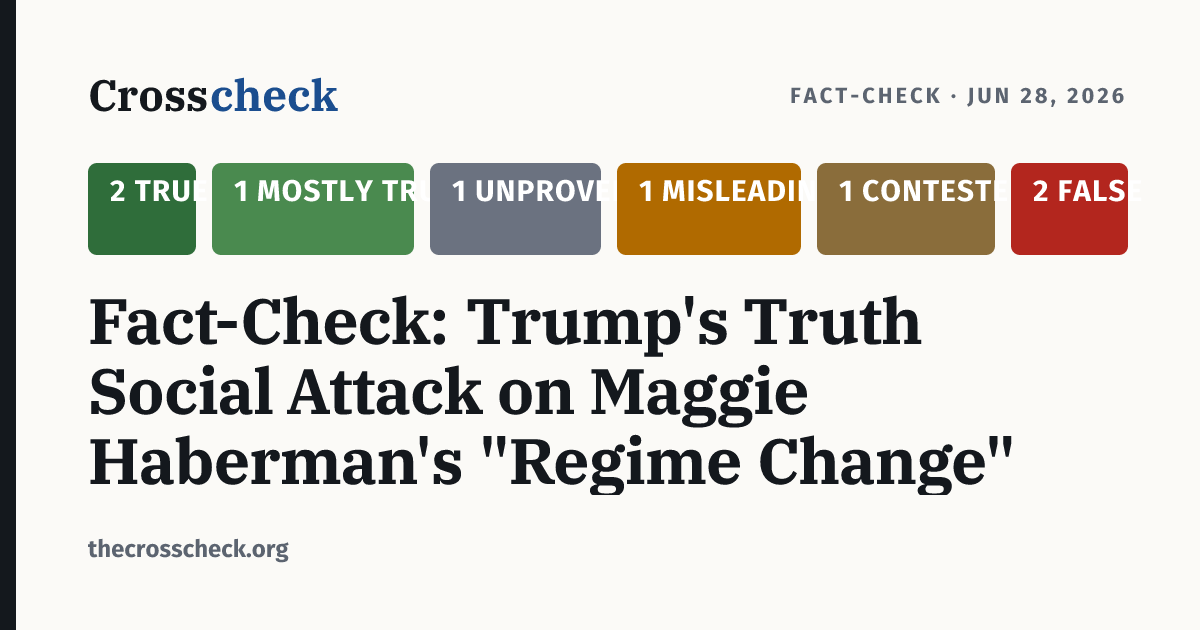
President Trump posted the following on Truth Social at 12:22 AM on June 28, 2026:
“Based on a very quick and boring briefing concerning the Magot Hagerman book about me, it is mostly made up, Fake News, largely fiction, as have been most of the things she has written about me for so many years. She is a third rate writer and intellect, who has made a first rate income because of your favorite President, ME. She was wrong about me on the Elections, although she knew I was going to win, BIG! She was wrong about me on the Russia, Russia, Russia Hoax, and she was wrong about me on just about everything else. But she continues to spew out garbage, and people continue to buy it. REMEMBER, I WON THE ELECTION, BIG - ALL SEVEN SWING STATES, THE POPULAR VOTE, 86% of the Counties…And they don’t have the audio tapes that they imply they have. Just another Margot Con Job! And Iran will never have a Nuclear Weapon!!! President DONALD J. TRUMP” Source: trumpstruth.org/statuses/39590[1]
Two factual errors appear before the first checkable claim: Trump spells the journalist’s name as “Magot Hagerman” and later as “Margot,” when her name is Maggie Haberman. More substantively, the book was co-authored with Jonathan Swan, a senior reporter at The New York Times. Trump’s post omits Swan entirely and attributes the work solely to Haberman.
What Is Regime Change?
Regime Change: Inside the Imperial Presidency of Donald Trump was published by Simon & Schuster on June 23, 2026 — five days before this post. The authors are Maggie Haberman and Jonathan Swan, both senior reporters at The New York Times, who conducted approximately 1,000 interviews over two years beginning in 2024.[2][3]
The book covers Trump’s second term in detail, including the decision to take the United States to war with Iran in early 2026, the administration’s internal management of the Epstein files, and deliberations inside the Situation Room. Pre-publication excerpts described verbatim exchanges among senior officials (Vice President JD Vance, Chief of Staff Susie Wiles, Deputy AG Todd Blanche, and others) that alarmed administration aides because of their specificity.[4]
Claim 1: The book is “mostly made up, Fake News, largely fiction”
The most direct refutation came from the White House itself. Its only public comment on the book’s contents was that the reporting is accurate. Separately, administration aides were alarmed by the scenes’ accuracy, not their inaccuracy.
Trump dismisses the book after what he describes as “a very quick and boring briefing,” meaning his own characterization rests on a second-hand summary, not a reading of the text. Against that, consider what the administration’s own officials said:
- Top White House officials believed Haberman and Swan had obtained audio recordings of Situation Room meetings specifically because the accounts were so verbatim and accurate.[4]
- The White House’s official response to the book’s reporting was that the reporting is accurate — not that it was fabricated.[5]
- No administration official has publicly disputed the specific scenes described in the book.[5]
The book is based on about 1,000 interviews over two years and is published by a major commercial press. It is not an anonymously sourced pamphlet. The threshold for calling a book by two Pulitzer-affiliated Times reporters “largely fiction” requires specific rebuttals of specific claims. None has been offered.
Claim 2: Haberman was wrong about the 2024 election, yet “knew” Trump would win
The claim is internally contradictory. Haberman is a reporter, not a pollster. She made no public prediction that Trump would lose. The post simultaneously accuses her of being “wrong” and of secretly knowing he would win.
Haberman covered the 2024 campaign as a journalist, reporting on both campaigns’ strategies, candidate dynamics, and voter sentiment. On November 1, 2024 (four days before Election Day), she appeared on CNN discussing Trump allies’ election optimism, a neutral account of what his campaign believed. She was not a forecaster who issued a public prediction on the outcome.[6]
The claim contains a self-canceling structure: if she “knew” Trump was going to win, she cannot simultaneously have been reporting that he would lose. The accusation collapses under its own terms. What Trump may be gesturing at is a broader belief that major media outlets expressed more skepticism about his chances than the final result warranted. That is a fair observation about the media environment generally; attributing a specific false prediction to Haberman personally requires identifying one.
Claim 3: Haberman was “wrong about the Russia, Russia, Russia Hoax”
Haberman’s Russia reporting was corroborated by Special Counsel Robert Mueller’s report. The NYT/WaPo Russia coverage team won a 2018 Pulitzer Prize; the Pulitzer board later refused to revoke the prizes when Trump demanded it.
Haberman was the most-cited journalist in the Mueller report, which documented Russian interference in the 2016 election, indicted 25 Russian nationals and three Russian companies, and established multiple contacts between Russian nationals and members of the Trump campaign.[7]
In 2018, the staff of The New York Times and The Washington Post jointly received the Pulitzer Prize for National Reporting for coverage described as “deeply sourced, relentlessly reported coverage in the public interest that dramatically furthered the nation’s understanding of Russian interference in the 2016 presidential election and its connections to the Trump campaign.”[8] Haberman co-authored two of the Times’ four pieces in the Pulitzer package and contributed to two others.
Trump has repeatedly called for the Pulitzer Prize Board to revoke these awards, arguing the reporting was fraudulent. The board declined in 2022, stating that it “does not typically comment on individual decisions” but had “carefully reviewed the body of work” and would not rescind the prizes.[8]
FactCheck.org examined Trump’s attacks on the Times and Post Russia reporting and found them “baseless,” noting that Trump and his press secretary “pointed to no errors in the reporting.” The reporting is “heavily supported by special counsel Robert Mueller’s report on Russian interference.”[9]
The word “Hoax” in Trump’s post refers to his characterization of the Russia investigation as fabricated. The investigation produced 34 indictments, seven guilty pleas, and one trial conviction. Reporting that accurately described a real federal investigation is not wrong because the president considers the investigation itself illegitimate.
Claims 4, 5, and 6: Election Statistics
Claim 4: “ALL SEVEN SWING STATES”
Trump won Pennsylvania, Georgia, North Carolina, Michigan, Arizona, Wisconsin, and Nevada (all seven recognized battleground states) in the November 2024 election. The Electoral College result was 312 to 226.
Nevada had not voted Republican for president since 2004. Trump’s sweep of the seven recognized swing states and the 312-226 Electoral College margin are both confirmed by official results.[10]
Claim 5: “THE POPULAR VOTE”
Trump received 49.8% of the popular vote to Harris’s 48.3%, a margin of 1.5 percentage points. This was the first Republican popular vote win since George W. Bush in 2004.
Trump’s 77,302,580 votes represented a plurality win in the national popular vote. Context worth noting: his 1.5-point margin was the third-smallest winning popular vote margin since 1888. It is a genuine win, not a blowout, despite the “BIG” framing.[10]
Claim 6: “86% of the Counties”
Brookings Institution confirmed Trump won 2,633 counties representing 86% of the total. Some analyses put the figure at approximately 85%. The figure is accurate within the rounding differences between methodologies.
A Brookings analysis found that “Trump’s winning base in 2,633 counties represents 86% of the nation’s total counties.”[11] The National Association of Counties and Ballotpedia analyses produce figures in the 85-86% range depending on how county-equivalents in Alaska and independent cities are counted.[12] The 86% figure is well-supported.
The geographic landslide is confirmed, and the number is essentially correct. Worth noting: those 2,633 counties represent 38% of U.S. GDP, meaning the geographic dominance does not translate to an economic majority of the country’s output.
Claim 7: “They don’t have the audio tapes that they imply they have”
The authors never claimed to possess tapes. It was Trump’s own aides who feared tapes existed. Haberman and Swan declined to discuss sourcing. No one has confirmed or denied the existence of recordings, including the White House, which confirmed only that the reporting is accurate.
The tape concern originated inside the White House, not in Haberman and Swan’s public statements. Axios reported in June that “top White House officials believe New York Times reporters Maggie Haberman and Jonathan Swan obtained audio recordings of Situation Room meetings” because verbatim pre-publication excerpts described internal deliberations in granular detail.[4] Recording devices inside the Situation Room are prohibited by security protocol.
When asked directly on television whether they possessed Situation Room recordings, the authors declined to comment on their sourcing. Swan noted during one appearance that it is significant that no administration official has denied the specific scenes described.[5]
Trump’s assertion that “they don’t have” the tapes is a claim about the absence of evidence he has not demonstrated. Verbatim dialogue in a reported book can come from contemporaneous notes, multiple independent recollections, or recordings; the source is unknown. What is known is that the White House’s own response treated the accounts as accurate.
Claim 8: “Iran will never have a Nuclear Weapon”
Iran’s nuclear program has been severely degraded by joint U.S.-Israeli military strikes, and Iranian officials have reaffirmed a pledge against nuclear weapons. But “never” is an absolute about a future that cannot be verified, the ceasefire is fragile, and the substantive nuclear accord is still being negotiated.
This claim has live context that makes it more plausible as a near-term policy description than it would have been a year ago, while remaining unprovable as an absolute permanent guarantee.
The 2026 Iran war, which began on February 28, 2026, saw U.S.-Israeli forces strike Iranian nuclear and military sites. By March 2026, Director of National Intelligence Tulsi Gabbard testified that Iran had not resumed uranium enrichment following the strikes. Israeli strikes had destroyed multiple weaponization facilities and eliminated nuclear scientists.[13]
The Islamabad Memorandum, signed June 17, 2026 (eleven days before this post), includes Iran reaffirming “that it shall not procure or develop nuclear weapons.” As the memorandum itself notes, this is a reaffirmation of Iran’s prior commitment under the Nuclear Non-Proliferation Treaty and the 2015 JCPOA, not a novel concession.[14]
What the memorandum does not resolve: the final terms of a nuclear accord are deferred to 60-day follow-on negotiations (running through approximately August 16, 2026), the ceasefire itself remained fragile at the time of the post, and the United States and Iran exchanged retaliatory strikes on June 27, the day before the post was published.[15][16]
Iran retains the underlying scientific knowledge to reconstruct centrifuge programs. “Never” is not a guarantee a ceasefire can provide; it describes a goal, not a verified outcome.
The Better Question About the Book
The post asks readers to treat the book as fiction. The better question is: What does Regime Change actually say, and does any of it hold up? The post answers by characterization, not by rebuttal. No specific claim in the book is named, disputed, or shown to be inaccurate. The administration’s own response, confirming the accuracy of the reporting, inverts the “fiction” claim entirely.
Calling a reported book “made up” without disputing a single scene or quote is not a fact-check; it is a posture. The post’s framing asks whether Haberman is a credible journalist, when the load-bearing question is whether the specific scenes she and Swan describe happened. On that question, the administration went silent rather than wrong.
Who Is Affected and What Is at Stake
The immediate audience for this post is the same audience that buys the book: people who want to understand what happened inside the Trump White House during a period that included the decision to go to war with Iran, the management of the Epstein file, and the transformation of the Justice Department into what the authors describe as “an agent of retribution.” That audience is large.
The stakes for press accountability are concrete. Regime Change is based on 1,000 interviews and covers, among other things, the decision-making behind one of the largest U.S. military engagements since Iraq. If the book’s accounts of Situation Room meetings are accurate (and the White House’s refusal to deny specific scenes suggests they are), it represents a substantial piece of public accountability journalism. The “fiction” framing functions as an attempt to pre-emptively discredit that record.
For Maggie Haberman specifically, this post extends a decade-long pattern: Trump attacks her coverage as biased while continuing to speak with her. (He called her during the 2024 campaign, details of which she shared publicly.) The CSIS analysis of her coverage found her work criticized from multiple directions, accused of being too sympathetic to Trump by some on the left and of bias against him by Trump himself, a dynamic that often marks reporters who pursue close access to obtain damaging information.[7]
For Jonathan Swan, the post’s omission of his name is itself notable. He is an equal co-author who conducted a substantial portion of the 1,000 interviews. Haberman is more recognizable to Trump and to Trump’s base; Swan’s contributions to the Situation Room accounts and the Iran war chapters are invisible in the post’s framing.
Steelman: The Strongest Case for Trump’s Complaints
On the Russia coverage: critics from multiple directions, including a 2023 Columbia Journalism Review investigation, argued that the NYT and WaPo Russia reporting “went too far” in framing some stories that did not ultimately produce evidence of direct conspiracy. Some stories were updated or walked back. The Pulitzer-winning pieces themselves covered interference and contacts, not “collusion” as a proven fact; the broader coverage environment often implied more than the final Mueller report showed.
A defensible Trump argument: the volume and intensity of Russia coverage created a public impression of direct conspiracy that the Mueller report did not establish, and some of that coverage did not age well. That is a legitimate observation about media overcorrection in a high-stakes environment. It is different from calling the coverage a “Hoax” or Haberman specifically wrong, and it does not require labeling accurate reports on a real federal investigation as fiction.
On the 2024 election coverage: The media landscape broadly underestimated Trump’s margins in the final days of the campaign. Haberman herself was not making explicit predictions, but the general tenor of major media coverage was skeptical of his chances in Pennsylvania and Michigan in ways the results refuted. A scoped complaint about election coverage being broadly miscalibrated has merit, even if attributing it personally to Haberman is an overreach.
On the tapes: If the book includes verbatim Situation Room accounts that came from after-the-fact reconstructions rather than recordings, that is a methodological choice that can be legitimately questioned. Readers cannot verify which sourcing method produced the dialogue. That uncertainty stands, even though the administration’s silence on the substance suggests the accounts are accurate.
What to Watch
- Iran nuclear negotiations (through August 16, 2026): The Islamabad Memorandum’s 60-day window expires mid-August. The nuclear accord (including the fate of Iran’s enriched uranium stockpile and whether enrichment resumes) will be negotiated in this window. Whether “Iran will never have a Nuclear Weapon” becomes a verifiable policy outcome depends on what those talks produce.
- Any specific rebuttal to Regime Change: Trump’s post names no claim as false. Watch whether the administration, or any of the officials named in the book, challenge a specific scene with evidence. The absence of any substantive rebuttal after five days is telling; continuation of that silence would further undercut the “fiction” verdict.
- Tape disclosure: Haberman and Swan declined to discuss sourcing. If recordings of Situation Room meetings were made by a government official who then provided them, that is a criminal leak. If they exist and are ultimately disclosed, the national security implications would dwarf the book itself. Watch for any reporting on the source of the verbatim accounts.
- Regime Change’s sales and reviews: Trump’s post has already driven attention to the book. Presidential denials historically function as effective marketing for books about the president. Watch first-week sales figures, which Simon & Schuster will report in late July.
- Ceasefire fragility: Retaliatory strikes between the U.S. and Iran continued as of June 27, the day before this post. Whether the Islamabad Memorandum holds or the war resumes directly bears on every Iran-related claim in the book and in this post.
Sources
- Trump Truth Social post, June 28, 2026 (12:22 AM)
- Regime Change: Inside the Imperial Presidency of Donald Trump — Amazon listing
- Regime Change (book) — Wikipedia
- Trump Aides Think Haberman, Swan Have Situation Room Tapes
- “Regime Change” authors on Trump’s “information bubble,” Situation Room meetings on Epstein
- Two Maggies: Maggie Haberman’s Coverage of Donald Trump
- Maggie Haberman — Wikipedia
- Pulitzer board rejects Trump’s calls to revoke prizes for reporting on Russian election meddling
- Trump’s Baseless Attacks on Times, Post Reporting on Russia Probe
- 2024 United States presidential election — Wikipedia
- Trump again won counties representing a minority share of national GDP, but with notable gains
- U.S. Elections Analysis 2024: Key Outcomes & Insights for Counties
- 2026 Iran war — Wikipedia
- Islamabad Memorandum — Wikipedia
- 2026 Iran war ceasefire — Wikipedia
- U.S. and Iran each announce retaliatory strikes in Iran, Kuwait and Bahrain